Serving Missouri City
The practical consequence of a mixed-era housing stock is that no single retrofit approach applies. Older homes may have less accessible attics, different wall construction, and no structured cabling at all. Newer ones follow the suburban pattern with builder panels and good attic access.
On the commercial side the work is mostly small offices and retail suites, where projects are compact and the main variables are ceiling construction and whether the space is leased.
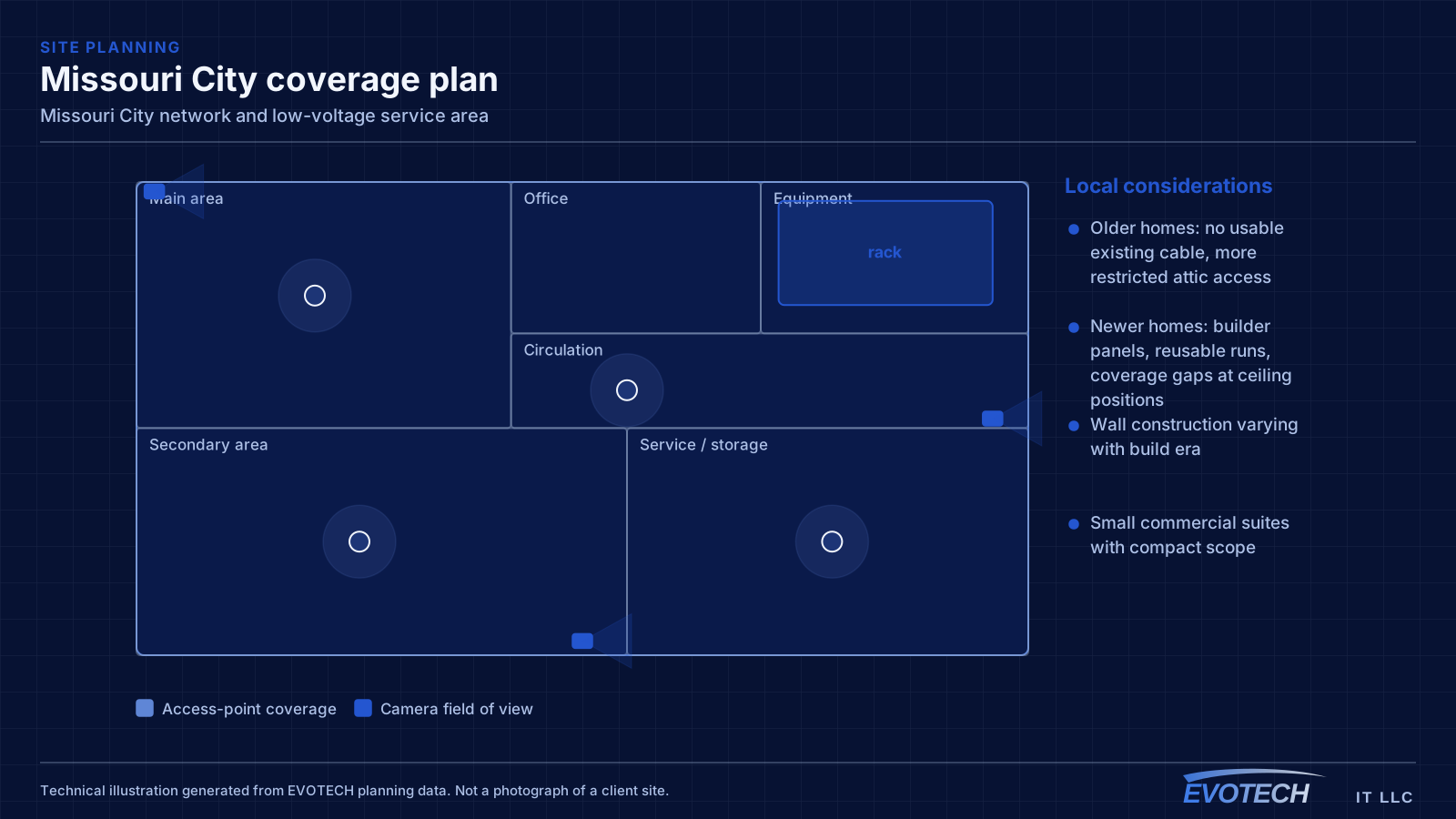
Two retrofit situations
In older homes, the assumption should be that nothing usable exists. Attic access may be more restricted, wall construction differs, and any existing low-voltage cable is likely to predate anything worth reusing. These projects are genuine retrofits and scope accordingly.
In newer areas the pattern matches the rest of the suburbs — a builder panel, terminated runs to wall outlets, and a coverage problem caused by floor-plan width and a perimeter equipment position.
- Older homes: no usable existing cable, more restricted attic access
- Newer homes: builder panels, reusable runs, coverage gaps at ceiling positions
- Wall construction varying with build era
- Small commercial suites with compact scope
- Leased retail units where landlord rules apply
What actually differs in Missouri City
These are the specific, verifiable conditions that change how a project is scoped in Missouri City — building stock, property mix, and Gulf Coast climate, with no invented landmarks, offices, or permit rules.
- Housing stock spanning both established and recent construction, producing materially different retrofit conditions between neighbourhoods
- Older homes without structured cabling and with less accessible attic space than newer subdivisions
- Newer subdivision homes following the regional pattern of builder panels and good attic access
- Small office and retail suites where ceiling construction and lease terms are the main variables
- Slab-on-grade construction throughout, keeping attic routing as the primary retrofit path
Establishing conditions first
Because conditions vary so much by property age, the walkthrough carries more weight here than in a uniform subdivision. Attic accessibility, wall construction, and whether any existing cable is worth testing are the three questions that set the scope.
For small commercial work, the questions are ceiling construction, where the equipment can live, and whether the landlord permits the pathway the design needs.
In Missouri City specifically, that planning weighs older homes without structured cabling and with less accessible attic space than newer subdivisions, and newer subdivision homes following the regional pattern of builder panels and good attic access. These are not generic checklist items — they are the conditions that most change cable routes, equipment placement, and coverage decisions here, which is why a short walkthrough or clear photographs settle a Missouri City scope faster than a floor plan can. The starting point stays housing stock spanning both established and recent construction, producing materially different retrofit conditions between neighbourhoods, because the right recommendation depends on what the specific building actually allows rather than on the city name.
- Attic accessibility confirmed before planning residential runs
- Existing cable tested rather than assumed usable
- Wall construction checked for blocking and insulation
- Ceiling construction confirmed in commercial suites
- Landlord permissions established for leased units
Practical conditions
Residential work follows the regional pattern of early summer scheduling for attic access and careful occupied-home practice. Older homes sometimes need a surface raceway or a small access cut where no cavity path exists, and that is worth discussing before work starts rather than mid-run.
Small commercial work is usually short enough to complete in a single visit outside operating hours.
The mixed-era character of this market has a second consequence worth naming: the useful comparison for a given property is another property of the same age rather than another property in the same city. An established home a few streets from a recent subdivision is a different project in almost every respect — wall construction, attic geometry, whether any structured wiring exists, and how much of the existing electrical layout constrains where equipment can sensibly live.
That argues for treating the walkthrough as a scoped step rather than a courtesy. In a uniform development, seeing one house tells you most of what you need about the next. Here it tells you about that house, and the next one may need a different answer entirely — which is a difference worth pricing honestly rather than averaging across.
On the ground, small office and retail suites where ceiling construction and lease terms are the main variables, together with slab-on-grade construction throughout, keeping attic routing as the primary retrofit path, shapes the schedule and the working method as much as the design does. EVOTECH scopes Missouri City projects from the actual property rather than assuming one approach fits every building in the market, and keeps the wording as service-area coverage rather than any office claim. Where a fact about Missouri City cannot be verified, it is left out rather than invented, which is why this page describes conditions and not landmarks, offices, or response times.
- Early summer scheduling for attic work
- Surface raceway or access cut discussed in advance where no cavity path exists
- Dust control and daily clear-down in occupied homes
- Single-visit scheduling for compact commercial scopes
- Exterior equipment rated for regional humidity and rainfall
Explore everything in this section
All 31 pages under Missouri City home and small-office network work.
- Access-control installation for Missouri City properties
- Cat6 cabling for Missouri City properties
- Data-jack installation for Missouri City properties
- Ethernet installation for Missouri City properties
- Fiber-optic cabling for Missouri City properties
- Fireplace TV mounting for Missouri City properties
- Floodlight camera installation for Missouri City properties
- Gate & license-plate cameras for Missouri City properties
- Home theater installation for Missouri City properties
- In-wall cable concealment for Missouri City properties
- Intercom installation for Missouri City properties
- Low-voltage installation for Missouri City properties
- Missouri City cabling across mixed-era buildings
- Network troubleshooting for Missouri City properties
- Network-rack installation for Missouri City properties
- NVR installation for Missouri City properties
- Outdoor & patio speakers for Missouri City properties
- Outdoor TV installation for Missouri City properties
- PoE camera installation for Missouri City properties
- Projector & screen installation for Missouri City properties
- Residential Wi-Fi for Missouri City properties
- Samsung Frame TV installation for Missouri City properties
- Security-camera installation for Missouri City properties
- Smart home & smart locks for Missouri City properties
- Soundbar mounting for Missouri City properties
- TV mounting for Missouri City properties
- Ubiquiti UniFi installation for Missouri City properties
- Video-doorbell installation for Missouri City properties
- Whole-home & multi-zone audio for Missouri City properties
- Wi-Fi installation for Missouri City properties
- Wireless bridge (point-to-point) for Missouri City properties
Frequently asked questions
Can Ethernet be added to an older home here?
Usually, though the route matters more than in newer construction. Interior destination walls reachable from an attic are straightforward; exterior walls with insulation and bracing are harder. Where no cavity path exists, the honest alternatives are a small access cut that gets patched, a surface raceway, or relocating the device — worth deciding before any cutting begins.
Why does the approach differ so much between neighbourhoods?
Build era. Newer subdivision homes generally have builder-installed cable, a media panel, and good attic access. Older homes typically have none of those and more restricted attic space. The two are genuinely different projects, which is why the walkthrough matters more here than in a uniform development.
Is existing cable in an older home worth reusing?
Only after testing. Older low-voltage cable frequently predates current category requirements or has been damaged, and a run that fails certification is cheaper to replace than to chase. Where it tests clean and lands somewhere useful, reusing it is sensible.