Why this page exists
Technology for new construction in Spring sits where two things meet: how new construction actually operate, and what Spring specifically brings to the building. Retail and food-service commercial base where payment-system separation is a standing requirement.
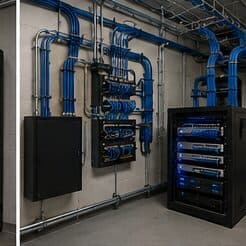
Low-voltage rough-in happens in a specific slot: after framing and electrical, before insulation and drywall. Inside that window, running a cable anywhere is straightforward. Once drywall goes up, the same cable costs many times more and sometimes cannot be run at all.
One window, and it does not reopen
Low-voltage rough-in happens in a specific slot: after framing and electrical, before insulation and drywall. Inside that window, running a cable anywhere is straightforward. Once drywall goes up, the same cable costs many times more and sometimes cannot be run at all.
The asymmetry is the whole story of new-construction low voltage. Decisions made cheaply during rough-in become expensive or impossible afterwards, which is why the pre-rough-in planning conversation is worth more than any equipment choice made later.
- Rough-in window sits between electrical and drywall
- Upstream delays compress the window without extending the deadline
- Post-drywall changes cost many times more, if they are possible at all
- Finish work happens months later, after paint and ceilings
Spring: what the location adds
Retail and food-service commercial base where payment-system separation is a standing requirement. In Spring, that is where the plan begins, because it changes cable paths, device placement, and access-point counts before anything else does. Ceiling construction varying considerably between adjacent units, from open deck to hard lid to suspended grid. Restaurant kitchen environments requiring equipment placement away from heat, steam, and grease-laden air. None of these are generic checklist items — each moves the design in a direction a citywide assumption would miss, and the honest recommendation always depends on what this particular property allows.
- Retail and food-service commercial base where payment-system separation is a standing requirement
- Ceiling construction varying considerably between adjacent units, from open deck to hard lid to suspended grid
- Restaurant kitchen environments requiring equipment placement away from heat, steam, and grease-laden air
- Storefront glazing on retail units complicating daylight entrance camera placement
- Residential areas following the regional slab-foundation and attic-routing pattern
Decide locations, claim pathways, leave capacity
Three things matter more than everything else combined: agreeing device locations before rough-in, claiming pathway before the other trades fill the ceiling, and running more capacity than the current plan requires.
The third is the one most often skipped and most often regretted. An extra run to a likely future access point, camera, or display position costs very little while the walls are open.
- Device locations agreed and marked before rough-in begins
- Pathway claimed early, since low voltage is usually last into the ceiling
- Spare runs to likely future positions while walls are open
- Equipment room sized for every system, with power and ventilation
- Rated penetrations sleeved and firestopped properly
Installing in Spring
Full system design is often not finished when the rough-in window arrives. That is normal, and it is not a reason to skip the pathway. Running conduit or sleeves to likely positions preserves the option cheaply even when the eventual equipment is undecided.
Getting Spring work done means planning around the site as it actually is. Storefront glazing on retail units complicating daylight entrance camera placement. Residential areas following the regional slab-foundation and attic-routing pattern. Both matter as much as the design to how and when the work happens. The scope is drawn from the real property, the coverage is stated as a service area rather than an office, and unverifiable specifics about Spring are kept off the page on purpose.
Explore everything in this section
All 38 pages under Technology for new construction in Spring.
- Access-control installation for new construction in Spring
- Business phone & VoIP for new construction in Spring
- Cat6 cabling for new construction in Spring
- Cat6A cabling for new construction in Spring
- Commercial Wi-Fi for new construction in Spring
- Conference-room AV for new construction in Spring
- Data-jack installation for new construction in Spring
- Digital signage for new construction in Spring
- Ethernet installation for new construction in Spring
- Fiber-optic cabling for new construction in Spring
- Fireplace TV mounting for new construction in Spring
- Floodlight camera installation for new construction in Spring
- Gate & license-plate cameras for new construction in Spring
- Home theater installation for new construction in Spring
- In-wall cable concealment for new construction in Spring
- Intercom installation for new construction in Spring
- Low-voltage installation for new construction in Spring
- Network cabling for new construction in Spring
- Network troubleshooting for new construction in Spring
- Network-rack installation for new construction in Spring
- NVR installation for new construction in Spring
- Outdoor & patio speakers for new construction in Spring
- Outdoor TV installation for new construction in Spring
- Paging & PA systems for new construction in Spring
- PoE camera installation for new construction in Spring
- Projector & screen installation for new construction in Spring
- Residential Wi-Fi for new construction in Spring
- Samsung Frame TV installation for new construction in Spring
- Security-camera installation for new construction in Spring
- Smart home & smart locks for new construction in Spring
- Soundbar mounting for new construction in Spring
- TV mounting for new construction in Spring
- Ubiquiti UniFi installation for new construction in Spring
- Video wall installation for new construction in Spring
- Video-doorbell installation for new construction in Spring
- Whole-home & multi-zone audio for new construction in Spring
- Wi-Fi installation for new construction in Spring
- Wireless bridge (point-to-point) for new construction in Spring
Frequently asked questions
What do new construction in Spring usually need first?
It varies by site, but the pattern for new construction holds in Spring: get the network and cabling backbone right, then layer cameras and access on top. What Spring changes is the physical install — the conditions listed above drive routes and equipment placement more than the sector alone does.
What has to be decided before rough-in?
Device locations, the equipment room position, and the pathway plan. Equipment selection can wait — you can run cable to a position without knowing which camera or access point will go there. What cannot wait is the decision about where things go, because that is what determines where cable is pulled while the walls are open.