Smart home & smart locks for new construction, in Spring
Smart home & smart locks for new construction in Spring is a three-part question: what smart home & smart locks involves, what new construction need from it, and what Spring changes about the install. Retail and food-service commercial base where payment-system separation is a standing requirement.
Smart-home devices are easy to buy and easy to end up with a drawer of apps that half-work. Getting a home that actually behaves means three decisions up front: which ecosystem everything lives in — a voice platform, a phone platform, or a manufacturer's own app — so devices cooperate instead of each needing their own login; whether devices talk over Wi-Fi or through a hub using a low-power protocol; and which functions must keep working when the internet drops. A smart lock that only unlocks from the cloud is a problem the first time the connection goes down.
One window, and it does not reopen
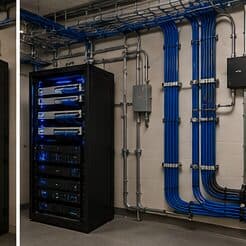
Low-voltage rough-in happens in a specific slot: after framing and electrical, before insulation and drywall. Inside that window, running a cable anywhere is straightforward. Once drywall goes up, the same cable costs many times more and sometimes cannot be run at all.
The asymmetry is the whole story of new-construction low voltage. Decisions made cheaply during rough-in become expensive or impossible afterwards, which is why the pre-rough-in planning conversation is worth more than any equipment choice made later.
- Rough-in window sits between electrical and drywall
- Upstream delays compress the window without extending the deadline
- Post-drywall changes cost many times more, if they are possible at all
- Finish work happens months later, after paint and ceilings
Where smart home & smart locks goes wrong — and how it's avoided
Smart-home disappointment comes from reliability shortcuts more than device choice.
- Buying across five ecosystems and expecting them to cooperate
- Fitting a smart lock to a door that does not operate smoothly
- Relying on cloud-only control for a lock or garage door
- Ignoring weak Wi-Fi at the door and blaming the device
- Removing the physical key with no offline way in
- No battery monitoring, so the first warning is a lockout
Spring: what the location changes
In Spring, the plan is built outward from the conditions that are actually here. Retail and food-service commercial base where payment-system separation is a standing requirement. Ceiling construction varying considerably between adjacent units, from open deck to hard lid to suspended grid. Restaurant kitchen environments requiring equipment placement away from heat, steam, and grease-laden air. Each one changes where cable can run, where equipment can sit, and how coverage is shaped, which is why a walkthrough settles a Spring scope faster than any generic estimate.
- Retail and food-service commercial base where payment-system separation is a standing requirement
- Ceiling construction varying considerably between adjacent units, from open deck to hard lid to suspended grid
- Restaurant kitchen environments requiring equipment placement away from heat, steam, and grease-laden air
- Storefront glazing on retail units complicating daylight entrance camera placement
- Residential areas following the regional slab-foundation and attic-routing pattern
Getting it done in Spring
Smart devices are commissioned by proving the important ones still work when things go wrong.
Full system design is often not finished when the rough-in window arrives. That is normal, and it is not a reason to skip the pathway. Running conduit or sleeves to likely positions preserves the option cheaply even when the eventual equipment is undecided.
On site, the schedule and working method turn on conditions like these. Storefront glazing on retail units complicating daylight entrance camera placement. Residential areas following the regional slab-foundation and attic-routing pattern. Both shape how and when a crew can actually operate, which is why EVOTECH scopes each Spring job from the property itself rather than assuming one approach fits every address. Coverage is stated as a service area, never an office claim, and anything about Spring that cannot be verified is left out instead of invented.
Frequently asked questions
Is smart home & smart locks for new construction different in Spring?
The sector needs stay the same, but the install changes with the place. In Spring, the conditions above — not the new construction label — decide routes, mounting, and equipment placement, which is why this page pairs all three.
Which smart-home ecosystem should we use?
Usually the one that matches the phones and habits in the house, because that is the control surface everyone already reaches for. Committing to one platform lets devices share routines instead of each needing its own app — the tradeoff is favouring devices that support it. Newer interoperability standards are narrowing the differences, but it is still worth checking that the specific devices you want work with the platform you choose.