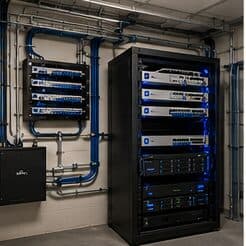
Outdoor TV installation for new construction, in Spring
Outdoor TV installation for new construction in Spring is a three-part question: what outdoor tv installation involves, what new construction need from it, and what Spring changes about the install. Retail and food-service commercial base where payment-system separation is a standing requirement.
An outdoor television has to do two things a living-room set does not: survive the environment and stay readable in bright ambient light. On a Gulf Coast patio that means an outdoor-rated display built to tolerate heat, humidity, and moisture, with brightness high enough to read against daylight — a regular indoor TV on a covered patio is dim in the day and degrades in the humidity within a season or two.
One window, and it does not reopen
Low-voltage rough-in happens in a specific slot: after framing and electrical, before insulation and drywall. Inside that window, running a cable anywhere is straightforward. Once drywall goes up, the same cable costs many times more and sometimes cannot be run at all.
The asymmetry is the whole story of new-construction low voltage. Decisions made cheaply during rough-in become expensive or impossible afterwards, which is why the pre-rough-in planning conversation is worth more than any equipment choice made later.
- Rough-in window sits between electrical and drywall
- Upstream delays compress the window without extending the deadline
- Post-drywall changes cost many times more, if they are possible at all
- Finish work happens months later, after paint and ceilings
Where outdoor tv installation goes wrong — and how it's avoided
Outdoor TV problems come from treating an exterior position like an interior one.
- Using an indoor television on a patio and losing it to daylight and humidity
- Under-specifying brightness for the exposure
- Fitting an indoor mount that corrodes outdoors
- Leaving cable entries unsealed so moisture reaches connections
- Ignoring weak patio Wi-Fi and blaming the streaming service
- Positioning the display where it overheats in afternoon sun
Spring: what the location changes
In Spring, the plan is built outward from the conditions that are actually here. Retail and food-service commercial base where payment-system separation is a standing requirement. Ceiling construction varying considerably between adjacent units, from open deck to hard lid to suspended grid. Restaurant kitchen environments requiring equipment placement away from heat, steam, and grease-laden air. Each one changes where cable can run, where equipment can sit, and how coverage is shaped, which is why a walkthrough settles a Spring scope faster than any generic estimate.
- Retail and food-service commercial base where payment-system separation is a standing requirement
- Ceiling construction varying considerably between adjacent units, from open deck to hard lid to suspended grid
- Restaurant kitchen environments requiring equipment placement away from heat, steam, and grease-laden air
- Storefront glazing on retail units complicating daylight entrance camera placement
- Residential areas following the regional slab-foundation and attic-routing pattern
Getting it done in Spring
An outdoor TV is checked for daylight readability, sealing, and signal.
Full system design is often not finished when the rough-in window arrives. That is normal, and it is not a reason to skip the pathway. Running conduit or sleeves to likely positions preserves the option cheaply even when the eventual equipment is undecided.
On site, the schedule and working method turn on conditions like these. Storefront glazing on retail units complicating daylight entrance camera placement. Residential areas following the regional slab-foundation and attic-routing pattern. Both shape how and when a crew can actually operate, which is why EVOTECH scopes each Spring job from the property itself rather than assuming one approach fits every address. Coverage is stated as a service area, never an office claim, and anything about Spring that cannot be verified is left out instead of invented.
Frequently asked questions
Is outdoor tv installation for new construction different in Spring?
The sector needs stay the same, but the install changes with the place. In Spring, the conditions above — not the new construction label — decide routes, mounting, and equipment placement, which is why this page pairs all three.
Can I just put a regular TV on my covered patio?
It rarely lasts or reads well. Even under a cover, a Gulf Coast patio subjects an indoor television to heat and humidity it was not built for, and it is usually too dim to see in daylight. An outdoor-rated display for the temperature and moisture, with brightness matched to the exposure, is what survives and stays watchable through the day.