Access-control installation for new construction, in Spring
Access-control installation for new construction in Spring is a three-part question: what access-control installation involves, what new construction need from it, and what Spring changes about the install. Retail and food-service commercial base where payment-system separation is a standing requirement.
The part that demands the most care is not the software. It is the door. A controlled door has to release for anyone leaving, under all conditions including power loss and fire alarm, and it has to do so in the manner the building's life-safety requirements dictate. Getting that wrong is a serious matter, and it is why door hardware selection is a design decision rather than a purchasing one.
One window, and it does not reopen
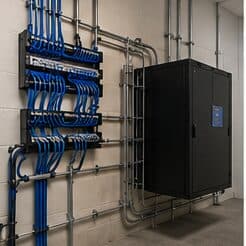
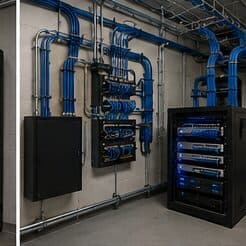
Low-voltage rough-in happens in a specific slot: after framing and electrical, before insulation and drywall. Inside that window, running a cable anywhere is straightforward. Once drywall goes up, the same cable costs many times more and sometimes cannot be run at all.
The asymmetry is the whole story of new-construction low voltage. Decisions made cheaply during rough-in become expensive or impossible afterwards, which is why the pre-rough-in planning conversation is worth more than any equipment choice made later.
- Rough-in window sits between electrical and drywall
- Upstream delays compress the window without extending the deadline
- Post-drywall changes cost many times more, if they are possible at all
- Finish work happens months later, after paint and ceilings
Where access-control installation goes wrong — and how it's avoided
Access-control mistakes range from irritating to genuinely unsafe.
- Choosing a lock type without considering egress and power-loss behaviour
- Installing a magnetic lock without proper release arrangements
- Mounting the controller on the unsecured side of the door
- Automating a door whose closer or alignment was already unreliable
- Issuing shared credentials, which destroys the audit record
- Having no defined revocation process, so old credentials stay valid
- Deploying legacy proximity credentials that are trivial to copy
Spring: what the location changes
What separates a Spring scope from the rest of the city is concrete and local. Retail and food-service commercial base where payment-system separation is a standing requirement. Ceiling construction varying considerably between adjacent units, from open deck to hard lid to suspended grid. Restaurant kitchen environments requiring equipment placement away from heat, steam, and grease-laden air. That short list is what actually drives the design in this pocket, and it is why photographs or a brief site visit beat a floor plan — the plan follows the building's real constraints, not the neighborhood name on the map.
- Retail and food-service commercial base where payment-system separation is a standing requirement
- Ceiling construction varying considerably between adjacent units, from open deck to hard lid to suspended grid
- Restaurant kitchen environments requiring equipment placement away from heat, steam, and grease-laden air
- Storefront glazing on retail units complicating daylight entrance camera placement
- Residential areas following the regional slab-foundation and attic-routing pattern
Getting it done in Spring
Access-control commissioning is about failure modes, not just successful entry.
Full system design is often not finished when the rough-in window arrives. That is normal, and it is not a reason to skip the pathway. Running conduit or sleeves to likely positions preserves the option cheaply even when the eventual equipment is undecided.
Getting Spring work done means planning around the site as it actually is. Storefront glazing on retail units complicating daylight entrance camera placement. Residential areas following the regional slab-foundation and attic-routing pattern. Both matter as much as the design to how and when the work happens. The scope is drawn from the real property, the coverage is stated as a service area rather than an office, and unverifiable specifics about Spring are kept off the page on purpose.
Frequently asked questions
Is access-control installation for new construction different in Spring?
The sector needs stay the same, but the install changes with the place. In Spring, the conditions above — not the new construction label — decide routes, mounting, and equipment placement, which is why this page pairs all three.
What is the difference between fail-safe and fail-secure?
It describes what happens when power is lost. Fail-safe hardware — typically a magnetic lock — releases and the door becomes passable. Fail-secure hardware — typically a standard electric strike — stays locked, though the door can still be opened from the inside by its mechanical hardware. Which is correct for a given opening depends on its role and on applicable life-safety requirements, so it is a design decision rather than a preference.