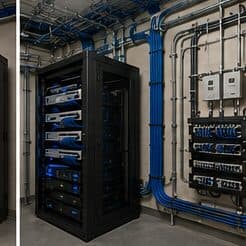
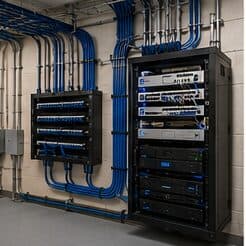
Network-rack installation for new construction, in Spring
Network-rack installation for new construction in Spring is a three-part question: what network-rack installation involves, what new construction need from it, and what Spring changes about the install. Retail and food-service commercial base where payment-system separation is a standing requirement.
Depth matters as much as height and is more often overlooked. A shallow wall-mount cabinet chosen because it fits a hallway will not accept a deeper server or a UPS, and the discovery usually happens after the cabinet is mounted. Checking the deepest intended device against the cabinet's usable depth — behind the mounting rails, allowing for cable bend at the rear — avoids that.
One window, and it does not reopen
Low-voltage rough-in happens in a specific slot: after framing and electrical, before insulation and drywall. Inside that window, running a cable anywhere is straightforward. Once drywall goes up, the same cable costs many times more and sometimes cannot be run at all.
The asymmetry is the whole story of new-construction low voltage. Decisions made cheaply during rough-in become expensive or impossible afterwards, which is why the pre-rough-in planning conversation is worth more than any equipment choice made later.
- Rough-in window sits between electrical and drywall
- Upstream delays compress the window without extending the deadline
- Post-drywall changes cost many times more, if they are possible at all
- Finish work happens months later, after paint and ceilings
Where network-rack installation goes wrong — and how it's avoided
Rack mistakes are the ones that make every future visit longer.
- Sizing to today's equipment with no growth allowance
- Choosing a cabinet by width and height while ignoring depth
- Sealing a cabinet in an unventilated closet
- Mounting a heavy cabinet to drywall anchors instead of structure
- Skipping horizontal management to save two U
- Daisy-chaining power strips
- Labeling after installation, which usually means not labeling
Spring: what the location changes
The starting point for any Spring job is one local fact. Retail and food-service commercial base where payment-system separation is a standing requirement. That single condition shapes where cable can run, where equipment can sit, and how coverage is laid out — more than any spec sheet does. Two more conditions weigh on it. Ceiling construction varying considerably between adjacent units, from open deck to hard lid to suspended grid. Restaurant kitchen environments requiring equipment placement away from heat, steam, and grease-laden air. Together they make the route specific to this pocket, which is why a short walkthrough or a few clear photos settle the scope faster than a floor plan can.
- Retail and food-service commercial base where payment-system separation is a standing requirement
- Ceiling construction varying considerably between adjacent units, from open deck to hard lid to suspended grid
- Restaurant kitchen environments requiring equipment placement away from heat, steam, and grease-laden air
- Storefront glazing on retail units complicating daylight entrance camera placement
- Residential areas following the regional slab-foundation and attic-routing pattern
Getting it done in Spring
A rack is commissioned by checking it under load, not by looking at it when everything is idle.
Full system design is often not finished when the rough-in window arrives. That is normal, and it is not a reason to skip the pathway. Running conduit or sleeves to likely positions preserves the option cheaply even when the eventual equipment is undecided.
Execution in Spring is planned around real conditions, not a template. Storefront glazing on retail units complicating daylight entrance camera placement. Residential areas following the regional slab-foundation and attic-routing pattern. These decide the sequence, the access, and the method as much as the design does. EVOTECH describes Spring as coverage rather than a place it occupies, and omits any area detail it cannot confirm — building and site conditions only, no invented landmarks or promised arrival times.
Popular services nearby
Frequently searched near this area — the pages people look for most.
Frequently asked questions
Is network-rack installation for new construction different in Spring?
The sector needs stay the same, but the install changes with the place. In Spring, the conditions above — not the new construction label — decide routes, mounting, and equipment placement, which is why this page pairs all three.
What size rack is needed?
Add the U heights of every intended device, add a U of management between logical groups, add the patch panels, then add roughly a third for growth. The result is usually a size or two larger than the first instinct, and the extra space costs far less than the disruption of replacing an undersized cabinet later.