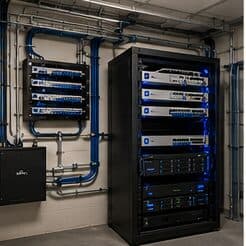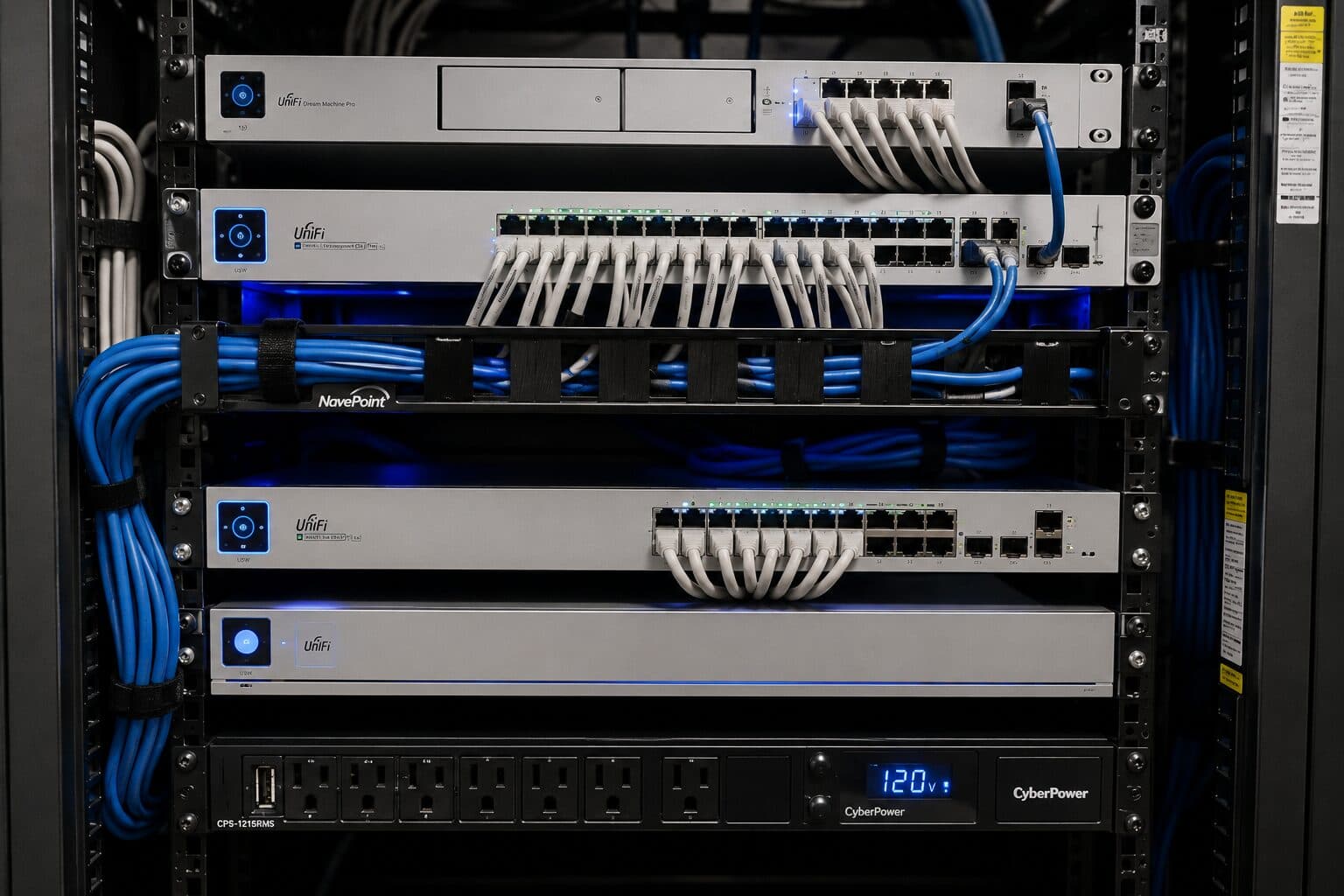
Network-rack installation for new construction, in Tomball
Network-rack installation for new construction in Tomball is a three-part question: what network-rack installation involves, what new construction need from it, and what Tomball changes about the install. A historic small-town core with masonry buildings and limited pathway.
Depth matters as much as height and is more often overlooked. A shallow wall-mount cabinet chosen because it fits a hallway will not accept a deeper server or a UPS, and the discovery usually happens after the cabinet is mounted. Checking the deepest intended device against the cabinet's usable depth — behind the mounting rails, allowing for cable bend at the rear — avoids that.
One window, and it does not reopen
Low-voltage rough-in happens in a specific slot: after framing and electrical, before insulation and drywall. Inside that window, running a cable anywhere is straightforward. Once drywall goes up, the same cable costs many times more and sometimes cannot be run at all.
The asymmetry is the whole story of new-construction low voltage. Decisions made cheaply during rough-in become expensive or impossible afterwards, which is why the pre-rough-in planning conversation is worth more than any equipment choice made later.
- Rough-in window sits between electrical and drywall
- Upstream delays compress the window without extending the deadline
- Post-drywall changes cost many times more, if they are possible at all
- Finish work happens months later, after paint and ceilings
What changes network-rack installation from job to job
Rack scope moves with location constraints more than with equipment count.
- Total U required including management and growth allowance
- Wall-mount cabinet versus floor-standing rack, and depth required
- Location ventilation and ambient temperature
- Structural mounting requirements for the loaded weight
- Power availability and whether a dedicated circuit is needed
- UPS capacity and its weight and heat contribution
- Whether existing cabling must be re-dressed and re-terminated into new panels
- Access clearance in front of and behind the rack
Tomball: what the location changes
The starting point for any Tomball job is one local fact. A historic small-town core with masonry buildings and limited pathway. That single condition shapes where cable can run, where equipment can sit, and how coverage is laid out — more than any spec sheet does. Two more conditions weigh on it. Growing retail and medical buildouts with suspended-grid ceilings and tenant-improvement conditions. Larger properties and outbuildings toward the northern edge, bringing longer runs. Together they make the route specific to this pocket, which is why a short walkthrough or a few clear photos settle the scope faster than a floor plan can.
- A historic small-town core with masonry buildings and limited pathway
- Growing retail and medical buildouts with suspended-grid ceilings and tenant-improvement conditions
- Larger properties and outbuildings toward the northern edge, bringing longer runs
- Slab-foundation residential across established and newer subdivisions
- Gulf Coast humidity requiring rated exterior housings and sealed penetrations
Getting it done in Tomball
A rack is commissioned by checking it under load, not by looking at it when everything is idle.
Full system design is often not finished when the rough-in window arrives. That is normal, and it is not a reason to skip the pathway. Running conduit or sleeves to likely positions preserves the option cheaply even when the eventual equipment is undecided.
Getting Tomball work done means planning around the site as it actually is. Slab-foundation residential across established and newer subdivisions. Gulf Coast humidity requiring rated exterior housings and sealed penetrations. Both matter as much as the design to how and when the work happens. The scope is drawn from the real property, the coverage is stated as a service area rather than an office, and unverifiable specifics about Tomball are kept off the page on purpose.
Popular services nearby
Frequently searched near this area — the pages people look for most.
Frequently asked questions
Is network-rack installation for new construction different in Tomball?
The sector needs stay the same, but the install changes with the place. In Tomball, the conditions above — not the new construction label — decide routes, mounting, and equipment placement, which is why this page pairs all three.
What size rack is needed?
Add the U heights of every intended device, add a U of management between logical groups, add the patch panels, then add roughly a third for growth. The result is usually a size or two larger than the first instinct, and the extra space costs far less than the disruption of replacing an undersized cabinet later.