Why this page exists
Technology for warehouses in Brookshire sits where two things meet: how warehouses actually operate, and what Brookshire specifically brings to the building. Large warehousing and distribution buildings along the I-10 corridor.
Warehouse projects come down to three things: wireless that works down the aisles with stock in place, a network topology that reaches the far end of the building properly, and camera coverage at the points where goods and vehicles move.
Cover the aisles, reach the far end, watch the docks
Warehouse projects come down to three things: wireless that works down the aisles with stock in place, a network topology that reaches the far end of the building properly, and camera coverage at the points where goods and vehicles move.
Office areas within the warehouse are comparatively ordinary and are usually the easiest part of the project.
- Access points positioned to cover along aisles rather than across them
- Intermediate equipment positions linked by fiber where distance requires
- Dock doors, receiving, and yard gates covered by cameras
- Scanner and handheld roaming validated with stock in place
- Equipment protected from dust and temperature in unconditioned areas
Brookshire: what the location adds
The starting point for any Brookshire job is one local fact. Large warehousing and distribution buildings along the I-10 corridor. That single condition shapes where cable can run, where equipment can sit, and how coverage is laid out — more than any spec sheet does. Two more conditions weigh on it. Metal construction that reflects wireless signal and complicates coverage. Building footprints frequently exceeding the 100 m copper channel limit. Together they make the route specific to this pocket, which is why a short walkthrough or a few clear photos settle the scope faster than a floor plan can.
- Large warehousing and distribution buildings along the I-10 corridor
- Metal construction that reflects wireless signal and complicates coverage
- Building footprints frequently exceeding the 100 m copper channel limit
- Unconditioned operational areas affecting equipment placement
- Long cable runs and yard/dock areas needing distinct approaches
Topology, mounting height, and roaming for handhelds
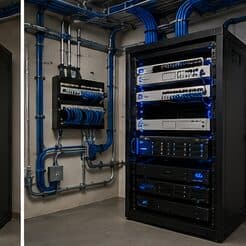
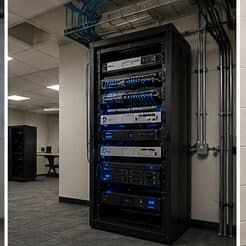
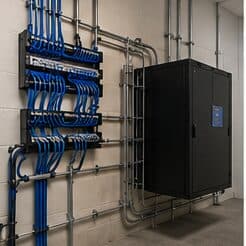
Where a building exceeds copper reach from a single position, the usual answer is one or more intermediate distribution points fed by fiber, each serving its area with copper within the limit. This is standard structured-cabling practice and it is far more reliable than attempting to stretch copper or bridge wirelessly across the building.
Access-point mounting height is a genuine design decision in high-ceiling spaces, not a default. Mounting at the roof deck maximises line of sight but puts the access point far from the devices and often above the racking, where the signal has to travel down through stock. Mounting lower — at or just above racking height, aimed along the aisles — frequently produces better coverage where the scanners actually are.
Roaming matters because the primary clients are mobile. A forklift-mounted or handheld scanner moving down an aisle needs clean handoffs between cells. That is a function of overlap and channel planning, and it is best validated by walking the aisles with the racking loaded.
- Fiber to intermediate distribution points where distance exceeds copper limits
- Mounting height chosen deliberately rather than defaulting to the roof deck
- Coverage designed along aisles, with directional antennas where useful
- Roaming validated by walking loaded aisles, not an empty floor
- Office, operations, and building-system traffic segmented
Installing in Brookshire
Warehouse camera coverage concentrates where goods and vehicles move: dock doors, receiving and shipping areas, yard gates, and the boundary between operational and office space. These views answer the questions warehouse footage is actually asked — what arrived, what left, and when.
Getting Brookshire work done means planning around the site as it actually is. Unconditioned operational areas affecting equipment placement. Long cable runs and yard/dock areas needing distinct approaches. Both matter as much as the design to how and when the work happens. The scope is drawn from the real property, the coverage is stated as a service area rather than an office, and unverifiable specifics about Brookshire are kept off the page on purpose.
Explore everything in this section
All 22 pages under Technology for warehouses in Brookshire.
- Access-control installation for warehouses in Brookshire
- Business phone & VoIP for warehouses in Brookshire
- Cat6A cabling for warehouses in Brookshire
- Commercial IT solutions for warehouses in Brookshire
- Commercial Wi-Fi for warehouses in Brookshire
- Conference-room AV for warehouses in Brookshire
- Digital signage for warehouses in Brookshire
- Ethernet installation for warehouses in Brookshire
- Fiber-optic cabling for warehouses in Brookshire
- Gate & license-plate cameras for warehouses in Brookshire
- In-wall cable concealment for warehouses in Brookshire
- Intercom installation for warehouses in Brookshire
- Low-voltage installation for warehouses in Brookshire
- Network troubleshooting for warehouses in Brookshire
- Outdoor & patio speakers for warehouses in Brookshire
- PoE camera installation for warehouses in Brookshire
- Projector & screen installation for warehouses in Brookshire
- Soundbar mounting for warehouses in Brookshire
- TV mounting for warehouses in Brookshire
- Ubiquiti UniFi installation for warehouses in Brookshire
- Wi-Fi installation for warehouses in Brookshire
- Wireless bridge (point-to-point) for warehouses in Brookshire
Frequently asked questions
What do warehouses in Brookshire usually need first?
It varies by site, but the pattern for warehouses holds in Brookshire: get the network and cabling backbone right, then layer cameras and access on top. What Brookshire changes is the physical install — the conditions listed above drive routes and equipment placement more than the sector alone does.
Why did warehouse Wi-Fi get worse after the racking was stocked?
Because the stock changed the radio environment. Metal racking reflects and palletised goods absorb, so coverage measured across an open floor no longer applies. This is why warehouse designs should assume loaded conditions and why validation should happen with the aisles full.