Intercom installation for warehouses, in Brookshire
Intercom installation for warehouses in Brookshire is a three-part question: what intercom installation involves, what warehouses need from it, and what Brookshire changes about the install. Large warehousing and distribution buildings along the I-10 corridor.
Where an intercom differs meaningfully from a doorbell is scale and integration. A doorbell serves one entry and one household. An intercom serves entries where multiple people or multiple tenants need to answer, where a gate is involved, or where release should be tied into an access-control system that logs the event.
Height, forklifts, and unconditioned space
High-level work needs lift access, and lift access needs floor space clear of racking, stock, and traffic. Coordinating that with warehouse operations is usually the single biggest scheduling constraint, and it is why warehouse installs often happen during shutdowns or quieter shifts.
Environmental conditions matter for equipment placement. Much of a warehouse is unconditioned, and equipment placed in that environment is subject to summer temperatures and dust. Enclosures, filtration, or siting equipment in a conditioned office area are the usual responses.
- Lift access requiring clear floor space coordinated with operations
- Work often scheduled during shutdowns or quieter shifts
- Equipment sited in conditioned space or protected enclosures
- Dust protection for anything in the operational area
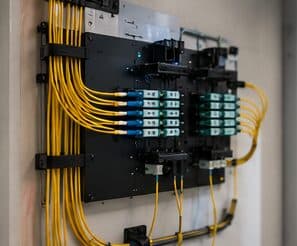
- Cable pathways kept clear of forklift and racking impact zones
Where intercom installation goes wrong — and how it's avoided
Intercom disappointments are usually placement decisions.
- Mounting a station beside an air-conditioning unit or facing a busy road
- Leaving a west-facing station unhooded in full afternoon sun
- Running gate cable without conduit or surge protection
- Wiring release without confirming the egress arrangement
- Installing answering points where nobody spends the working day
- Assuming an existing gate operator's wiring can carry the intercom too
Brookshire: what the location changes
The starting point for any Brookshire job is one local fact. Large warehousing and distribution buildings along the I-10 corridor. That single condition shapes where cable can run, where equipment can sit, and how coverage is laid out — more than any spec sheet does. Two more conditions weigh on it. Metal construction that reflects wireless signal and complicates coverage. Building footprints frequently exceeding the 100 m copper channel limit. Together they make the route specific to this pocket, which is why a short walkthrough or a few clear photos settle the scope faster than a floor plan can.
- Large warehousing and distribution buildings along the I-10 corridor
- Metal construction that reflects wireless signal and complicates coverage
- Building footprints frequently exceeding the 100 m copper channel limit
- Unconditioned operational areas affecting equipment placement
- Long cable runs and yard/dock areas needing distinct approaches
Getting it done in Brookshire
Intercom commissioning is mostly listening and looking, from both ends.
Warehouse projects come down to three things: wireless that works down the aisles with stock in place, a network topology that reaches the far end of the building properly, and camera coverage at the points where goods and vehicles move.
Getting Brookshire work done means planning around the site as it actually is. Unconditioned operational areas affecting equipment placement. Long cable runs and yard/dock areas needing distinct approaches. Both matter as much as the design to how and when the work happens. The scope is drawn from the real property, the coverage is stated as a service area rather than an office, and unverifiable specifics about Brookshire are kept off the page on purpose.
Frequently asked questions
Is intercom installation for warehouses different in Brookshire?
The sector needs stay the same, but the install changes with the place. In Brookshire, the conditions above — not the warehouses label — decide routes, mounting, and equipment placement, which is why this page pairs all three.
Can an intercom release the door as well as show who is there?
Yes, and that is usually the point. The release is wired to the door's lock hardware, and the choice of lock determines power-loss behaviour. Where the door is also part of an access-control system, the two should be coordinated so the release is logged and the systems do not conflict over the same hardware.