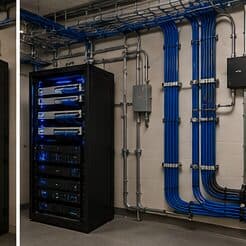
PoE camera installation for warehouses, in Brookshire
PoE camera installation for warehouses in Brookshire is a three-part question: what poe camera installation involves, what warehouses need from it, and what Brookshire changes about the install. Large warehousing and distribution buildings along the I-10 corridor.
A PoE camera takes its power from the same Ethernet cable that carries its video, which removes the need for a local outlet at every mounting position. That is the entire practical appeal: one run per camera, no electrician at each soffit, and centralised power that can sit behind a UPS so the cameras stay up during a short outage.
Height, forklifts, and unconditioned space
High-level work needs lift access, and lift access needs floor space clear of racking, stock, and traffic. Coordinating that with warehouse operations is usually the single biggest scheduling constraint, and it is why warehouse installs often happen during shutdowns or quieter shifts.
Environmental conditions matter for equipment placement. Much of a warehouse is unconditioned, and equipment placed in that environment is subject to summer temperatures and dust. Enclosures, filtration, or siting equipment in a conditioned office area are the usual responses.
- Lift access requiring clear floor space coordinated with operations
- Work often scheduled during shutdowns or quieter shifts
- Equipment sited in conditioned space or protected enclosures
- Dust protection for anything in the operational area
- Cable pathways kept clear of forklift and racking impact zones
Where poe camera installation goes wrong — and how it's avoided
PoE mistakes are almost always arithmetic mistakes made early.
- Sizing the switch on port count and ignoring the PoE budget
- Budgeting idle draw and being surprised by the night-time load
- Using copper-clad aluminium cable on long PoE runs
- Tightly bundling many high-power runs with no thought to heat
- Leaving the switch off a UPS so a brief flicker takes the whole system down
- Assuming a mid-span injector solves a budget problem it does not address
Brookshire: what the location changes
Large warehousing and distribution buildings along the I-10 corridor. In Brookshire, that is where the plan begins, because it changes cable paths, device placement, and access-point counts before anything else does. Metal construction that reflects wireless signal and complicates coverage. Building footprints frequently exceeding the 100 m copper channel limit. None of these are generic checklist items — each moves the design in a direction a citywide assumption would miss, and the honest recommendation always depends on what this particular property allows.
- Large warehousing and distribution buildings along the I-10 corridor
- Metal construction that reflects wireless signal and complicates coverage
- Building footprints frequently exceeding the 100 m copper channel limit
- Unconditioned operational areas affecting equipment placement
- Long cable runs and yard/dock areas needing distinct approaches
Getting it done in Brookshire
The meaningful PoE test is under peak load after dark, because that is the condition that exposes budget problems.
Warehouse projects come down to three things: wireless that works down the aisles with stock in place, a network topology that reaches the far end of the building properly, and camera coverage at the points where goods and vehicles move.
On site, the schedule and working method turn on conditions like these. Unconditioned operational areas affecting equipment placement. Long cable runs and yard/dock areas needing distinct approaches. Both shape how and when a crew can actually operate, which is why EVOTECH scopes each Brookshire job from the property itself rather than assuming one approach fits every address. Coverage is stated as a service area, never an office claim, and anything about Brookshire that cannot be verified is left out instead of invented.
Frequently asked questions
Is poe camera installation for warehouses different in Brookshire?
The sector needs stay the same, but the install changes with the place. In Brookshire, the conditions above — not the warehouses label — decide routes, mounting, and equipment placement, which is why this page pairs all three.
Why do cameras reboot at night but work fine during the day?
Almost always PoE budget. Infrared illuminators engage after dark and the total draw rises, pushing the switch past its budget. It presents as intermittent camera dropouts and gets misdiagnosed as a network fault. The fix is a switch with sufficient budget and headroom, calculated from peak draw rather than idle.