Gate & license-plate cameras for warehouses, in Brookshire
Gate & license-plate cameras for warehouses in Brookshire is a three-part question: what gate & license-plate cameras involves, what warehouses need from it, and what Brookshire changes about the install. Large warehousing and distribution buildings along the I-10 corridor.
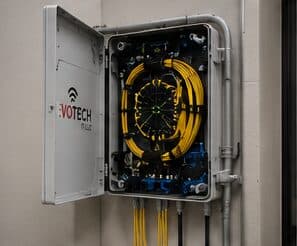
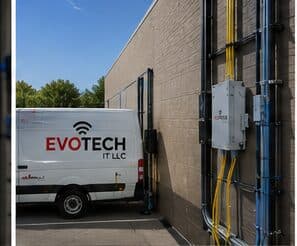
The other half of the job is getting to the gate. Entry points are often far from the building, so power and a reliable connection to a gate or driveway position have to be planned — frequently a fiber or intermediate-powered run rather than a stretched copper one — along with mounting that gives the right angle and distance for the plate.
Height, forklifts, and unconditioned space
High-level work needs lift access, and lift access needs floor space clear of racking, stock, and traffic. Coordinating that with warehouse operations is usually the single biggest scheduling constraint, and it is why warehouse installs often happen during shutdowns or quieter shifts.
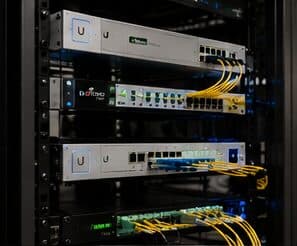
Environmental conditions matter for equipment placement. Much of a warehouse is unconditioned, and equipment placed in that environment is subject to summer temperatures and dust. Enclosures, filtration, or siting equipment in a conditioned office area are the usual responses.
- Lift access requiring clear floor space coordinated with operations
- Work often scheduled during shutdowns or quieter shifts
- Equipment sited in conditioned space or protected enclosures
- Dust protection for anything in the operational area
- Cable pathways kept clear of forklift and racking impact zones
Where gate & license-plate cameras goes wrong — and how it's avoided
Entry camera systems fail when one camera is asked to do two jobs.
- Expecting one camera to both show the scene and read plates
- A slow shutter smearing plates on moving vehicles
- Uncontrolled infrared blowing out the reflective plate
- Field of view too wide to resolve a plate
- Stretching copper to a gate beyond its reach
- Skipping the overview camera and losing context
Brookshire: what the location changes
The starting point for any Brookshire job is one local fact. Large warehousing and distribution buildings along the I-10 corridor. That single condition shapes where cable can run, where equipment can sit, and how coverage is laid out — more than any spec sheet does. Two more conditions weigh on it. Metal construction that reflects wireless signal and complicates coverage. Building footprints frequently exceeding the 100 m copper channel limit. Together they make the route specific to this pocket, which is why a short walkthrough or a few clear photos settle the scope faster than a floor plan can.
- Large warehousing and distribution buildings along the I-10 corridor
- Metal construction that reflects wireless signal and complicates coverage
- Building footprints frequently exceeding the 100 m copper channel limit
- Unconditioned operational areas affecting equipment placement
- Long cable runs and yard/dock areas needing distinct approaches
Getting it done in Brookshire
Entry cameras are verified against their objectives, day and night.
Warehouse projects come down to three things: wireless that works down the aisles with stock in place, a network topology that reaches the far end of the building properly, and camera coverage at the points where goods and vehicles move.
Getting Brookshire work done means planning around the site as it actually is. Unconditioned operational areas affecting equipment placement. Long cable runs and yard/dock areas needing distinct approaches. Both matter as much as the design to how and when the work happens. The scope is drawn from the real property, the coverage is stated as a service area rather than an office, and unverifiable specifics about Brookshire are kept off the page on purpose.
Frequently asked questions
Is gate & license-plate cameras for warehouses different in Brookshire?
The sector needs stay the same, but the install changes with the place. In Brookshire, the conditions above — not the warehouses label — decide routes, mounting, and equipment placement, which is why this page pairs all three.
Can one camera watch the gate and read plates?
Rarely well. Reading a plate needs a fast shutter, a narrow view, a shallow angle, and controlled infrared — settings that make the plate legible also make the wider scene dark. A general overview camera cannot resolve a plate on a moving vehicle. The reliable approach is two cameras: one for the scene, one dedicated to plates.