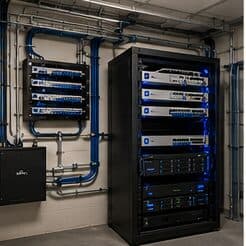
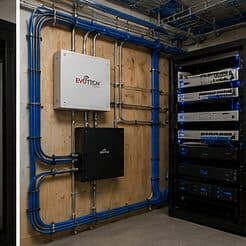
In-wall cable concealment for professional offices, in Brookshire
In-wall cable concealment for professional offices in Brookshire is a three-part question: what in-wall cable concealment involves, what professional offices need from it, and what Brookshire changes about the install. Large warehousing and distribution buildings along the I-10 corridor.
The work itself is fishing cable through a finished wall, and how hard that is depends entirely on what is inside it. An open stud cavity is quick; fire blocking, insulation, a masonry or metal-stud wall, or a fireplace structure can stop a fish tape and change the approach. Where a clean in-wall path genuinely isn't available, a paintable surface raceway is the honest alternative.
Fit-outs, occupied floors, and landlords
The easiest time to do office low-voltage work is during a fit-out, when ceilings are open and the space is empty. Work in an occupied office is entirely feasible but slower, with furniture protection, containment, and noise consideration all adding time.
Multi-tenant buildings introduce a third party. Base-building rules on core access, riser use, after-hours work, and ceiling penetration vary considerably, and confirming them before scheduling avoids a crew arriving to find they cannot access the riser.
- Fit-out timing preferred where the schedule allows
- Furniture protection and containment in occupied areas
- Base-building rules on riser and core access confirmed in advance
- After-hours access arrangements agreed with building management
- Noise-sensitive work scheduled outside core hours
What changes in-wall cable concealment from job to job
Scope depends on the wall and the run.
- Wall construction: drywall, masonry, metal stud, or fireplace
- Fire blocking, insulation, and bracing in the cavity
- Distance from the display to the outlet or equipment
- Whether a recessed outlet must be added
- Number of cables to conceal
- Finish expectations and any patch-and-paint
Brookshire: what the location changes
The starting point for any Brookshire job is one local fact. Large warehousing and distribution buildings along the I-10 corridor. That single condition shapes where cable can run, where equipment can sit, and how coverage is laid out — more than any spec sheet does. Two more conditions weigh on it. Metal construction that reflects wireless signal and complicates coverage. Building footprints frequently exceeding the 100 m copper channel limit. Together they make the route specific to this pocket, which is why a short walkthrough or a few clear photos settle the scope faster than a floor plan can.
- Large warehousing and distribution buildings along the I-10 corridor
- Metal construction that reflects wireless signal and complicates coverage
- Building footprints frequently exceeding the 100 m copper channel limit
- Unconditioned operational areas affecting equipment placement
- Long cable runs and yard/dock areas needing distinct approaches
Getting it done in Brookshire
Concealment is judged by a clean result and a safe, code-compliant power path.
In an office, the technology most people judge is the meeting room, and the two things they judge it on are whether the far end can hear them and whether the meeting started on time. Both are solvable, and both are more about microphone coverage and simple control than about display specification.
Execution in Brookshire is planned around real conditions, not a template. Unconditioned operational areas affecting equipment placement. Long cable runs and yard/dock areas needing distinct approaches. These decide the sequence, the access, and the method as much as the design does. EVOTECH describes Brookshire as coverage rather than a place it occupies, and omits any area detail it cannot confirm — building and site conditions only, no invented landmarks or promised arrival times.
Frequently asked questions
Is in-wall cable concealment for professional offices different in Brookshire?
The sector needs stay the same, but the install changes with the place. In Brookshire, the conditions above — not the professional offices label — decide routes, mounting, and equipment placement, which is why this page pairs all three.
Can the power cord be hidden in the wall too?
Not the standard cord — running one inside a wall is against code and a genuine hazard. Power is concealed correctly with a recessed outlet behind the display or a rated in-wall power-relocation kit, which puts the outlet where the TV needs it without burying a cord. The signal cables can go in the wall; power is handled the right way.