In-wall cable concealment for professional offices, in Friendswood
In-wall cable concealment for professional offices in Friendswood is a three-part question: what in-wall cable concealment involves, what professional offices need from it, and what Friendswood changes about the install. Established suburban homes on larger lots with mature landscaping.
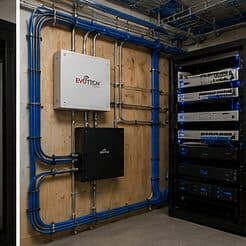
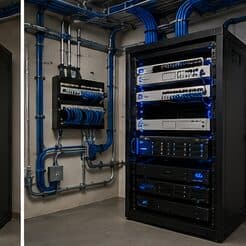
The work itself is fishing cable through a finished wall, and how hard that is depends entirely on what is inside it. An open stud cavity is quick; fire blocking, insulation, a masonry or metal-stud wall, or a fireplace structure can stop a fish tape and change the approach. Where a clean in-wall path genuinely isn't available, a paintable surface raceway is the honest alternative.
Entry control and modest camera coverage
Office camera requirements are usually limited: the main entrance, the suite door, any rear or service entrance, and sometimes the server or equipment room. Interior open-plan coverage is less common and is worth questioning when requested, since it changes the character of the workplace for limited benefit.
Access control frequently matters more. A suite door with credential access, an after-hours schedule, and a record of entries covers most of what an office actually needs. In multi-tenant buildings this also handles the situation where base-building hours differ from a tenant's own working pattern.
- Main entrance and suite door coverage framed for identification
- Rear and service entrances where they exist
- Equipment room access controlled and logged
- Access schedules matched to actual working patterns
- Interior general coverage questioned rather than assumed
Where in-wall cable concealment goes wrong — and how it's avoided
Concealment goes wrong on power and on the wall's contents.
- Running a standard power cord inside the wall
- Forcing a fish tape past fire blocking and damaging the finish or wall
- Not planning patch-and-paint before cutting access
- Leaving no service loop for future work
- Assuming a clean path exists without checking the construction
- Compromising the wall's fire integrity to hide a cable
Friendswood: what the location changes
What separates a Friendswood scope from the rest of the city is concrete and local. Established suburban homes on larger lots with mature landscaping. Wider and multi-storey plans needing multiple wired access points. Slab-foundation construction with attic-to-interior-wall retrofit routing. That short list is what actually drives the design in this pocket, and it is why photographs or a brief site visit beat a floor plan — the plan follows the building's real constraints, not the neighborhood name on the map.
- Established suburban homes on larger lots with mature landscaping
- Wider and multi-storey plans needing multiple wired access points
- Slab-foundation construction with attic-to-interior-wall retrofit routing
- Detached structures and outdoor areas needing dedicated coverage
- Mature trees affecting outdoor wireless and camera framing
Getting it done in Friendswood
Concealment is judged by a clean result and a safe, code-compliant power path.
An office floor's network demand is not spread evenly. Individual desks are undemanding. Meeting rooms concentrate a dozen people, their laptops and phones, a display system, and a video call into one radio cell for an hour at a time. That concentration is where the design effort belongs.
Getting Friendswood work done means planning around the site as it actually is. Detached structures and outdoor areas needing dedicated coverage. Mature trees affecting outdoor wireless and camera framing. Both matter as much as the design to how and when the work happens. The scope is drawn from the real property, the coverage is stated as a service area rather than an office, and unverifiable specifics about Friendswood are kept off the page on purpose.
Frequently asked questions
Is in-wall cable concealment for professional offices different in Friendswood?
The sector needs stay the same, but the install changes with the place. In Friendswood, the conditions above — not the professional offices label — decide routes, mounting, and equipment placement, which is why this page pairs all three.
Can the power cord be hidden in the wall too?
Not the standard cord — running one inside a wall is against code and a genuine hazard. Power is concealed correctly with a recessed outlet behind the display or a rated in-wall power-relocation kit, which puts the outlet where the TV needs it without burying a cord. The signal cables can go in the wall; power is handled the right way.