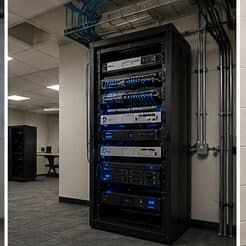
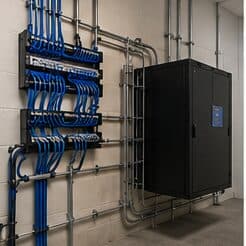
In-wall cable concealment for professional offices, in Fulshear
In-wall cable concealment for professional offices in Fulshear is a three-part question: what in-wall cable concealment involves, what professional offices need from it, and what Fulshear changes about the install. Predominantly recent residential construction, so prewire timing rather than retrofit access is the usual constraint.
The work itself is fishing cable through a finished wall, and how hard that is depends entirely on what is inside it. An open stud cavity is quick; fire blocking, insulation, a masonry or metal-stud wall, or a fireplace structure can stop a fish tape and change the approach. Where a clean in-wall path genuinely isn't available, a paintable surface raceway is the honest alternative.
Density is concentrated, not distributed
An office floor's network demand is not spread evenly. Individual desks are undemanding. Meeting rooms concentrate a dozen people, their laptops and phones, a display system, and a video call into one radio cell for an hour at a time. That concentration is where the design effort belongs.
The second characteristic is churn. Desk layouts change, teams grow, hot-desking arrives and departs. Offices benefit from more outlets than the current plan requires and from wireless coverage designed around areas rather than around today's seating chart.
- Demand concentrated in meeting and collaboration areas
- Desk layouts changing more often than the cabling can economically follow
- Video calls as the most visible and least forgiving workload
- Printers, phones, and access points adding to the wired device count
Where in-wall cable concealment goes wrong — and how it's avoided
Concealment goes wrong on power and on the wall's contents.
- Running a standard power cord inside the wall
- Forcing a fish tape past fire blocking and damaging the finish or wall
- Not planning patch-and-paint before cutting access
- Leaving no service loop for future work
- Assuming a clean path exists without checking the construction
- Compromising the wall's fire integrity to hide a cable
Fulshear: what the location changes
The starting point for any Fulshear job is one local fact. Predominantly recent residential construction, so prewire timing rather than retrofit access is the usual constraint. That single condition shapes where cable can run, where equipment can sit, and how coverage is laid out — more than any spec sheet does. Two more conditions weigh on it. Large single-family floor plans requiring multiple wired coverage positions rather than a single router. Builder-provided media enclosures frequently undersized, unventilated, or awkwardly positioned for wireless coverage. Together they make the route specific to this pocket, which is why a short walkthrough or a few clear photos settle the scope faster than a floor plan can.
- Predominantly recent residential construction, so prewire timing rather than retrofit access is the usual constraint
- Large single-family floor plans requiring multiple wired coverage positions rather than a single router
- Builder-provided media enclosures frequently undersized, unventilated, or awkwardly positioned for wireless coverage
- Slab-on-grade foundations with accessible attics for post-construction additions
- Larger lots with detached garages and outbuildings needing their own deliberate connectivity approach
Getting it done in Fulshear
Concealment is judged by a clean result and a safe, code-compliant power path.
Wireless capacity should be planned from peak simultaneous use in each area. A floor with several meeting rooms in constant use needs more cells concentrated around them than its square footage would suggest, and those cells need a channel plan that stops them contending with each other.
Execution in Fulshear is planned around real conditions, not a template. Slab-on-grade foundations with accessible attics for post-construction additions. Larger lots with detached garages and outbuildings needing their own deliberate connectivity approach. These decide the sequence, the access, and the method as much as the design does. EVOTECH describes Fulshear as coverage rather than a place it occupies, and omits any area detail it cannot confirm — building and site conditions only, no invented landmarks or promised arrival times.
Frequently asked questions
Is in-wall cable concealment for professional offices different in Fulshear?
The sector needs stay the same, but the install changes with the place. In Fulshear, the conditions above — not the professional offices label — decide routes, mounting, and equipment placement, which is why this page pairs all three.
Can the power cord be hidden in the wall too?
Not the standard cord — running one inside a wall is against code and a genuine hazard. Power is concealed correctly with a recessed outlet behind the display or a rated in-wall power-relocation kit, which puts the outlet where the TV needs it without burying a cord. The signal cables can go in the wall; power is handled the right way.