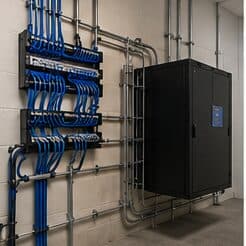
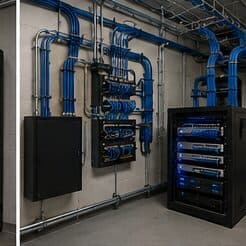
Cat6 cabling for professional offices, in Brookshire
Cat6 cabling for professional offices in Brookshire is a three-part question: what cat6 cabling involves, what professional offices need from it, and what Brookshire changes about the install. Large warehousing and distribution buildings along the I-10 corridor.
So the honest framing is this: specify Cat6 when the device locations need gigabit and the building is unlikely to push 10G to the desk. Specify Cat6A when a run has to support 10G at full distance, when the cable will sit in a dense bundle, or when the location feeds equipment that already asks for more than gigabit.
Fit-outs, occupied floors, and landlords
The easiest time to do office low-voltage work is during a fit-out, when ceilings are open and the space is empty. Work in an occupied office is entirely feasible but slower, with furniture protection, containment, and noise consideration all adding time.
Multi-tenant buildings introduce a third party. Base-building rules on core access, riser use, after-hours work, and ceiling penetration vary considerably, and confirming them before scheduling avoids a crew arriving to find they cannot access the riser.
- Fit-out timing preferred where the schedule allows
- Furniture protection and containment in occupied areas
- Base-building rules on riser and core access confirmed in advance
- After-hours access arrangements agreed with building management
- Noise-sensitive work scheduled outside core hours
What changes cat6 cabling from job to job
The Cat6-versus-Cat6A decision is usually made run by run rather than for the whole building, and the inputs are specific.
- Actual pathway length per run, measured rather than estimated
- Whether the location will ever need more than gigabit
- Bundle density along the shared portion of the pathway
- Whether shielding is warranted by the electrical environment
- Pathway capacity, since Cat6A occupies noticeably more space
- Termination labour, which rises with shielded constructions
Brookshire: what the location changes
What separates a Brookshire scope from the rest of the city is concrete and local. Large warehousing and distribution buildings along the I-10 corridor. Metal construction that reflects wireless signal and complicates coverage. Building footprints frequently exceeding the 100 m copper channel limit. That short list is what actually drives the design in this pocket, and it is why photographs or a brief site visit beat a floor plan — the plan follows the building's real constraints, not the neighborhood name on the map.
- Large warehousing and distribution buildings along the I-10 corridor
- Metal construction that reflects wireless signal and complicates coverage
- Building footprints frequently exceeding the 100 m copper channel limit
- Unconditioned operational areas affecting equipment placement
- Long cable runs and yard/dock areas needing distinct approaches
Getting it done in Brookshire
Certification for a Cat6 link measures the parameters that define the category: insertion loss, near-end and far-end crosstalk, return loss, and propagation delay skew across the frequency range up to 250 MHz. A pass means the link meets the standard's limits with margin recorded.
In an office, the technology most people judge is the meeting room, and the two things they judge it on are whether the far end can hear them and whether the meeting started on time. Both are solvable, and both are more about microphone coverage and simple control than about display specification.
Execution in Brookshire is planned around real conditions, not a template. Unconditioned operational areas affecting equipment placement. Long cable runs and yard/dock areas needing distinct approaches. These decide the sequence, the access, and the method as much as the design does. EVOTECH describes Brookshire as coverage rather than a place it occupies, and omits any area detail it cannot confirm — building and site conditions only, no invented landmarks or promised arrival times.
Frequently asked questions
Is cat6 cabling for professional offices different in Brookshire?
The sector needs stay the same, but the install changes with the place. In Brookshire, the conditions above — not the professional offices label — decide routes, mounting, and equipment placement, which is why this page pairs all three.
Is Cat6 enough, or should everything be Cat6A?
For most device locations Cat6 is enough, because most devices need gigabit and will for a long time. Cat6A earns its place on runs that must carry 10G at distance, runs sitting in dense bundles, and uplinks between equipment positions. Specifying Cat6A for the whole building is rarely wrong technically, but it costs pathway space and termination time that a mixed design keeps.