Intercom installation for home offices, in Cypress
Intercom installation for home offices in Cypress is a three-part question: what intercom installation involves, what home offices need from it, and what Cypress changes about the install. Large newer residential floor plans that exceed single-position wireless coverage.
Where an intercom differs meaningfully from a doorbell is scale and integration. A doorbell serves one entry and one household. An intercom serves entries where multiple people or multiple tenants need to answer, where a gate is involved, or where release should be tied into an access-control system that logs the event.
Wire the desk, then fix the coverage
The single highest-value change for a home office is a wired connection to the desk. It removes wireless variability entirely for the machine that matters, and it is usually one cable run.
After that: an access point positioned to serve the office area properly for the devices that stay wireless, and enough separation that work equipment is not sharing a flat network with everything else in the house.
- One wired run to the primary work position
- An access point positioned for the office end of the house
- Work equipment separated from household and guest devices
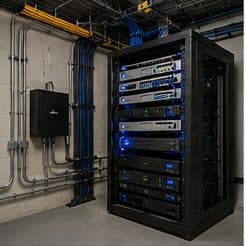
- Equipment position with power and ventilation, not a sealed cabinet
- Wired connections for stationary devices elsewhere that compete for airtime
Where intercom installation goes wrong — and how it's avoided
Intercom disappointments are usually placement decisions.
- Mounting a station beside an air-conditioning unit or facing a busy road
- Leaving a west-facing station unhooded in full afternoon sun
- Running gate cable without conduit or surge protection
- Wiring release without confirming the egress arrangement
- Installing answering points where nobody spends the working day
- Assuming an existing gate operator's wiring can carry the intercom too
Cypress: what the location changes
The starting point for any Cypress job is one local fact. Large newer residential floor plans that exceed single-position wireless coverage. That single condition shapes where cable can run, where equipment can sit, and how coverage is laid out — more than any spec sheet does. Two more conditions weigh on it. Community and worship facilities with large main spaces and high ceilings requiring distributed coverage. Retail centres with substantial footprints and mixed ceiling construction between units. Together they make the route specific to this pocket, which is why a short walkthrough or a few clear photos settle the scope faster than a floor plan can.
- Large newer residential floor plans that exceed single-position wireless coverage
- Community and worship facilities with large main spaces and high ceilings requiring distributed coverage
- Retail centres with substantial footprints and mixed ceiling construction between units
- Renovation and remodel work common, with pathway discovery a genuine part of the project rather than a formality
- Slab foundations with attic access as the standard residential retrofit route
Getting it done in Cypress
Intercom commissioning is mostly listening and looking, from both ends.
Home office projects frequently expand slightly, because the same attic access and the same equipment position serve other things. A doorbell run, a camera at the driveway approach, a wired connection to a television, and an access point for the upstairs are all much cheaper done in the same visit than separately.
Execution in Cypress is planned around real conditions, not a template. Renovation and remodel work common, with pathway discovery a genuine part of the project rather than a formality. Slab foundations with attic access as the standard residential retrofit route. These decide the sequence, the access, and the method as much as the design does. EVOTECH describes Cypress as coverage rather than a place it occupies, and omits any area detail it cannot confirm — building and site conditions only, no invented landmarks or promised arrival times.
Frequently asked questions
Is intercom installation for home offices different in Cypress?
The sector needs stay the same, but the install changes with the place. In Cypress, the conditions above — not the home offices label — decide routes, mounting, and equipment placement, which is why this page pairs all three.
Can an intercom release the door as well as show who is there?
Yes, and that is usually the point. The release is wired to the door's lock hardware, and the choice of lock determines power-loss behaviour. Where the door is also part of an access-control system, the two should be coordinated so the release is logged and the systems do not conflict over the same hardware.