Low-voltage installation for warehouses, in Cypress
Low-voltage installation for warehouses in Cypress is a three-part question: what low-voltage installation involves, what warehouses need from it, and what Cypress changes about the install. Large newer residential floor plans that exceed single-position wireless coverage.
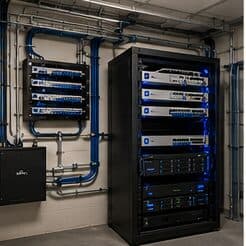
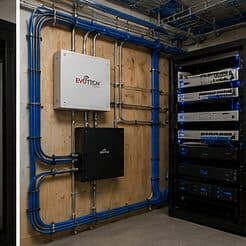
Low-voltage work covers the systems that run on cable rather than mains power: data, wireless, cameras, door access, intercoms, and audio-visual. In a new build or a fit-out these systems share pathways, share an equipment position, and increasingly share a network — so planning them together during rough-in costs far less than adding each one separately after the walls close.
The building changes its own radio environment
A warehouse surveyed empty and a warehouse full of stock are different radio environments. Metal racking reflects, palletised inventory absorbs, and coverage that measured well across an open floor can disappear once the aisles fill. Any design based on an empty-building survey should be treated as provisional.
The second defining feature is distance. Warehouse footprints regularly exceed what a single equipment room can serve within the 100-metre copper limit, which means either intermediate equipment positions connected by fiber or a deliberately distributed design.
- Racking and stock materially change coverage after the survey
- Distances frequently exceed the 100 m copper channel limit
- High ceilings complicate mounting, access, and coverage geometry
- Dock doors, yard, and office areas each have distinct requirements
Where low-voltage installation goes wrong — and how it's avoided
The expensive low-voltage mistakes all happen before anyone pulls cable.
- Specifying systems one at a time instead of planning them together
- Sizing the equipment room for the network only
- Missing the rough-in window and having to retrofit through closed walls
- Leaving device locations unresolved and guessing during rough-in
- Making rated penetrations without sleeves and firestopping
- Leaving cable unlabeled and unprotected between rough-in and finish
Cypress: what the location changes
Large newer residential floor plans that exceed single-position wireless coverage. In Cypress, that is where the plan begins, because it changes cable paths, device placement, and access-point counts before anything else does. Community and worship facilities with large main spaces and high ceilings requiring distributed coverage. Retail centres with substantial footprints and mixed ceiling construction between units. None of these are generic checklist items — each moves the design in a direction a citywide assumption would miss, and the honest recommendation always depends on what this particular property allows.
- Large newer residential floor plans that exceed single-position wireless coverage
- Community and worship facilities with large main spaces and high ceilings requiring distributed coverage
- Retail centres with substantial footprints and mixed ceiling construction between units
- Renovation and remodel work common, with pathway discovery a genuine part of the project rather than a formality
- Slab foundations with attic access as the standard residential retrofit route
Getting it done in Cypress
Each system is commissioned on its own terms, but the low-voltage handover is the point where they are verified together.
Where a building exceeds copper reach from a single position, the usual answer is one or more intermediate distribution points fed by fiber, each serving its area with copper within the limit. This is standard structured-cabling practice and it is far more reliable than attempting to stretch copper or bridge wirelessly across the building.
On site, the schedule and working method turn on conditions like these. Renovation and remodel work common, with pathway discovery a genuine part of the project rather than a formality. Slab foundations with attic access as the standard residential retrofit route. Both shape how and when a crew can actually operate, which is why EVOTECH scopes each Cypress job from the property itself rather than assuming one approach fits every address. Coverage is stated as a service area, never an office claim, and anything about Cypress that cannot be verified is left out instead of invented.
Frequently asked questions
Is low-voltage installation for warehouses different in Cypress?
The sector needs stay the same, but the install changes with the place. In Cypress, the conditions above — not the warehouses label — decide routes, mounting, and equipment placement, which is why this page pairs all three.
When should low-voltage work happen in a construction schedule?
Rough-in sits after electrical and framing and before insulation and drywall. Finish work — terminations, device mounting, and commissioning — happens after paint and ceilings. The risk is that upstream delays compress the rough-in window, so having device locations and pathway plans settled in advance is what keeps that window usable.