Low-voltage installation for warehouses, in League City
Low-voltage installation for warehouses in League City is a three-part question: what low-voltage installation involves, what warehouses need from it, and what League City changes about the install. Coastal proximity raising the weight on exterior sealing, rated housings, and surge protection.
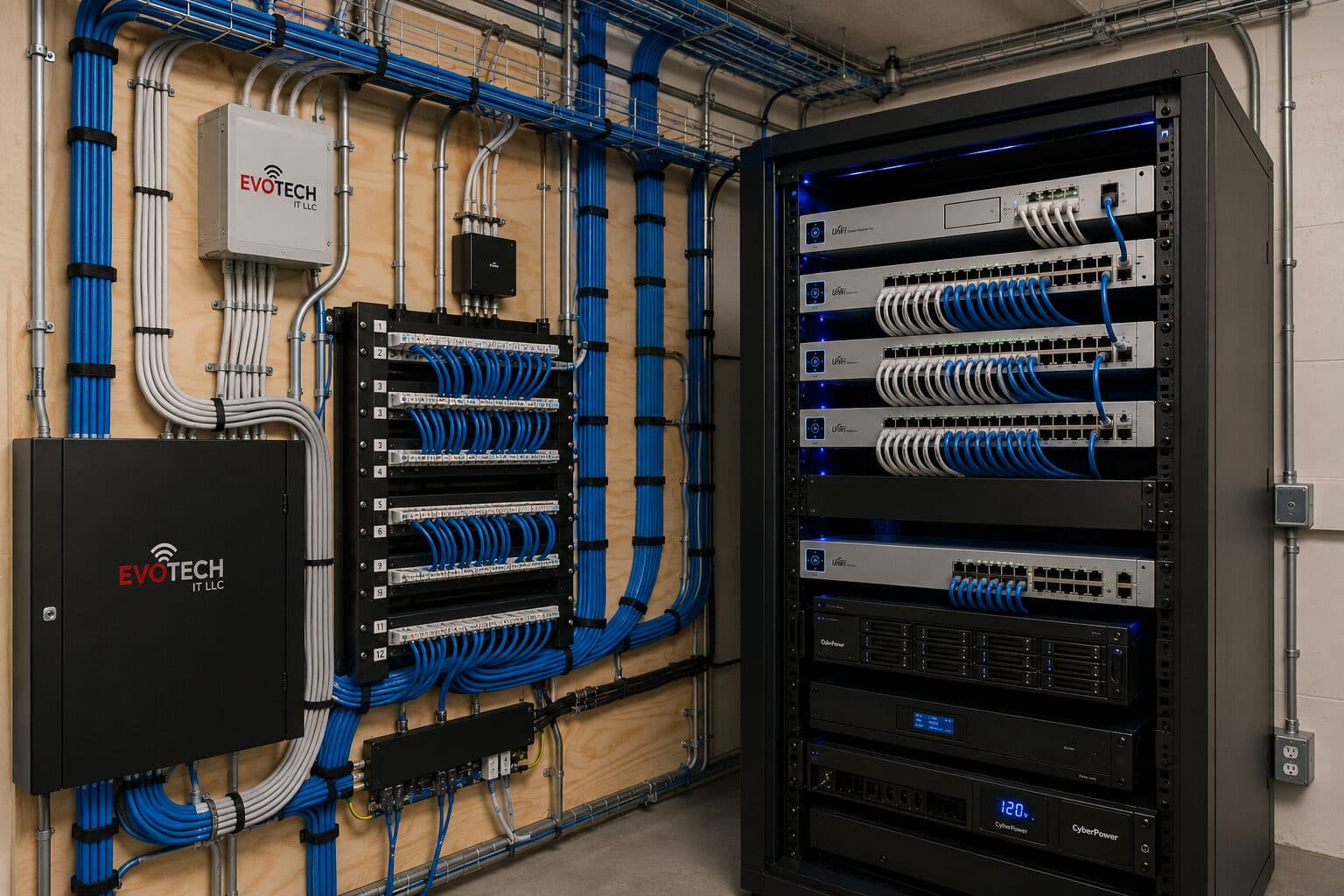
Low-voltage work covers the systems that run on cable rather than mains power: data, wireless, cameras, door access, intercoms, and audio-visual. In a new build or a fit-out these systems share pathways, share an equipment position, and increasingly share a network — so planning them together during rough-in costs far less than adding each one separately after the walls close.
Cover the aisles, reach the far end, watch the docks
Warehouse projects come down to three things: wireless that works down the aisles with stock in place, a network topology that reaches the far end of the building properly, and camera coverage at the points where goods and vehicles move.
Office areas within the warehouse are comparatively ordinary and are usually the easiest part of the project.
- Access points positioned to cover along aisles rather than across them
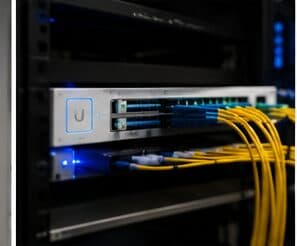
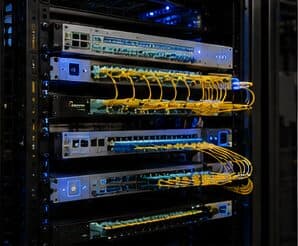
- Intermediate equipment positions linked by fiber where distance requires
- Dock doors, receiving, and yard gates covered by cameras
- Scanner and handheld roaming validated with stock in place
- Equipment protected from dust and temperature in unconditioned areas
What changes low-voltage installation from job to job
Low-voltage scope depends heavily on how many systems are in play and how coordinated the schedule is.
- Which systems are included and whether they share pathways
- Building size, floor count, and pathway complexity
- New construction versus occupied retrofit
- Ceiling type and how much of the pathway is accessible
- Number and type of rated penetrations
- Equipment room provision and whether it exists yet
- Schedule reliability and whether the rough-in window is likely to compress
- Gap between rough-in and finish, which affects protection and re-identification
League City: what the location changes
Coastal proximity raising the weight on exterior sealing, rated housings, and surge protection. In League City, that is where the plan begins, because it changes cable paths, device placement, and access-point counts before anything else does. Storm-season resilience planning, favouring UPS and failover where uptime matters. Newer suburban slab-foundation homes with multi-room coverage needs. None of these are generic checklist items — each moves the design in a direction a citywide assumption would miss, and the honest recommendation always depends on what this particular property allows.
- Coastal proximity raising the weight on exterior sealing, rated housings, and surge protection
- Storm-season resilience planning, favouring UPS and failover where uptime matters
- Newer suburban slab-foundation homes with multi-room coverage needs
- Growing medical and retail commercial space
- Gulf Coast humidity and driven-rain events as a routine design factor
Getting it done in League City
Each system is commissioned on its own terms, but the low-voltage handover is the point where they are verified together.
Warehouse camera coverage concentrates where goods and vehicles move: dock doors, receiving and shipping areas, yard gates, and the boundary between operational and office space. These views answer the questions warehouse footage is actually asked — what arrived, what left, and when.
On site, the schedule and working method turn on conditions like these. Growing medical and retail commercial space. Gulf Coast humidity and driven-rain events as a routine design factor. Both shape how and when a crew can actually operate, which is why EVOTECH scopes each League City job from the property itself rather than assuming one approach fits every address. Coverage is stated as a service area, never an office claim, and anything about League City that cannot be verified is left out instead of invented.
Frequently asked questions
Is low-voltage installation for warehouses different in League City?
The sector needs stay the same, but the install changes with the place. In League City, the conditions above — not the warehouses label — decide routes, mounting, and equipment placement, which is why this page pairs all three.
When should low-voltage work happen in a construction schedule?
Rough-in sits after electrical and framing and before insulation and drywall. Finish work — terminations, device mounting, and commissioning — happens after paint and ceilings. The risk is that upstream delays compress the rough-in window, so having device locations and pathway plans settled in advance is what keeps that window usable.