Security-camera installation for warehouses, in Baytown
Security-camera installation for warehouses in Baytown is a three-part question: what security-camera installation involves, what warehouses need from it, and what Baytown changes about the install. An industrial and refining base with rugged operational environments.
The useful design question is not how many cameras a property needs. It is what each camera has to accomplish. Detecting that a person is present, recognising someone you already know, and identifying a stranger from footage are three different requirements, and they need increasing pixel density on the subject. Planning guidance commonly cited from industry standards puts detection in the region of ten pixels per foot of subject, recognition around forty, and identification around eighty.
Docks, yard, and inventory movement
Warehouse camera coverage concentrates where goods and vehicles move: dock doors, receiving and shipping areas, yard gates, and the boundary between operational and office space. These views answer the questions warehouse footage is actually asked — what arrived, what left, and when.
Dock doors present a specific lighting challenge. A camera facing an open dock door in daylight is looking at a bright rectangle with a dark interior, which is the worst case for dynamic range. Positioning so the camera views along the dock rather than straight into the opening, or accepting a camera specifically chosen for high contrast, addresses it.
Yard and perimeter coverage runs into distance and power. Positions beyond copper reach need fiber and local power, or a designed wireless link — and either way, the power question has to be answered before the camera is specified.
- Dock doors, receiving, and shipping framed for vehicle and goods movement
- Camera positions that avoid shooting straight into a bright dock opening
- Yard gates and perimeter, with the power and distance question resolved first
- Boundary between operational and office areas
- Retention long enough to cover inventory reconciliation cycles
What drives the cost of security-camera installation here
Camera cost is driven by positions and cable routes, with storage the other major line.
- Camera count and the type each objective requires
- Cable run difficulty, particularly exterior and high-level runs
- Recorder capacity sized to the retention target
- Mounting hardware, junction boxes, and weather-appropriate housings
- Lift or scaffold access for elevated positions
- Network and PoE switching capacity
- Configuration of remote access and user permissions
Baytown: what the location changes
In Baytown, the plan is built outward from the conditions that are actually here. An industrial and refining base with rugged operational environments. Older commercial stock needing pathway remediation and rack cleanup. Newer retail development with more straightforward conditions. Each one changes where cable can run, where equipment can sit, and how coverage is shaped, which is why a walkthrough settles a Baytown scope faster than any generic estimate.
- An industrial and refining base with rugged operational environments
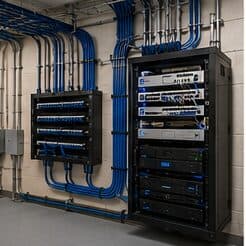
- Older commercial stock needing pathway remediation and rack cleanup
- Newer retail development with more straightforward conditions
- Coastal humidity and driven rain requiring durable exterior sealing and surge protection
- Slab-foundation residential following the regional pattern
Getting it done in Baytown
A camera system is commissioned by looking at its recordings, not its live view. Live video on a monitor at midday tells you very little about what the recorded file will show at nine in the evening.
A warehouse surveyed empty and a warehouse full of stock are different radio environments. Metal racking reflects, palletised inventory absorbs, and coverage that measured well across an open floor can disappear once the aisles fill. Any design based on an empty-building survey should be treated as provisional.
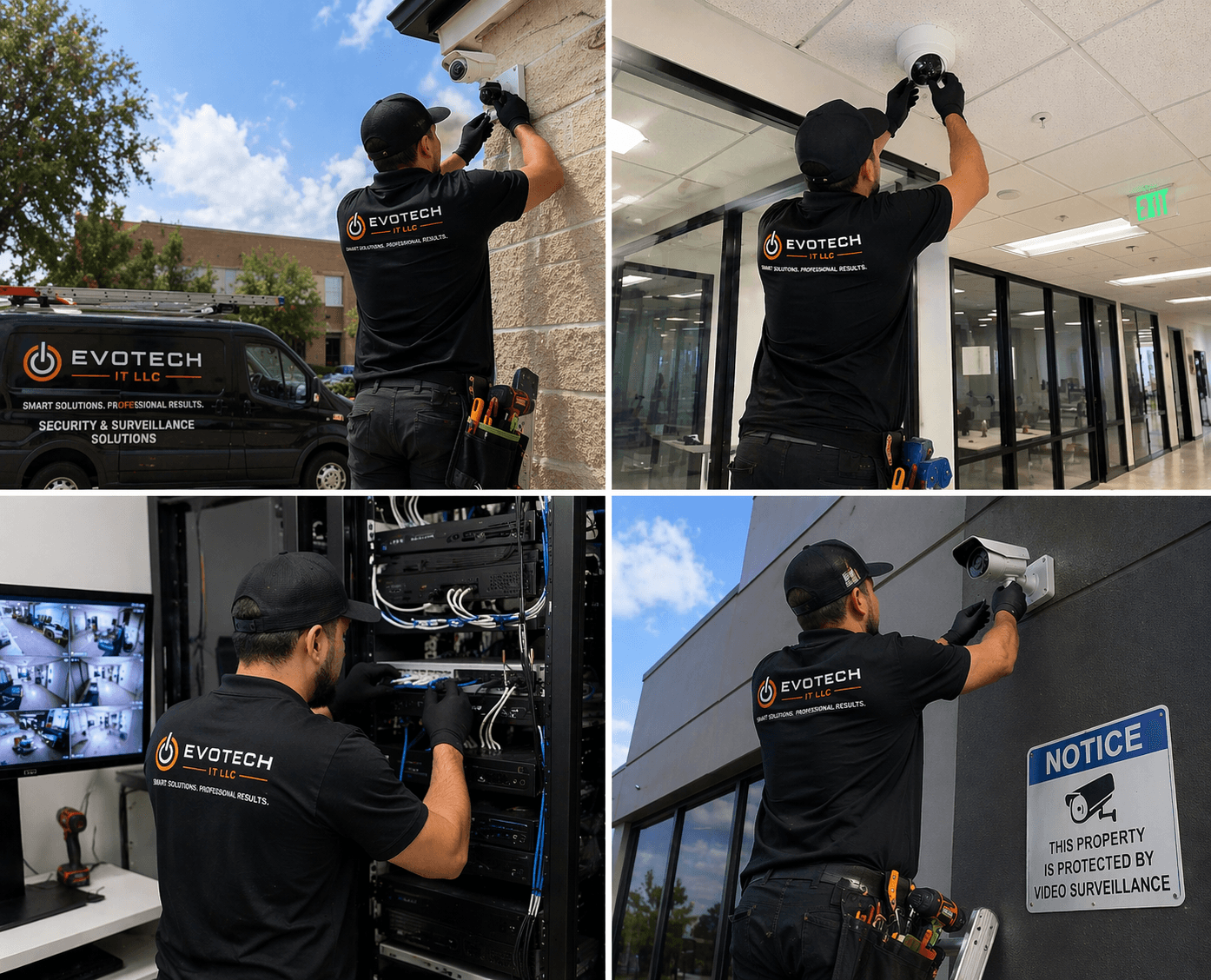
On site, the schedule and working method turn on conditions like these. Coastal humidity and driven rain requiring durable exterior sealing and surge protection. Slab-foundation residential following the regional pattern. Both shape how and when a crew can actually operate, which is why EVOTECH scopes each Baytown job from the property itself rather than assuming one approach fits every address. Coverage is stated as a service area, never an office claim, and anything about Baytown that cannot be verified is left out instead of invented.
Popular services nearby
Frequently searched near this area — the pages people look for most.
Frequently asked questions
Is security-camera installation for warehouses different in Baytown?
The sector needs stay the same, but the install changes with the place. In Baytown, the conditions above — not the warehouses label — decide routes, mounting, and equipment placement, which is why this page pairs all three.
How many cameras does a property need?
Count objectives, not walls. Each area needs a stated purpose — detect activity, recognise a known person, or identify a stranger — and the camera serving it is chosen for that purpose. A property with four well-framed cameras at the points that matter usually produces more useful footage than one with twelve wide shots covering everything approximately.