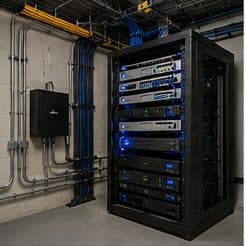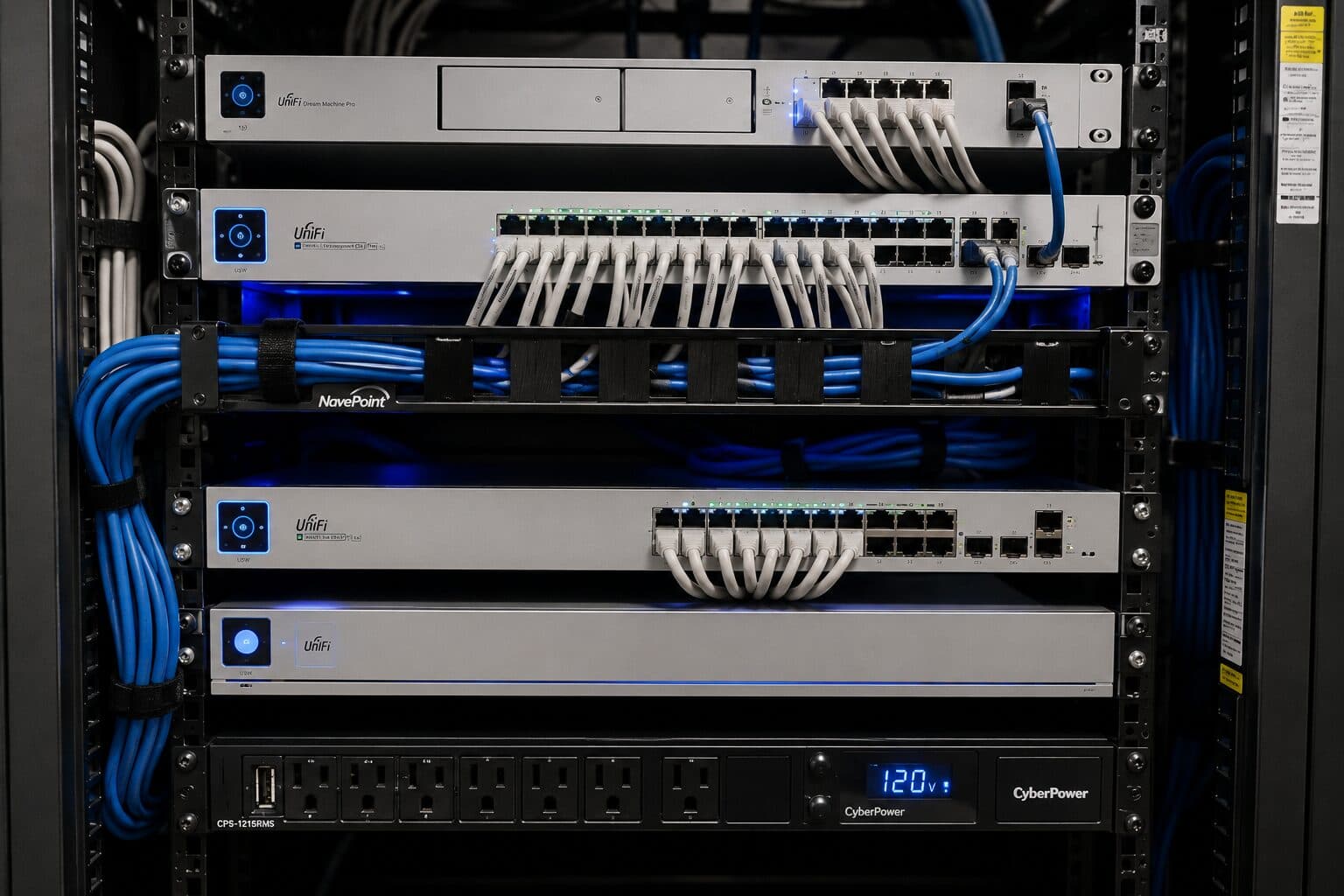
Ubiquiti UniFi installation for warehouses, in Baytown
Ubiquiti UniFi installation for warehouses in Baytown is a three-part question: what ubiquiti unifi installation involves, what warehouses need from it, and what Baytown changes about the install. An industrial and refining base with rugged operational environments.
A UniFi deployment puts the gateway, switching, wireless, and often cameras and door access under one controller. The practical benefit is operational rather than raw performance: one interface for network configuration, client visibility, firmware updates, and camera review, instead of separate systems that each need their own knowledge.
Docks, yard, and inventory movement
Warehouse camera coverage concentrates where goods and vehicles move: dock doors, receiving and shipping areas, yard gates, and the boundary between operational and office space. These views answer the questions warehouse footage is actually asked — what arrived, what left, and when.
Dock doors present a specific lighting challenge. A camera facing an open dock door in daylight is looking at a bright rectangle with a dark interior, which is the worst case for dynamic range. Positioning so the camera views along the dock rather than straight into the opening, or accepting a camera specifically chosen for high contrast, addresses it.
Yard and perimeter coverage runs into distance and power. Positions beyond copper reach need fiber and local power, or a designed wireless link — and either way, the power question has to be answered before the camera is specified.
- Dock doors, receiving, and shipping framed for vehicle and goods movement
- Camera positions that avoid shooting straight into a bright dock opening
- Yard gates and perimeter, with the power and distance question resolved first
- Boundary between operational and office areas
- Retention long enough to cover inventory reconciliation cycles
What drives the cost of ubiquiti unifi installation here
Equipment is visible, but configuration and cabling usually decide the total.
- Device count across gateway, switching, wireless, cameras, and access
- Cable runs and their difficulty
- Storage capacity for the camera retention target
- Number of segments and depth of the policy configuration
- Migration complexity from existing equipment
- Whether structured documentation and handover training are included
Baytown: what the location changes
An industrial and refining base with rugged operational environments. In Baytown, that is where the plan begins, because it changes cable paths, device placement, and access-point counts before anything else does. Older commercial stock needing pathway remediation and rack cleanup. Newer retail development with more straightforward conditions. None of these are generic checklist items — each moves the design in a direction a citywide assumption would miss, and the honest recommendation always depends on what this particular property allows.
- An industrial and refining base with rugged operational environments
- Older commercial stock needing pathway remediation and rack cleanup
- Newer retail development with more straightforward conditions
- Coastal humidity and driven rain requiring durable exterior sealing and surge protection
- Slab-foundation residential following the regional pattern
Getting it done in Baytown
Validation covers the network design as well as the radio coverage, because segmentation that was configured but not tested is not yet segmentation.
A warehouse surveyed empty and a warehouse full of stock are different radio environments. Metal racking reflects, palletised inventory absorbs, and coverage that measured well across an open floor can disappear once the aisles fill. Any design based on an empty-building survey should be treated as provisional.
Getting Baytown work done means planning around the site as it actually is. Coastal humidity and driven rain requiring durable exterior sealing and surge protection. Slab-foundation residential following the regional pattern. Both matter as much as the design to how and when the work happens. The scope is drawn from the real property, the coverage is stated as a service area rather than an office, and unverifiable specifics about Baytown are kept off the page on purpose.
Frequently asked questions
Is ubiquiti unifi installation for warehouses different in Baytown?
The sector needs stay the same, but the install changes with the place. In Baytown, the conditions above — not the warehouses label — decide routes, mounting, and equipment placement, which is why this page pairs all three.
Is UniFi the right choice for a small business?
It suits sites that want proper segmentation, decent wireless, and cameras under one interface without employing a network administrator. The tradeoff is committing to one vendor's ecosystem. A mixed-vendor design gives more freedom to pick the best component for each role; the single-vendor version is easier to live with day to day. Both are defensible — it is worth choosing on purpose.