Why this page exists
Technology for churches in the 77523 area east of Baytown sits where two things meet: how churches actually operate, and what the 77523 area east of Baytown specifically brings to the building. 77523 east of Baytown into Chambers County is newer-growth, larger-lot suburban and semi-rural residential.
The first design priority is that the routine operation is genuinely simple: a small number of clearly labeled controls that start the normal service configuration. Everything complex sits behind that, available to whoever maintains the system but not required for weekly use.
Simple to operate, then everything else
The first design priority is that the routine operation is genuinely simple: a small number of clearly labeled controls that start the normal service configuration. Everything complex sits behind that, available to whoever maintains the system but not required for weekly use.
After that: audio intelligibility in the main space, display visibility from the back, coverage across the campus including classrooms and offices, and access control for a building that many people use at many different times.
- A simple, labeled routine operation that volunteers can run confidently
- Speech intelligibility prioritised over volume in the main space
- Displays sized and positioned for the furthest seats
- Wireless coverage across sanctuary, classrooms, offices, and fellowship areas
- Access control suited to many users and irregular schedules
the 77523 area east of Baytown: what the location adds
The starting point for any the 77523 area east of Baytown job is one local fact. 77523 east of Baytown into Chambers County is newer-growth, larger-lot suburban and semi-rural residential. That single condition shapes where cable can run, where equipment can sit, and how coverage is laid out — more than any spec sheet does. Two more conditions weigh on it. Larger and acreage lots create long house-to-road and house-to-outbuilding distances that drive run lengths. Detached shops and secondary structures often need buried conduit or a wireless bridge back to the main house. Together they make the route specific to this pocket, which is why a short walkthrough or a few clear photos settle the scope faster than a floor plan can.
- 77523 east of Baytown into Chambers County is newer-growth, larger-lot suburban and semi-rural residential
- Larger and acreage lots create long house-to-road and house-to-outbuilding distances that drive run lengths
- Detached shops and secondary structures often need buried conduit or a wireless bridge back to the main house
- Coastal-plain wind exposure factors into exterior camera and antenna mounting
- Newer subdivision rough-in sits beside older rural properties needing full retrofits
Campus coverage and the systems that share it
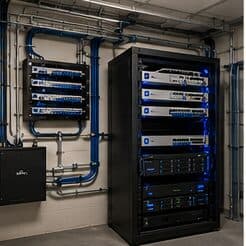
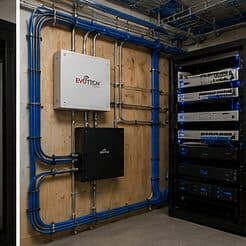
Church networks often have to cover a surprising spread: a sanctuary, classrooms, offices, a fellowship hall, and sometimes separate buildings. Where separate structures are involved, the link between them should be fiber rather than copper, both for distance and because a copper run between buildings carries genuine electrical risk.
Segmentation is worth doing here for a specific reason: churches typically offer guest wireless, run children's-ministry check-in systems, operate AV equipment on the network, and have office computers handling sensitive information. Those should not share one flat network, and separating them is straightforward at installation.
Streaming has become a standard requirement, and it adds an upload-bandwidth dependency that most other building systems do not have. Confirming the circuit's upload capacity, and separating streaming traffic so it does not contend with guest use during a service, is worth doing before rather than after the first stream.
- Fiber between separate buildings on the campus
- Separate segments for guest, office, AV, and check-in systems
- Upload bandwidth confirmed where services are streamed
- Coverage extended to classrooms and fellowship areas, not just the sanctuary
- AV control devices wired rather than depending on wireless during a service
Installing in the 77523 area east of Baytown
Church buildings are used by many people at many different times, which makes key management genuinely burdensome and access control genuinely useful. Credential access with schedules — different groups having access to different areas at different times — solves a problem that physical keys solve badly.
Execution in the 77523 area east of Baytown is planned around real conditions, not a template. Coastal-plain wind exposure factors into exterior camera and antenna mounting. Newer subdivision rough-in sits beside older rural properties needing full retrofits. These decide the sequence, the access, and the method as much as the design does. EVOTECH describes the 77523 area east of Baytown as coverage rather than a place it occupies, and omits any area detail it cannot confirm — building and site conditions only, no invented landmarks or promised arrival times.
Popular services nearby
Frequently searched near this area — the pages people look for most.
Frequently asked questions
What do churches in the 77523 area east of Baytown usually need first?
It varies by site, but the pattern for churches holds in the 77523 area east of Baytown: get the network and cabling backbone right, then layer cameras and access on top. What the 77523 area east of Baytown changes is the physical install — the conditions listed above drive routes and equipment placement more than the sector alone does.
What makes a church AV system volunteer-friendly?
A small number of clearly labeled controls that produce the normal configuration reliably, with complexity hidden behind them. If starting a service requires selecting sources, adjusting levels, and remembering a sequence, it will eventually fail during a service. The design goal is that a new volunteer can run the routine case on their first attempt.