Fiber-optic cabling for schools and educational facilities, in Spring
Fiber-optic cabling for schools and educational facilities in Spring is a three-part question: what fiber-optic cabling involves, what schools and educational facilities need from it, and what Spring changes about the install. Retail and food-service commercial base where payment-system separation is a standing requirement.
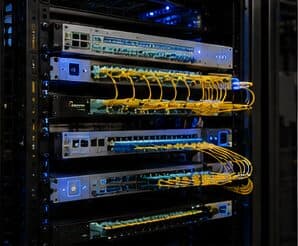
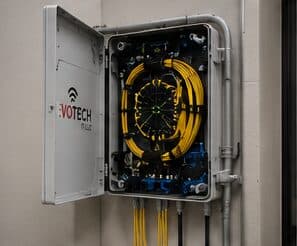
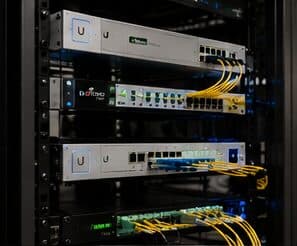
Fiber gets specified for reasons copper cannot address. The first is distance — multimode carries 10 gigabit a few hundred metres and single-mode carries it far further, while copper stops at 100 metres. The second is electrical isolation: a link between two separate buildings should not be a copper conductor, because the two structures can sit at different ground potentials and a lightning event has to go somewhere.
Entry control and perimeter coverage
Camera coverage on a school campus concentrates on entrances, circulation between buildings, parking and drop-off areas, and the perimeter. Corridors are common; classrooms are not, and that boundary is agreed at design.
Entry control is typically the higher priority. Controlled main entry with a visitor process, secondary doors that are secured but permit free egress, and records of who entered when address the requirement more directly than camera coverage does. Free egress on every controlled door is non-negotiable and is designed in from the start.
- Main and secondary entrances with controlled access and free egress
- Circulation routes between buildings
- Parking, drop-off, and perimeter coverage
- Corridor coverage where required; classrooms excluded
- Entry records available to administration
What drives the cost of fiber-optic cabling here
Fiber cost concentrates in the route and the terminations rather than the cable itself.
- Route length and construction method, especially for outdoor segments
- Strand count and whether spares are included
- Number of terminations and the method used
- Enclosures, trays, and protection hardware
- Transceivers at each end
- Testing and documentation depth
- Trenching, boring, or aerial work on between-building routes
Spring: what the location changes
Retail and food-service commercial base where payment-system separation is a standing requirement. In Spring, that is where the plan begins, because it changes cable paths, device placement, and access-point counts before anything else does. Ceiling construction varying considerably between adjacent units, from open deck to hard lid to suspended grid. Restaurant kitchen environments requiring equipment placement away from heat, steam, and grease-laden air. None of these are generic checklist items — each moves the design in a direction a citywide assumption would miss, and the honest recommendation always depends on what this particular property allows.
- Retail and food-service commercial base where payment-system separation is a standing requirement
- Ceiling construction varying considerably between adjacent units, from open deck to hard lid to suspended grid
- Restaurant kitchen environments requiring equipment placement away from heat, steam, and grease-laden air
- Storefront glazing on retail units complicating daylight entrance camera placement
- Residential areas following the regional slab-foundation and attic-routing pattern
Getting it done in Spring
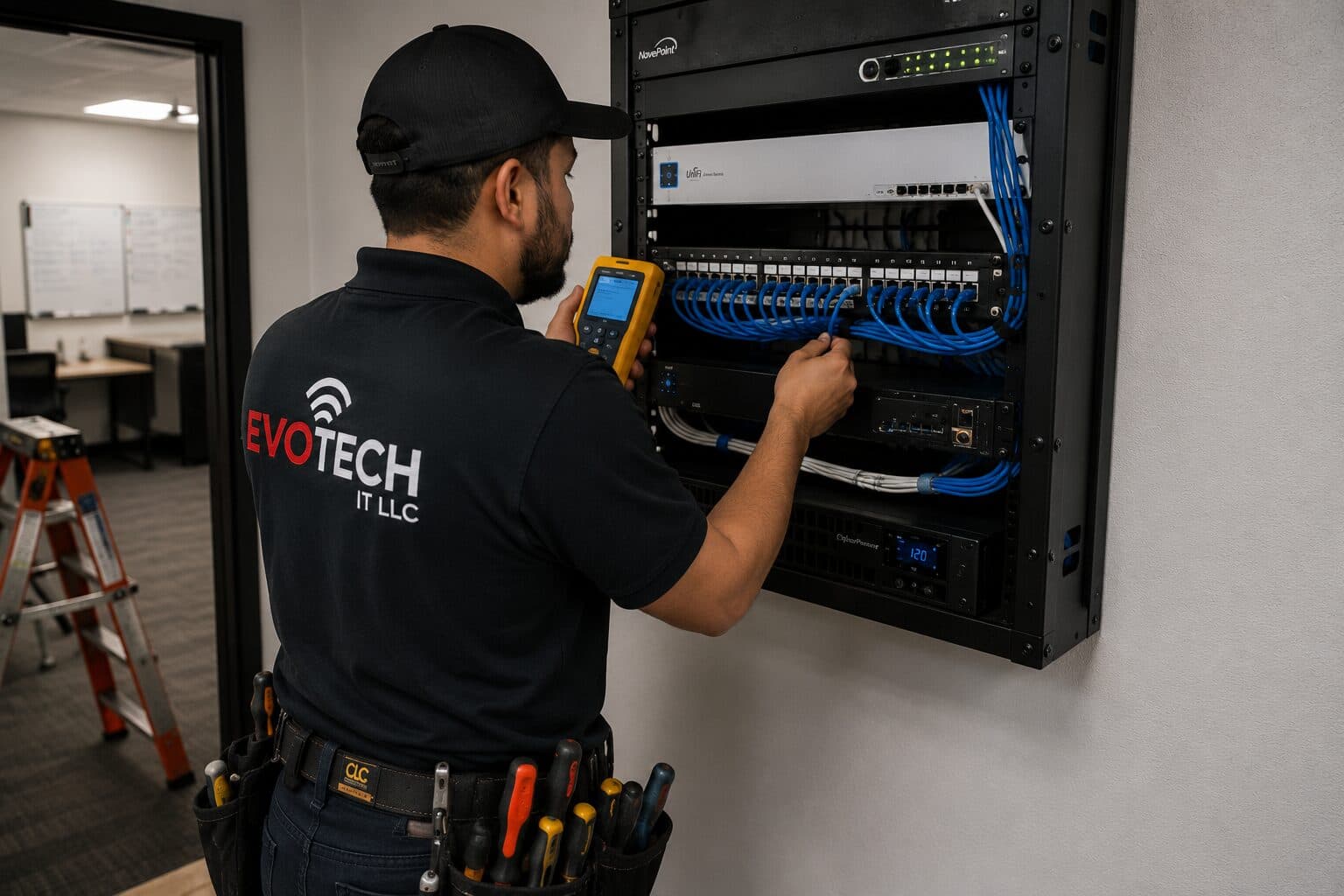
The baseline test is an insertion-loss measurement across the installed link, compared against the calculated budget for that distance and connector count. A link that passes with margin is a link that will tolerate a future re-patch.
A classroom with thirty students on devices is one of the densest wireless environments in any building type, and it happens simultaneously in every classroom on a bell schedule. That is a capacity problem of a specific shape: predictable, synchronised, and concentrated.
On site, the schedule and working method turn on conditions like these. Storefront glazing on retail units complicating daylight entrance camera placement. Residential areas following the regional slab-foundation and attic-routing pattern. Both shape how and when a crew can actually operate, which is why EVOTECH scopes each Spring job from the property itself rather than assuming one approach fits every address. Coverage is stated as a service area, never an office claim, and anything about Spring that cannot be verified is left out instead of invented.
Popular services nearby
Frequently searched near this area — the pages people look for most.
Frequently asked questions
Is fiber-optic cabling for schools and educational facilities different in Spring?
The sector needs stay the same, but the install changes with the place. In Spring, the conditions above — not the schools and educational facilities label — decide routes, mounting, and equipment placement, which is why this page pairs all three.
When is fiber necessary rather than optional?
Two situations make it necessary rather than a preference. First, distance: past the 100-metre copper channel limit there is no compliant copper answer. Second, links between separate buildings, where a copper conductor creates a path for surge and ground-potential differences. Inside those two cases fiber is not an upgrade — it is the correct method.