Fiber-optic cabling for schools and educational facilities, in Stafford
Fiber-optic cabling for schools and educational facilities in Stafford is a three-part question: what fiber-optic cabling involves, what schools and educational facilities need from it, and what Stafford changes about the install. Commercial base weighted toward warehouse, showroom, and light-industrial buildings rather than office space.
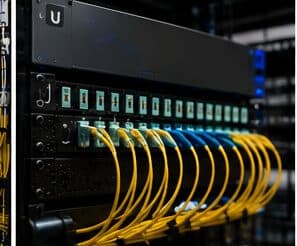
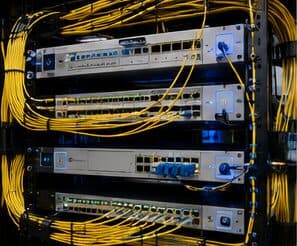
Fiber gets specified for reasons copper cannot address. The first is distance — multimode carries 10 gigabit a few hundred metres and single-mode carries it far further, while copper stops at 100 metres. The second is electrical isolation: a link between two separate buildings should not be a copper conductor, because the two structures can sit at different ground potentials and a lightning event has to go somewhere.
The academic calendar sets the schedule
Substantial infrastructure work happens during breaks. That concentrates a lot of activity into a short window and makes preparation disproportionately important — materials on site, pathways confirmed, and decisions made before the window opens, because there is no extending it.
Work during term time is possible but constrained: classroom access has to fit around teaching, and any work in occupied areas requires appropriate coordination with the school's own procedures for contractors on site.
- Major work concentrated into scheduled breaks
- Preparation completed before the window opens, since it cannot be extended
- Term-time work coordinated around teaching schedules
- Contractor procedures and site access governed by school policy
- Phased approaches common where budgets follow academic years
Where fiber-optic cabling goes wrong — and how it's avoided
Fiber punishes shortcuts more visibly than copper does.
- Mating connectors without inspecting and cleaning end faces
- Installing exactly the strand count needed with no spares
- Violating bend radius inside enclosures where slack is coiled
- Pulling on the fibers rather than the cable's strength member
- Running copper between separate buildings to save on fiber
- Leaving unused connectors uncapped in a dusty environment
Stafford: what the location changes
Commercial base weighted toward warehouse, showroom, and light-industrial buildings rather than office space. In Stafford, that is where the plan begins, because it changes cable paths, device placement, and access-point counts before anything else does. Metal building construction that reflects wireless signal and changes coverage behaviour compared with drywall interiors. Building footprints frequently exceeding the 100 m copper channel limit from a single equipment position. None of these are generic checklist items — each moves the design in a direction a citywide assumption would miss, and the honest recommendation always depends on what this particular property allows.
- Commercial base weighted toward warehouse, showroom, and light-industrial buildings rather than office space
- Metal building construction that reflects wireless signal and changes coverage behaviour compared with drywall interiors
- Building footprints frequently exceeding the 100 m copper channel limit from a single equipment position
- Largely unconditioned operational areas where equipment placement has to account for summer temperatures and dust
- Mixed occupancy within single buildings, with small conditioned office areas attached to large operational space
Getting it done in Stafford
The baseline test is an insertion-loss measurement across the installed link, compared against the calculated budget for that distance and connector count. A link that passes with margin is a link that will tolerate a future re-patch.
Two priorities dominate: enough wireless capacity in each classroom to serve a full class simultaneously, and controlled entry at the points where people come into the campus.
On site, the schedule and working method turn on conditions like these. Largely unconditioned operational areas where equipment placement has to account for summer temperatures and dust. Mixed occupancy within single buildings, with small conditioned office areas attached to large operational space. Both shape how and when a crew can actually operate, which is why EVOTECH scopes each Stafford job from the property itself rather than assuming one approach fits every address. Coverage is stated as a service area, never an office claim, and anything about Stafford that cannot be verified is left out instead of invented.
Popular services nearby
Frequently searched near this area — the pages people look for most.
Frequently asked questions
Is fiber-optic cabling for schools and educational facilities different in Stafford?
The sector needs stay the same, but the install changes with the place. In Stafford, the conditions above — not the schools and educational facilities label — decide routes, mounting, and equipment placement, which is why this page pairs all three.
When is fiber necessary rather than optional?
Two situations make it necessary rather than a preference. First, distance: past the 100-metre copper channel limit there is no compliant copper answer. Second, links between separate buildings, where a copper conductor creates a path for surge and ground-potential differences. Inside those two cases fiber is not an upgrade — it is the correct method.