Network cabling for schools and educational facilities, in Spring
Network cabling for schools and educational facilities in Spring is a three-part question: what network cabling involves, what schools and educational facilities need from it, and what Spring changes about the install. Retail and food-service commercial base where payment-system separation is a standing requirement.
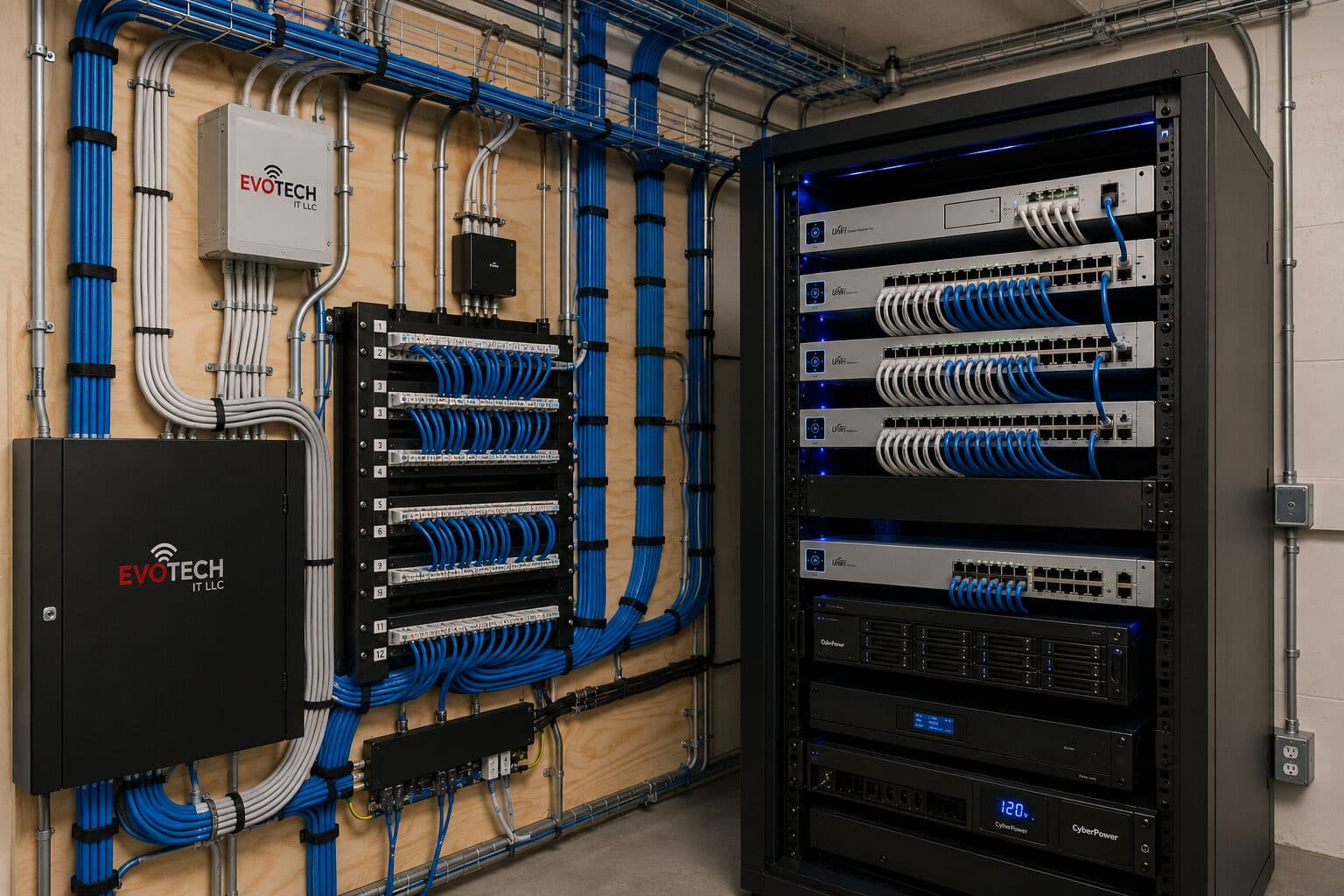
Network cabling is the permanent copper and fiber pathway between a building's equipment room and every device location. Done properly it is a structured system — horizontal runs from a patch panel out to labeled outlets, each one under the 90-metre permanent-link limit, each one tested and documented. Done casually it is a bundle of unlabeled patch cords stapled to a joist, and every future change costs someone an afternoon of tracing.
Entry control and perimeter coverage
Camera coverage on a school campus concentrates on entrances, circulation between buildings, parking and drop-off areas, and the perimeter. Corridors are common; classrooms are not, and that boundary is agreed at design.
Entry control is typically the higher priority. Controlled main entry with a visitor process, secondary doors that are secured but permit free egress, and records of who entered when address the requirement more directly than camera coverage does. Free egress on every controlled door is non-negotiable and is designed in from the start.
- Main and secondary entrances with controlled access and free egress
- Circulation routes between buildings
- Parking, drop-off, and perimeter coverage
- Corridor coverage where required; classrooms excluded
- Entry records available to administration
What drives the cost of network cabling here
Cabling scope is priced from conditions, not from a per-outlet number, which is why a walkthrough or a good set of photos changes an estimate more than any other input. The largest single driver is usually whether the pathway already exists.
- Total run count and average run length
- Whether existing tray, conduit, or sleeves can be reused
- Ceiling and wall construction, including hard-lid areas requiring cut and patch
- Category of cable specified and whether shielding is required
- Depth of testing and documentation requested
- Working hours: occupied space and after-hours windows extend the schedule
Spring: what the location changes
In Spring, the plan is built outward from the conditions that are actually here. Retail and food-service commercial base where payment-system separation is a standing requirement. Ceiling construction varying considerably between adjacent units, from open deck to hard lid to suspended grid. Restaurant kitchen environments requiring equipment placement away from heat, steam, and grease-laden air. Each one changes where cable can run, where equipment can sit, and how coverage is shaped, which is why a walkthrough settles a Spring scope faster than any generic estimate.
- Retail and food-service commercial base where payment-system separation is a standing requirement
- Ceiling construction varying considerably between adjacent units, from open deck to hard lid to suspended grid
- Restaurant kitchen environments requiring equipment placement away from heat, steam, and grease-laden air
- Storefront glazing on retail units complicating daylight entrance camera placement
- Residential areas following the regional slab-foundation and attic-routing pattern
Getting it done in Spring
Testing is what separates a cabling installation from a cable pull. A basic continuity or wire-map check confirms the pairs land in the right order; it says nothing about whether the link will carry its rated bandwidth. Certification testing against the relevant TIA channel or permanent-link limits measures insertion loss, return loss, near-end crosstalk, and delay skew, and produces a per-port record.
A classroom with thirty students on devices is one of the densest wireless environments in any building type, and it happens simultaneously in every classroom on a bell schedule. That is a capacity problem of a specific shape: predictable, synchronised, and concentrated.
Getting Spring work done means planning around the site as it actually is. Storefront glazing on retail units complicating daylight entrance camera placement. Residential areas following the regional slab-foundation and attic-routing pattern. Both matter as much as the design to how and when the work happens. The scope is drawn from the real property, the coverage is stated as a service area rather than an office, and unverifiable specifics about Spring are kept off the page on purpose.
Frequently asked questions
Is network cabling for schools and educational facilities different in Spring?
The sector needs stay the same, but the install changes with the place. In Spring, the conditions above — not the schools and educational facilities label — decide routes, mounting, and equipment placement, which is why this page pairs all three.
How long can a single network cable run be?
The fixed cable between patch panel and outlet is limited to 90 metres, with patch cords at each end bringing the total channel to 100 metres. Beyond that, the answer is not a longer cable — it is either an intermediate equipment location or a fiber link to a secondary switch.