Network cabling for schools and educational facilities, in Tomball
Network cabling for schools and educational facilities in Tomball is a three-part question: what network cabling involves, what schools and educational facilities need from it, and what Tomball changes about the install. A historic small-town core with masonry buildings and limited pathway.
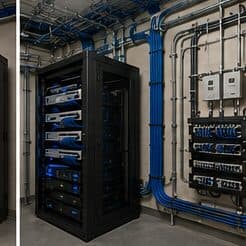
Network cabling is the permanent copper and fiber pathway between a building's equipment room and every device location. Done properly it is a structured system — horizontal runs from a patch panel out to labeled outlets, each one under the 90-metre permanent-link limit, each one tested and documented. Done casually it is a bundle of unlabeled patch cords stapled to a joist, and every future change costs someone an afternoon of tracing.
The academic calendar sets the schedule
Substantial infrastructure work happens during breaks. That concentrates a lot of activity into a short window and makes preparation disproportionately important — materials on site, pathways confirmed, and decisions made before the window opens, because there is no extending it.
Work during term time is possible but constrained: classroom access has to fit around teaching, and any work in occupied areas requires appropriate coordination with the school's own procedures for contractors on site.
- Major work concentrated into scheduled breaks
- Preparation completed before the window opens, since it cannot be extended
- Term-time work coordinated around teaching schedules
- Contractor procedures and site access governed by school policy
- Phased approaches common where budgets follow academic years
What changes network cabling from job to job
Two buildings with the same square footage can differ by a factor of three in cabling effort. What drives that spread is access, not area.
- Ceiling type: accessible grid versus hard lid, and whether the plenum is shared
- Building age and whether existing pathway can be reused
- Number of outlets and whether each location gets one, two, or more
- Rack or wall-cabinet location relative to the incoming service
- Fire-rated wall and floor penetrations requiring proper sleeving and firestop
- Occupied-space constraints: after-hours access, dust control, furniture protection
- Whether the design leaves spare capacity for the next expansion
Tomball: what the location changes
In Tomball, the plan is built outward from the conditions that are actually here. A historic small-town core with masonry buildings and limited pathway. Growing retail and medical buildouts with suspended-grid ceilings and tenant-improvement conditions. Larger properties and outbuildings toward the northern edge, bringing longer runs. Each one changes where cable can run, where equipment can sit, and how coverage is shaped, which is why a walkthrough settles a Tomball scope faster than any generic estimate.
- A historic small-town core with masonry buildings and limited pathway
- Growing retail and medical buildouts with suspended-grid ceilings and tenant-improvement conditions
- Larger properties and outbuildings toward the northern edge, bringing longer runs
- Slab-foundation residential across established and newer subdivisions
- Gulf Coast humidity requiring rated exterior housings and sealed penetrations
Getting it done in Tomball
Testing is what separates a cabling installation from a cable pull. A basic continuity or wire-map check confirms the pairs land in the right order; it says nothing about whether the link will carry its rated bandwidth. Certification testing against the relevant TIA channel or permanent-link limits measures insertion loss, return loss, near-end crosstalk, and delay skew, and produces a per-port record.
Two priorities dominate: enough wireless capacity in each classroom to serve a full class simultaneously, and controlled entry at the points where people come into the campus.
Getting Tomball work done means planning around the site as it actually is. Slab-foundation residential across established and newer subdivisions. Gulf Coast humidity requiring rated exterior housings and sealed penetrations. Both matter as much as the design to how and when the work happens. The scope is drawn from the real property, the coverage is stated as a service area rather than an office, and unverifiable specifics about Tomball are kept off the page on purpose.
Frequently asked questions
Is network cabling for schools and educational facilities different in Tomball?
The sector needs stay the same, but the install changes with the place. In Tomball, the conditions above — not the schools and educational facilities label — decide routes, mounting, and equipment placement, which is why this page pairs all three.
How long can a single network cable run be?
The fixed cable between patch panel and outlet is limited to 90 metres, with patch cords at each end bringing the total channel to 100 metres. Beyond that, the answer is not a longer cable — it is either an intermediate equipment location or a fiber link to a secondary switch.