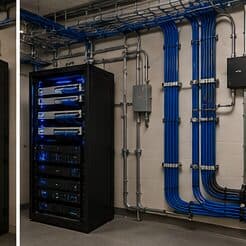
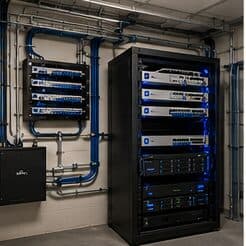
Conference-room AV for retail stores, in Tomball
Conference-room AV for retail stores in Tomball is a three-part question: what conference-room av involves, what retail stores need from it, and what Tomball changes about the install. A historic small-town core with masonry buildings and limited pathway.
The complaint that ends meetings early is almost always audio. Remote participants tolerate a mediocre picture indefinitely and abandon a call with poor sound within minutes. So microphone coverage — enough pickup for everyone in the room, positioned for the actual seating, in a room whose acoustics do not fight it — is the first design decision, ahead of the display.
The floor plan is not permanent
Retail interiors get reset. Fixtures move, register positions shift for seasonal layouts, and a stockroom gets reorganised around whatever the current inventory demands. A network installed as if the layout were fixed becomes an obstacle within a couple of resets.
That argues for a specific design posture: more outlets than currently needed at likely fixture positions, ceiling access points placed to cover zones rather than aimed at current register locations, and a rack with spare capacity because the device count only ever goes up.
- Fixture and register positions change with seasonal resets
- Stockroom and receiving areas need connectivity that survives reorganisation
- Customer-facing technology increases the device count over time
- Coverage has to work with shelving in place, not in an empty store
Where conference-room av goes wrong — and how it's avoided
Meeting rooms fail in ways that are obvious in hindsight.
- Buying a larger display before solving the audio
- Fitting one microphone to a room seating twelve
- Mounting the camera above the display so the room is viewed from above
- Ignoring a glass-walled room's acoustics
- Leaving joining complex enough that meetings start late
- Running cables across the table because connectivity was not designed in
Tomball: what the location changes
In Tomball, the plan is built outward from the conditions that are actually here. A historic small-town core with masonry buildings and limited pathway. Growing retail and medical buildouts with suspended-grid ceilings and tenant-improvement conditions. Larger properties and outbuildings toward the northern edge, bringing longer runs. Each one changes where cable can run, where equipment can sit, and how coverage is shaped, which is why a walkthrough settles a Tomball scope faster than any generic estimate.
- A historic small-town core with masonry buildings and limited pathway
- Growing retail and medical buildouts with suspended-grid ceilings and tenant-improvement conditions
- Larger properties and outbuildings toward the northern edge, bringing longer runs
- Slab-foundation residential across established and newer subdivisions
- Gulf Coast humidity requiring rated exterior housings and sealed penetrations
Getting it done in Tomball
Rooms are commissioned from the far end, because that is where the problems are audible.
Payment systems sit on their own segment for the same reasons they do in food service. What differs in retail is the number of mobile devices: handheld scanners, mobile checkout tablets, and inventory devices that move continuously across the floor and depend on clean roaming between access points.
On site, the schedule and working method turn on conditions like these. Slab-foundation residential across established and newer subdivisions. Gulf Coast humidity requiring rated exterior housings and sealed penetrations. Both shape how and when a crew can actually operate, which is why EVOTECH scopes each Tomball job from the property itself rather than assuming one approach fits every address. Coverage is stated as a service area, never an office claim, and anything about Tomball that cannot be verified is left out instead of invented.
Popular services nearby
Frequently searched near this area — the pages people look for most.
Frequently asked questions
Is conference-room av for retail stores different in Tomball?
The sector needs stay the same, but the install changes with the place. In Tomball, the conditions above — not the retail stores label — decide routes, mounting, and equipment placement, which is why this page pairs all three.
Why do remote participants say the room sounds echoey?
Reflections. Glass, hard tables, and bare walls send sound back into the microphone alongside the speech, and the far end hears the room. Adding some soft surface — panels, carpet, fabric furnishings — usually improves intelligibility more than changing microphones, because it addresses the cause rather than compensating for it.