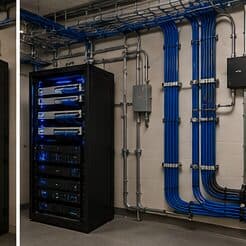
Cat6 cabling for professional offices, in Katy
Cat6 cabling for professional offices in Katy is a three-part question: what cat6 cabling involves, what professional offices need from it, and what Katy changes about the install. Housing stock skewed toward newer, larger single-family construction with wide floor plans that exceed single-router coverage.
Cat6 carries gigabit Ethernet across the full 100-metre channel without drama, and that covers the overwhelming majority of what plugs into an office or home wall plate: computers, phones, printers, access points, cameras, and door controllers. Where it gets interesting is 10 gigabit. Cat6 can carry 10GBASE-T, but only to roughly 55 metres, and that figure assumes a favourable alien-crosstalk environment — cables not bundled tightly with many neighbours carrying the same signal.
Meeting rooms first
In an office, the technology most people judge is the meeting room, and the two things they judge it on are whether the far end can hear them and whether the meeting started on time. Both are solvable, and both are more about microphone coverage and simple control than about display specification.
After that: wireless capacity in the areas where people gather, enough desk outlets to survive a layout change, and an equipment room that someone can actually work in.
- Meeting-room audio coverage matched to the seating, not to the room's floor area
- One obvious action that starts a meeting
- Wireless capacity concentrated where people gather
- Two outlets at each desk position rather than one
- Equipment room with ventilation, power, and working clearance
What drives the cost of cat6 cabling here
Cable is a small share of an installed run. The spread between a cheap and an expensive Cat6 project comes from access and count, with component quality a distant third.
- Number of runs and their average length
- Ceiling and wall construction along the pathway
- Whether Cat6A is specified for some or all runs
- Shielded versus unshielded construction and the extra termination time shielding adds
- Certification depth and documentation format
Katy: what the location changes
Housing stock skewed toward newer, larger single-family construction with wide floor plans that exceed single-router coverage. In Katy, that is where the plan begins, because it changes cable paths, device placement, and access-point counts before anything else does. Structured media panels commonly present but frequently located in a garage or perimeter utility space rather than centrally. Builder-installed cable often terminated to a panel but not extended to ceiling positions suitable for access points. None of these are generic checklist items — each moves the design in a direction a citywide assumption would miss, and the honest recommendation always depends on what this particular property allows.
- Housing stock skewed toward newer, larger single-family construction with wide floor plans that exceed single-router coverage
- Structured media panels commonly present but frequently located in a garage or perimeter utility space rather than centrally
- Builder-installed cable often terminated to a panel but not extended to ceiling positions suitable for access points
- Slab foundations with accessible attics, making attic-to-interior-wall routing the standard retrofit path
- Suburban commercial development in retail pads and medical suites with suspended-grid ceilings and comparatively straightforward pathway
Getting it done in Katy
Certification for a Cat6 link measures the parameters that define the category: insertion loss, near-end and far-end crosstalk, return loss, and propagation delay skew across the frequency range up to 250 MHz. A pass means the link meets the standard's limits with margin recorded.
Office camera requirements are usually limited: the main entrance, the suite door, any rear or service entrance, and sometimes the server or equipment room. Interior open-plan coverage is less common and is worth questioning when requested, since it changes the character of the workplace for limited benefit.
On site, the schedule and working method turn on conditions like these. Slab foundations with accessible attics, making attic-to-interior-wall routing the standard retrofit path. Suburban commercial development in retail pads and medical suites with suspended-grid ceilings and comparatively straightforward pathway. Both shape how and when a crew can actually operate, which is why EVOTECH scopes each Katy job from the property itself rather than assuming one approach fits every address. Coverage is stated as a service area, never an office claim, and anything about Katy that cannot be verified is left out instead of invented.
Frequently asked questions
Is cat6 cabling for professional offices different in Katy?
The sector needs stay the same, but the install changes with the place. In Katy, the conditions above — not the professional offices label — decide routes, mounting, and equipment placement, which is why this page pairs all three.
Is Cat6 enough, or should everything be Cat6A?
For most device locations Cat6 is enough, because most devices need gigabit and will for a long time. Cat6A earns its place on runs that must carry 10G at distance, runs sitting in dense bundles, and uplinks between equipment positions. Specifying Cat6A for the whole building is rarely wrong technically, but it costs pathway space and termination time that a mixed design keeps.