Home theater installation for new construction, in Tomball
Home theater installation for new construction in Tomball is a three-part question: what home theater installation involves, what new construction need from it, and what Tomball changes about the install. A historic small-town core with masonry buildings and limited pathway.
Good surround sound comes from placing speakers correctly relative to where people sit, not from buying larger ones. A surround layout — front left, centre, and right across the screen; surrounds to the sides and slightly behind; a subwoofer positioned for even bass; and height or ceiling speakers for object-based formats — only works when each speaker sits where the format expects it relative to the primary seat. A theater with excellent equipment in the wrong positions sounds worse than modest equipment placed well.
One window, and it does not reopen
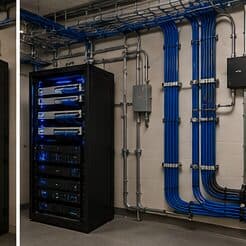
Low-voltage rough-in happens in a specific slot: after framing and electrical, before insulation and drywall. Inside that window, running a cable anywhere is straightforward. Once drywall goes up, the same cable costs many times more and sometimes cannot be run at all.
The asymmetry is the whole story of new-construction low voltage. Decisions made cheaply during rough-in become expensive or impossible afterwards, which is why the pre-rough-in planning conversation is worth more than any equipment choice made later.
- Rough-in window sits between electrical and drywall
- Upstream delays compress the window without extending the deadline
- Post-drywall changes cost many times more, if they are possible at all
- Finish work happens months later, after paint and ceilings
What changes home theater installation from job to job
Scope depends on the room type and the format, more than on the component budget.
- Living room versus dedicated media room
- Surround format and therefore the speaker count and height layout
- In-wall/in-ceiling speakers versus freestanding
- Room acoustics and any treatment required
- Cable routing difficulty and whether it is pre- or post-construction
- Equipment position, ventilation, and control system
- Display or projector and screen, where included
Tomball: what the location changes
In Tomball, the plan is built outward from the conditions that are actually here. A historic small-town core with masonry buildings and limited pathway. Growing retail and medical buildouts with suspended-grid ceilings and tenant-improvement conditions. Larger properties and outbuildings toward the northern edge, bringing longer runs. Each one changes where cable can run, where equipment can sit, and how coverage is shaped, which is why a walkthrough settles a Tomball scope faster than any generic estimate.
- A historic small-town core with masonry buildings and limited pathway
- Growing retail and medical buildouts with suspended-grid ceilings and tenant-improvement conditions
- Larger properties and outbuildings toward the northern edge, bringing longer runs
- Slab-foundation residential across established and newer subdivisions
- Gulf Coast humidity requiring rated exterior housings and sealed penetrations
Getting it done in Tomball
A theater is commissioned by listening from the seats, with measurement to back up placement.
Full system design is often not finished when the rough-in window arrives. That is normal, and it is not a reason to skip the pathway. Running conduit or sleeves to likely positions preserves the option cheaply even when the eventual equipment is undecided.
On site, the schedule and working method turn on conditions like these. Slab-foundation residential across established and newer subdivisions. Gulf Coast humidity requiring rated exterior housings and sealed penetrations. Both shape how and when a crew can actually operate, which is why EVOTECH scopes each Tomball job from the property itself rather than assuming one approach fits every address. Coverage is stated as a service area, never an office claim, and anything about Tomball that cannot be verified is left out instead of invented.
Popular services nearby
Frequently searched near this area — the pages people look for most.
Frequently asked questions
Is home theater installation for new construction different in Tomball?
The sector needs stay the same, but the install changes with the place. In Tomball, the conditions above — not the new construction label — decide routes, mounting, and equipment placement, which is why this page pairs all three.
Why is dialogue hard to hear but explosions too loud?
Usually the centre channel and the room. Dialogue lives in the centre speaker, and if it is poorly placed or the room smears it through reflection, speech gets buried while wide effects stay loud. Correcting centre placement, setting levels relative to the seat, and adding some absorption fixes far more of this than adjusting the volume ever will.