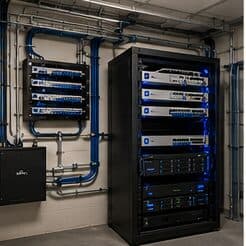
In-wall cable concealment for new construction, in Sugar Land
In-wall cable concealment for new construction in Sugar Land is a three-part question: what in-wall cable concealment involves, what new construction need from it, and what Sugar Land changes about the install. Commercial base weighted toward professional offices and medical suites rather than industrial space.
Concealing the cables behind a wall-mounted TV or AV setup is what turns it from a device with wires hanging down into something that looks built-in. The signal cables — HDMI, network, speaker — can be routed inside the wall to a recessed box behind the display, but power is different: a standard power cord must never be run inside a wall. Power is handled with a recessed outlet behind the display or an in-wall rated power solution, which keeps the installation safe and to code.
Positions to prewire even if cameras come later
Camera positions are among the cheapest things to prewire and among the most annoying to retrofit, because they are usually exterior, high, and behind finished soffit. Running cable to likely positions during rough-in preserves the option at almost no cost.
The positions worth prewiring in nearly every building: primary entrance, rear or service entrance, any delivery or receiving point, parking approaches, and the equipment room itself. In residential construction, add the front door for a doorbell and the driveway approach.
- Primary and secondary entrance positions
- Delivery, receiving, and service door approaches
- Parking and vehicle approach positions
- Doorbell position in residential builds
- Cable terminated and labeled even where no camera is installed yet
Where in-wall cable concealment goes wrong — and how it's avoided
Concealment goes wrong on power and on the wall's contents.
- Running a standard power cord inside the wall
- Forcing a fish tape past fire blocking and damaging the finish or wall
- Not planning patch-and-paint before cutting access
- Leaving no service loop for future work
- Assuming a clean path exists without checking the construction
- Compromising the wall's fire integrity to hide a cable
Sugar Land: what the location changes
In Sugar Land, the plan is built outward from the conditions that are actually here. Commercial base weighted toward professional offices and medical suites rather than industrial space. Multi-tenant buildings where base-building rules govern riser access, core penetrations, and after-hours work. Suspended-grid ceilings common in office suites, with hard-lid areas in reception and clinical spaces. Each one changes where cable can run, where equipment can sit, and how coverage is shaped, which is why a walkthrough settles a Sugar Land scope faster than any generic estimate.
- Commercial base weighted toward professional offices and medical suites rather than industrial space
- Multi-tenant buildings where base-building rules govern riser access, core penetrations, and after-hours work
- Suspended-grid ceilings common in office suites, with hard-lid areas in reception and clinical spaces
- Retail centres with storefront glazing that complicates entrance camera placement due to daylight backlighting
- Master-planned commercial development producing comparatively consistent, newer construction
Getting it done in Sugar Land
Concealment is judged by a clean result and a safe, code-compliant power path.
Low-voltage rough-in happens in a specific slot: after framing and electrical, before insulation and drywall. Inside that window, running a cable anywhere is straightforward. Once drywall goes up, the same cable costs many times more and sometimes cannot be run at all.
Getting Sugar Land work done means planning around the site as it actually is. Retail centres with storefront glazing that complicates entrance camera placement due to daylight backlighting. Master-planned commercial development producing comparatively consistent, newer construction. Both matter as much as the design to how and when the work happens. The scope is drawn from the real property, the coverage is stated as a service area rather than an office, and unverifiable specifics about Sugar Land are kept off the page on purpose.
Frequently asked questions
Is in-wall cable concealment for new construction different in Sugar Land?
The sector needs stay the same, but the install changes with the place. In Sugar Land, the conditions above — not the new construction label — decide routes, mounting, and equipment placement, which is why this page pairs all three.
Can the power cord be hidden in the wall too?
Not the standard cord — running one inside a wall is against code and a genuine hazard. Power is concealed correctly with a recessed outlet behind the display or a rated in-wall power-relocation kit, which puts the outlet where the TV needs it without burying a cord. The signal cables can go in the wall; power is handled the right way.