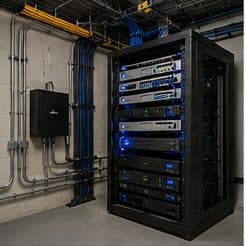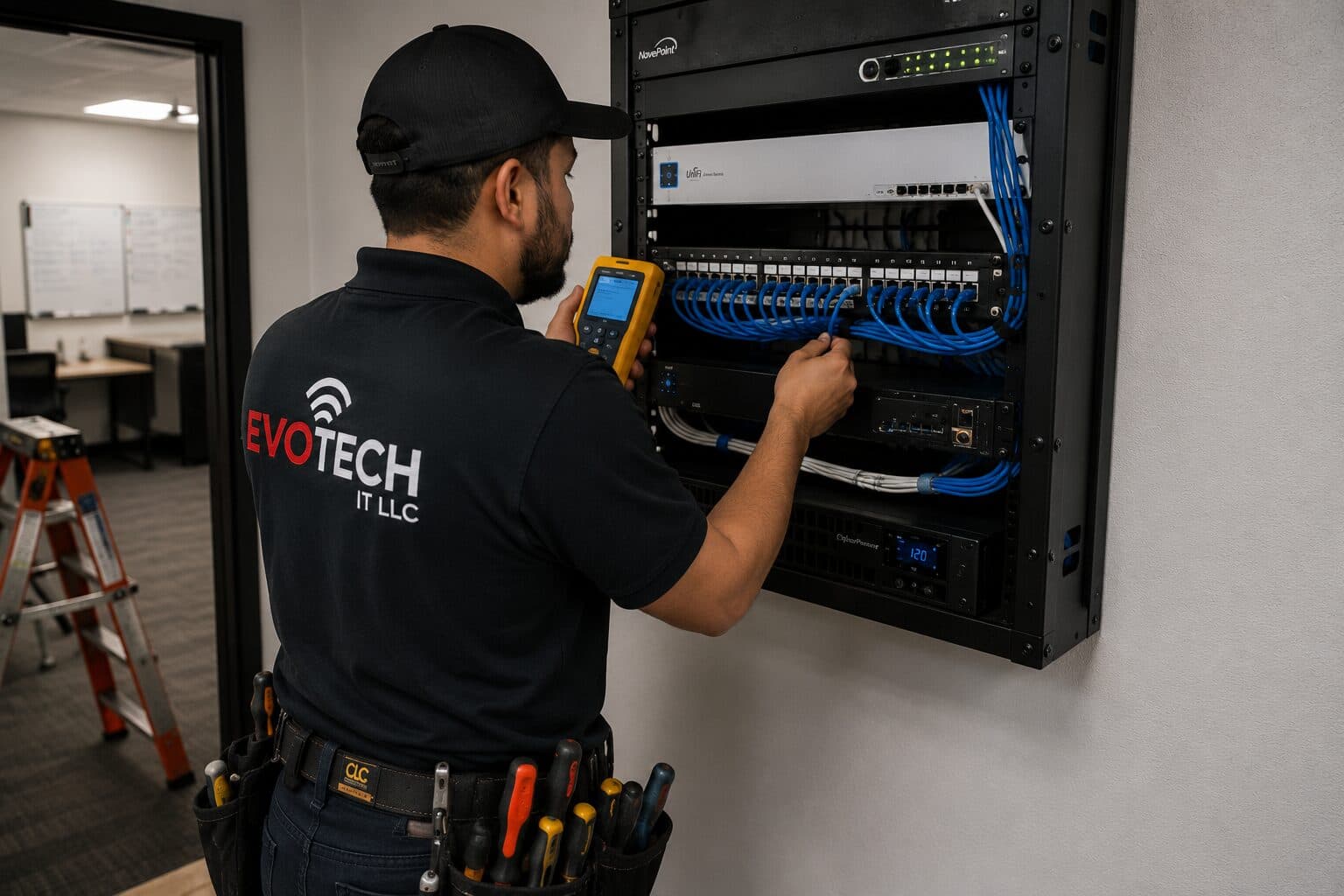
Fiber-optic cabling for new construction, in Sugar Land
Fiber-optic cabling for new construction in Sugar Land is a three-part question: what fiber-optic cabling involves, what new construction need from it, and what Sugar Land changes about the install. Commercial base weighted toward professional offices and medical suites rather than industrial space.
Fiber gets specified for reasons copper cannot address. The first is distance — multimode carries 10 gigabit a few hundred metres and single-mode carries it far further, while copper stops at 100 metres. The second is electrical isolation: a link between two separate buildings should not be a copper conductor, because the two structures can sit at different ground potentials and a lightning event has to go somewhere.
Positions to prewire even if cameras come later
Camera positions are among the cheapest things to prewire and among the most annoying to retrofit, because they are usually exterior, high, and behind finished soffit. Running cable to likely positions during rough-in preserves the option at almost no cost.
The positions worth prewiring in nearly every building: primary entrance, rear or service entrance, any delivery or receiving point, parking approaches, and the equipment room itself. In residential construction, add the front door for a doorbell and the driveway approach.
- Primary and secondary entrance positions
- Delivery, receiving, and service door approaches
- Parking and vehicle approach positions
- Doorbell position in residential builds
- Cable terminated and labeled even where no camera is installed yet
Where fiber-optic cabling goes wrong — and how it's avoided
Fiber punishes shortcuts more visibly than copper does.
- Mating connectors without inspecting and cleaning end faces
- Installing exactly the strand count needed with no spares
- Violating bend radius inside enclosures where slack is coiled
- Pulling on the fibers rather than the cable's strength member
- Running copper between separate buildings to save on fiber
- Leaving unused connectors uncapped in a dusty environment
Sugar Land: what the location changes
In Sugar Land, the plan is built outward from the conditions that are actually here. Commercial base weighted toward professional offices and medical suites rather than industrial space. Multi-tenant buildings where base-building rules govern riser access, core penetrations, and after-hours work. Suspended-grid ceilings common in office suites, with hard-lid areas in reception and clinical spaces. Each one changes where cable can run, where equipment can sit, and how coverage is shaped, which is why a walkthrough settles a Sugar Land scope faster than any generic estimate.
- Commercial base weighted toward professional offices and medical suites rather than industrial space
- Multi-tenant buildings where base-building rules govern riser access, core penetrations, and after-hours work
- Suspended-grid ceilings common in office suites, with hard-lid areas in reception and clinical spaces
- Retail centres with storefront glazing that complicates entrance camera placement due to daylight backlighting
- Master-planned commercial development producing comparatively consistent, newer construction
Getting it done in Sugar Land
The baseline test is an insertion-loss measurement across the installed link, compared against the calculated budget for that distance and connector count. A link that passes with margin is a link that will tolerate a future re-patch.
Low-voltage rough-in happens in a specific slot: after framing and electrical, before insulation and drywall. Inside that window, running a cable anywhere is straightforward. Once drywall goes up, the same cable costs many times more and sometimes cannot be run at all.
Getting Sugar Land work done means planning around the site as it actually is. Retail centres with storefront glazing that complicates entrance camera placement due to daylight backlighting. Master-planned commercial development producing comparatively consistent, newer construction. Both matter as much as the design to how and when the work happens. The scope is drawn from the real property, the coverage is stated as a service area rather than an office, and unverifiable specifics about Sugar Land are kept off the page on purpose.
Popular services nearby
Frequently searched near this area — the pages people look for most.
Frequently asked questions
Is fiber-optic cabling for new construction different in Sugar Land?
The sector needs stay the same, but the install changes with the place. In Sugar Land, the conditions above — not the new construction label — decide routes, mounting, and equipment placement, which is why this page pairs all three.
When is fiber necessary rather than optional?
Two situations make it necessary rather than a preference. First, distance: past the 100-metre copper channel limit there is no compliant copper answer. Second, links between separate buildings, where a copper conductor creates a path for surge and ground-potential differences. Inside those two cases fiber is not an upgrade — it is the correct method.