Network troubleshooting for new construction, in Sugar Land
Network troubleshooting for new construction in Sugar Land is a three-part question: what network troubleshooting involves, what new construction need from it, and what Sugar Land changes about the install. Commercial base weighted toward professional offices and medical suites rather than industrial space.
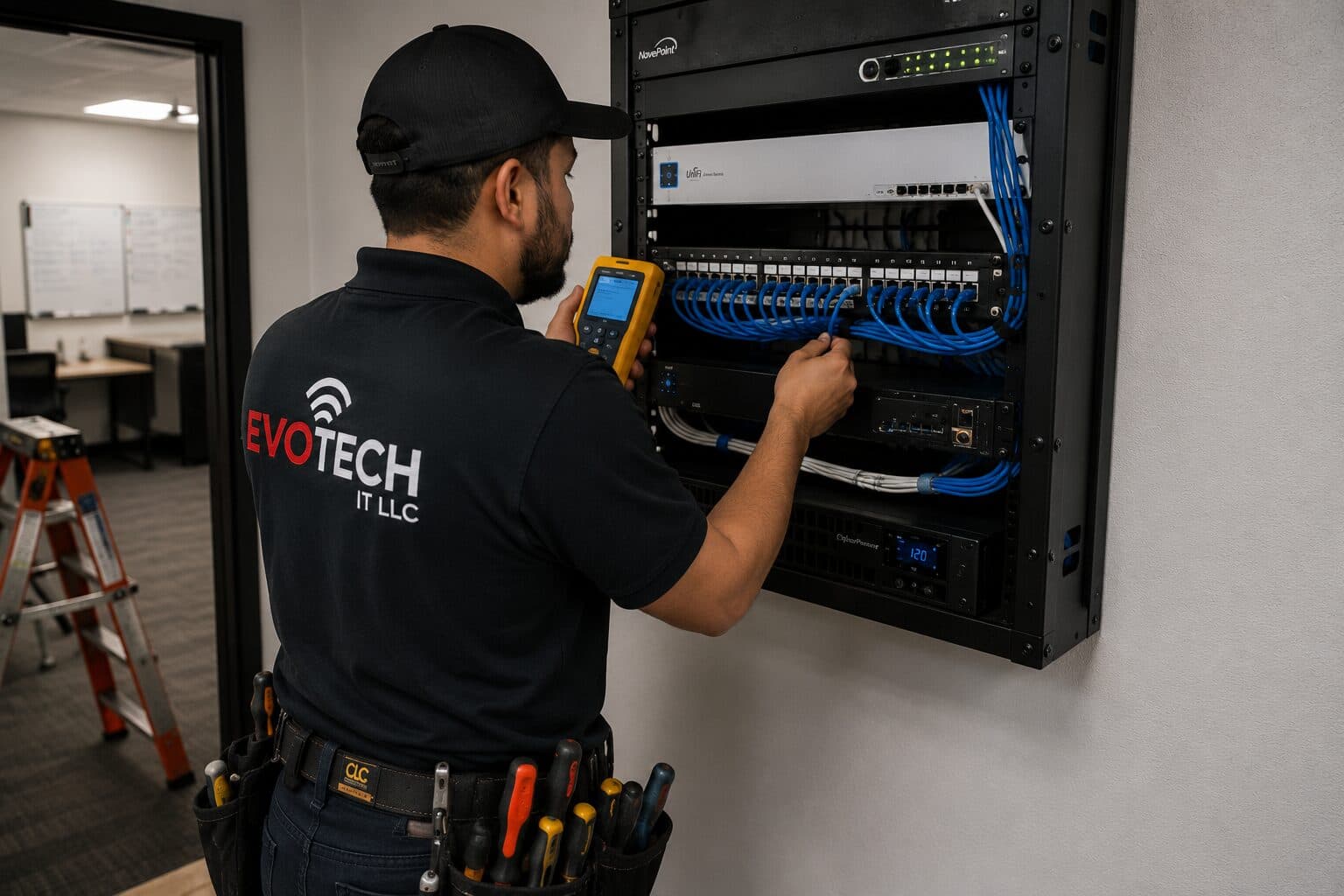
Effective troubleshooting is a process of elimination against a specific, reproducible symptom. 'The internet is slow' is not yet a diagnosis — slow for whom, on which devices, wired or wireless, at what times, to which destinations. Those answers usually point at a layer before any equipment is touched.
Positions to prewire even if cameras come later
Camera positions are among the cheapest things to prewire and among the most annoying to retrofit, because they are usually exterior, high, and behind finished soffit. Running cable to likely positions during rough-in preserves the option at almost no cost.
The positions worth prewiring in nearly every building: primary entrance, rear or service entrance, any delivery or receiving point, parking approaches, and the equipment room itself. In residential construction, add the front door for a doorbell and the driveway approach.
- Primary and secondary entrance positions
- Delivery, receiving, and service door approaches
- Parking and vehicle approach positions
- Doorbell position in residential builds
- Cable terminated and labeled even where no camera is installed yet
Where network troubleshooting goes wrong — and how it's avoided
Troubleshooting goes wrong mainly by skipping the narrowing step.
- Replacing the router first because it is the most visible device
- Changing several things at once, so the actual cause stays unknown
- Accepting 'the internet is slow' without narrowing scope and timing
- Ignoring switch error counters that already identify the faulty port
- Blaming wireless for a saturated circuit or an oversubscribed uplink
- Fixing the symptom without documenting the cause, so it recurs unrecognised
Sugar Land: what the location changes
Commercial base weighted toward professional offices and medical suites rather than industrial space. In Sugar Land, that is where the plan begins, because it changes cable paths, device placement, and access-point counts before anything else does. Multi-tenant buildings where base-building rules govern riser access, core penetrations, and after-hours work. Suspended-grid ceilings common in office suites, with hard-lid areas in reception and clinical spaces. None of these are generic checklist items — each moves the design in a direction a citywide assumption would miss, and the honest recommendation always depends on what this particular property allows.
- Commercial base weighted toward professional offices and medical suites rather than industrial space
- Multi-tenant buildings where base-building rules govern riser access, core penetrations, and after-hours work
- Suspended-grid ceilings common in office suites, with hard-lid areas in reception and clinical spaces
- Retail centres with storefront glazing that complicates entrance camera placement due to daylight backlighting
- Master-planned commercial development producing comparatively consistent, newer construction
Getting it done in Sugar Land
The test that matters is the one that reproduces the original complaint, run again after the change.
Low-voltage rough-in happens in a specific slot: after framing and electrical, before insulation and drywall. Inside that window, running a cable anywhere is straightforward. Once drywall goes up, the same cable costs many times more and sometimes cannot be run at all.
On site, the schedule and working method turn on conditions like these. Retail centres with storefront glazing that complicates entrance camera placement due to daylight backlighting. Master-planned commercial development producing comparatively consistent, newer construction. Both shape how and when a crew can actually operate, which is why EVOTECH scopes each Sugar Land job from the property itself rather than assuming one approach fits every address. Coverage is stated as a service area, never an office claim, and anything about Sugar Land that cannot be verified is left out instead of invented.
Frequently asked questions
Is network troubleshooting for new construction different in Sugar Land?
The sector needs stay the same, but the install changes with the place. In Sugar Land, the conditions above — not the new construction label — decide routes, mounting, and equipment placement, which is why this page pairs all three.
Why is the network slow only in the afternoon?
Time-correlated symptoms usually mean capacity rather than a fault. Something is consuming the shared resource at that time — backups, updates, more people on site, or a scheduled process. Measuring at the gateway during the slow period, and comparing it to a quiet period, distinguishes a saturated circuit from an internal bottleneck quickly.