Commercial IT solutions for new construction, in Sugar Land
Commercial IT solutions for new construction in Sugar Land is a three-part question: what commercial it solutions involves, what new construction need from it, and what Sugar Land changes about the install. Commercial base weighted toward professional offices and medical suites rather than industrial space.
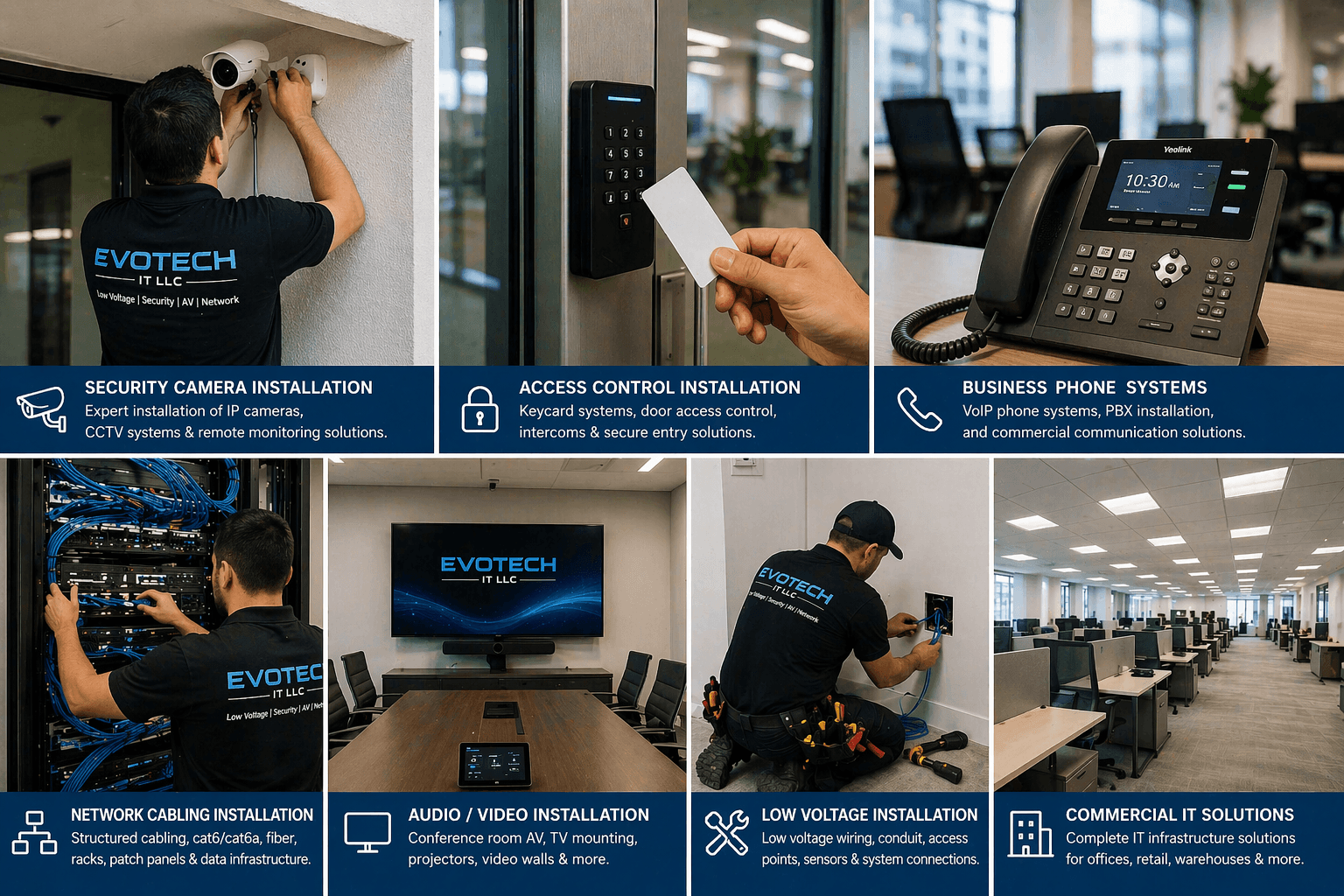
A business does not need a network, then some cameras, then a phone system, then Wi-Fi, each chosen by a different vendor at a different time. It needs those systems designed to work together on shared infrastructure, sized for how the business will grow, and delivered so one party is accountable for the whole thing working. That is what commercial IT solutions means here: the full low-voltage and network stack — structured cabling, managed switching and Wi-Fi, cameras, access control, and phones — planned as a single system rather than assembled from disconnected projects.
Positions to prewire even if cameras come later
Camera positions are among the cheapest things to prewire and among the most annoying to retrofit, because they are usually exterior, high, and behind finished soffit. Running cable to likely positions during rough-in preserves the option at almost no cost.
The positions worth prewiring in nearly every building: primary entrance, rear or service entrance, any delivery or receiving point, parking approaches, and the equipment room itself. In residential construction, add the front door for a doorbell and the driveway approach.
- Primary and secondary entrance positions
- Delivery, receiving, and service door approaches
- Parking and vehicle approach positions
- Doorbell position in residential builds
- Cable terminated and labeled even where no camera is installed yet
Where commercial it solutions goes wrong — and how it's avoided
Commercial technology fails on coordination far more than on components.
- Buying each system separately and inheriting a flat, fragile network
- Cabling for one system at a time rather than a shared backbone
- Sizing infrastructure to today and rebuilding at the next hire
- No accountable party, leaving the business to integrate its own vendors
- Relocating without a coordinated cutover and losing days
- Building each site differently, so support never gets consistent
Sugar Land: what the location changes
Commercial base weighted toward professional offices and medical suites rather than industrial space. In Sugar Land, that is where the plan begins, because it changes cable paths, device placement, and access-point counts before anything else does. Multi-tenant buildings where base-building rules govern riser access, core penetrations, and after-hours work. Suspended-grid ceilings common in office suites, with hard-lid areas in reception and clinical spaces. None of these are generic checklist items — each moves the design in a direction a citywide assumption would miss, and the honest recommendation always depends on what this particular property allows.
- Commercial base weighted toward professional offices and medical suites rather than industrial space
- Multi-tenant buildings where base-building rules govern riser access, core penetrations, and after-hours work
- Suspended-grid ceilings common in office suites, with hard-lid areas in reception and clinical spaces
- Retail centres with storefront glazing that complicates entrance camera placement due to daylight backlighting
- Master-planned commercial development producing comparatively consistent, newer construction
Getting it done in Sugar Land
A coordinated system is verified as a whole, not one component at a time.
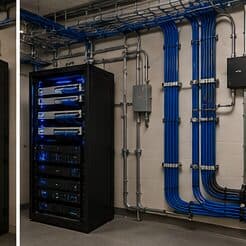
Low-voltage rough-in happens in a specific slot: after framing and electrical, before insulation and drywall. Inside that window, running a cable anywhere is straightforward. Once drywall goes up, the same cable costs many times more and sometimes cannot be run at all.
On site, the schedule and working method turn on conditions like these. Retail centres with storefront glazing that complicates entrance camera placement due to daylight backlighting. Master-planned commercial development producing comparatively consistent, newer construction. Both shape how and when a crew can actually operate, which is why EVOTECH scopes each Sugar Land job from the property itself rather than assuming one approach fits every address. Coverage is stated as a service area, never an office claim, and anything about Sugar Land that cannot be verified is left out instead of invented.
Frequently asked questions
Is commercial it solutions for new construction different in Sugar Land?
The sector needs stay the same, but the install changes with the place. In Sugar Land, the conditions above — not the new construction label — decide routes, mounting, and equipment placement, which is why this page pairs all three.
How is this different from just hiring separate installers?
Coordination and accountability. Separate installers each optimise their own system, which is how a business ends up with everything on one flat network, cabling that suits nobody, and no one able to say why something does not work. A coordinated design puts every system on shared, segmented infrastructure and gives you one party accountable for the whole thing working — which is usually cheaper over the life of the fit-out, not just simpler.