Why this page exists
Security-camera installation for new construction is shaped by how the space is used, not just by the service itself. New construction bring their own operating constraints, and this page pairs what security-camera installation actually involves with what that environment changes about it.
The useful design question is not how many cameras a property needs. It is what each camera has to accomplish. Detecting that a person is present, recognising someone you already know, and identifying a stranger from footage are three different requirements, and they need increasing pixel density on the subject. Planning guidance commonly cited from industry standards puts detection in the region of ten pixels per foot of subject, recognition around forty, and identification around eighty.
One window, and it does not reopen
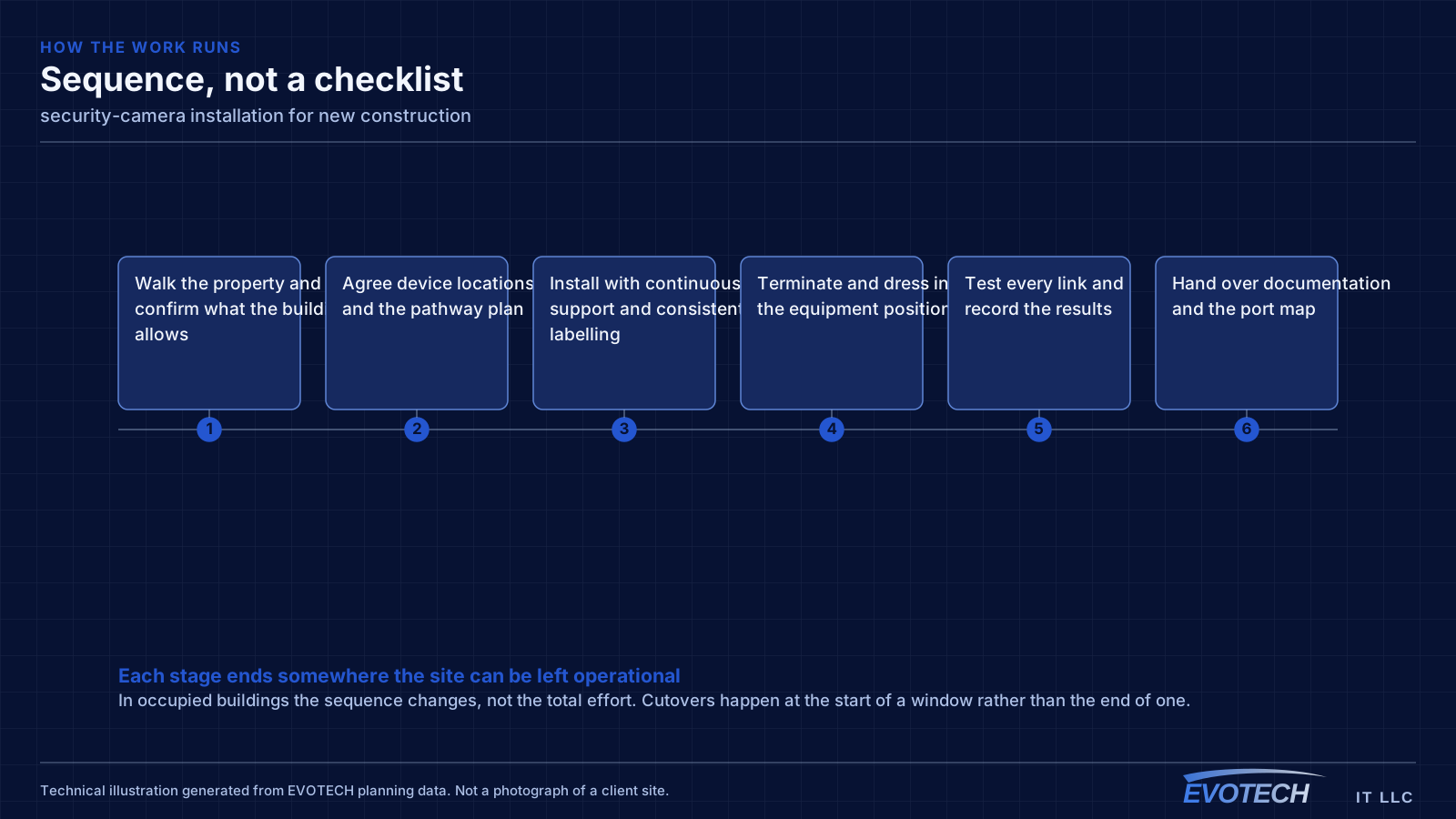
Low-voltage rough-in happens in a specific slot: after framing and electrical, before insulation and drywall. Inside that window, running a cable anywhere is straightforward. Once drywall goes up, the same cable costs many times more and sometimes cannot be run at all.
The asymmetry is the whole story of new-construction low voltage. Decisions made cheaply during rough-in become expensive or impossible afterwards, which is why the pre-rough-in planning conversation is worth more than any equipment choice made later.
- Rough-in window sits between electrical and drywall
- Upstream delays compress the window without extending the deadline
- Post-drywall changes cost many times more, if they are possible at all
- Finish work happens months later, after paint and ceilings
What security-camera installation usually involves
The dominant complaint about existing systems is footage that shows an event happened without showing anything useful about it. That is a design outcome: the camera was too far away, the lens too wide, or the scene lit so that the subject appears as a silhouette.
Backlighting is the specific and very common version of this. A camera pointed at a glass entrance during daylight sees a bright background and a dark figure. Wide dynamic range helps, but positioning that avoids shooting directly into the light source helps more.
- Wide-angle coverage that produces recognisable scenes but unidentifiable people
- Cameras pointed toward windows or the sky, silhouetting anyone in frame
- Infrared illumination reflecting off a nearby wall, soffit, or spider web and washing out the image
- Retention too short to be useful by the time an incident is noticed
- No remote access configured, so footage is only available on site
- Cameras mounted where they are exposed to tampering or weather they were not rated for
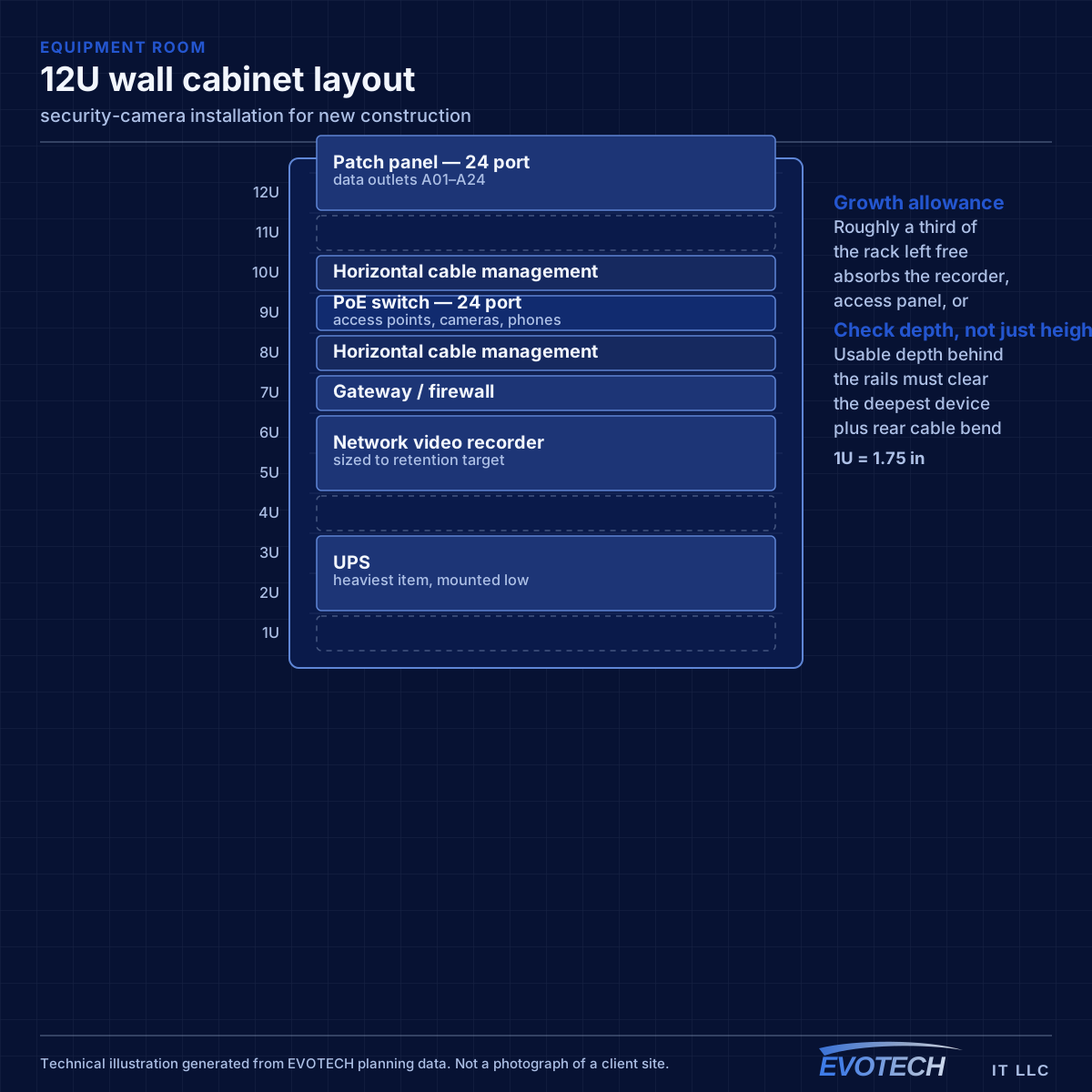
What to rough in even without a final design
Full system design is often not finished when the rough-in window arrives. That is normal, and it is not a reason to skip the pathway. Running conduit or sleeves to likely positions preserves the option cheaply even when the eventual equipment is undecided.
For a commercial building, the reliable rough-in set is: cable to every likely device outlet, ceiling positions for access points spaced for the intended coverage, camera positions at entries and approaches, door positions with cable to the controller location, and pathway to any likely display or AV position. Plus, in every case, a properly located equipment room.
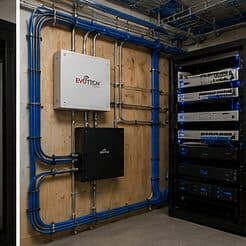
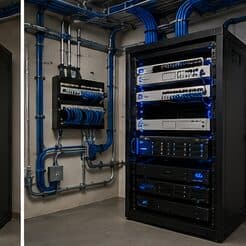
The equipment room deserves particular emphasis because it is the most commonly under-provisioned item. It has to hold the network rack, camera recorder, access-control panel, and any AV equipment, with dedicated power, ventilation, and clearance to work. Sizing it from the network alone is a decision that gets discovered eighteen months later.
- Sleeves and conduit to likely positions even before final design
- Ceiling access-point positions spaced for the intended coverage
- Camera positions at entries, approaches, and service areas
- Cable from every controlled door to the controller position
- Equipment room with dedicated power, ventilation, and working clearance
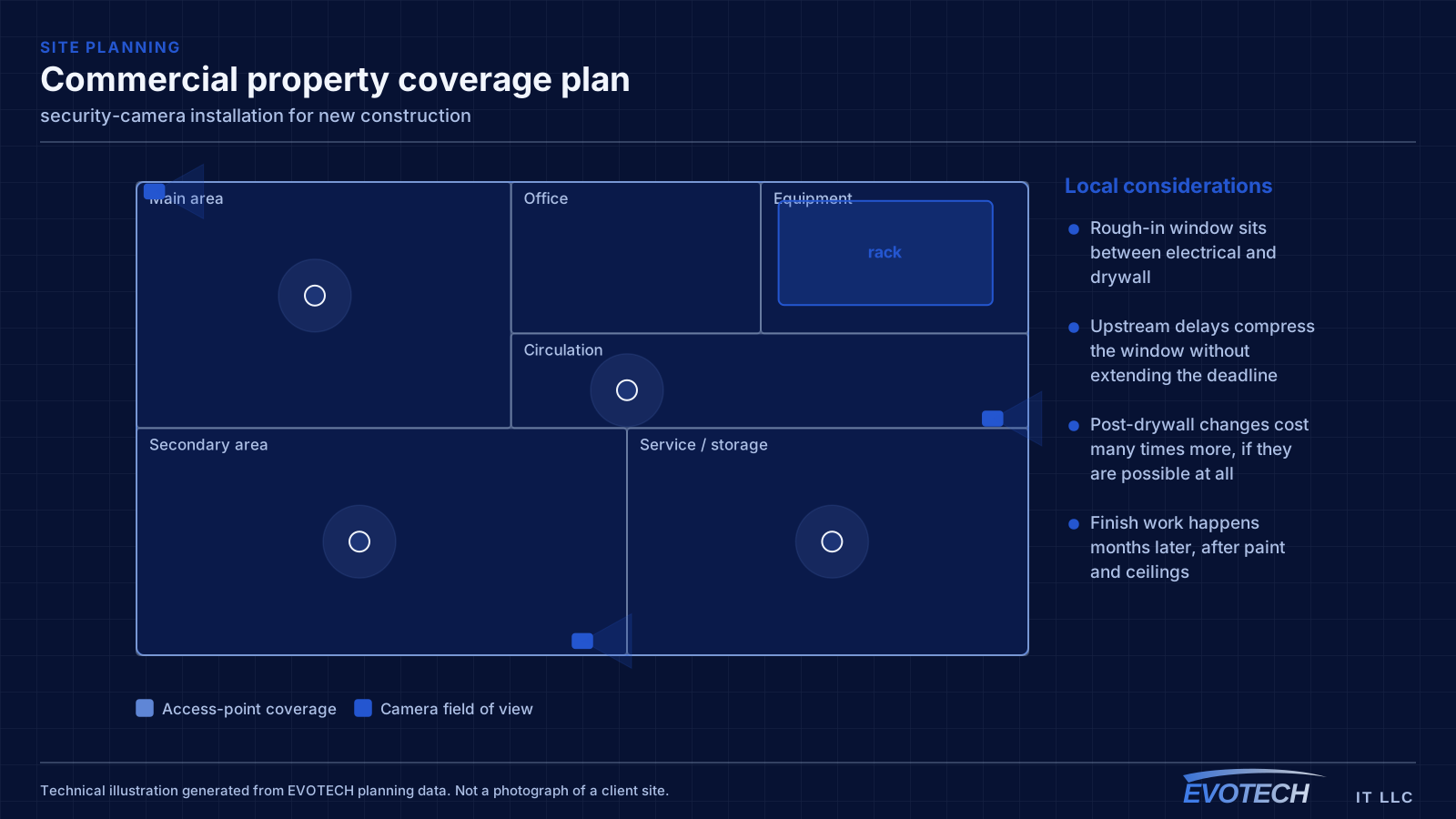
Pixel density, lighting, field of view, and mounting height
Pixel density on the target is the governing figure. It falls off with distance and with wider fields of view, so the design pairs each camera's resolution and lens with the distance to the area it must cover. A camera intended for identification at an entry door is placed close and framed tightly; a camera intended to show general activity across a yard is framed wide and is not expected to identify anyone.
- Commonly cited planning targets: roughly 10 px/ft detection, 40 px/ft recognition, 80 px/ft identification
- Frame identification cameras tightly on the approach rather than across a whole area
- Avoid aiming into windows, sky, or fixed light sources
- Keep infrared illumination clear of nearby walls, soffits, and obstructions
- Balance mounting height against viewing angle; steep angles rarely identify anyone
- Match housing rating to the actual exposure, including driven rain and heat
Popular services nearby
Frequently searched near this area — the pages people look for most.
Frequently asked questions
What changes about security-camera installation in new construction?
The operating environment does. New construction bring specific constraints — how the space is used, when work can happen, and what has to keep running — and those shape the security-camera installation plan as much as the service's own technical requirements.
How many cameras does a property need?
Count objectives, not walls. Each area needs a stated purpose — detect activity, recognise a known person, or identify a stranger — and the camera serving it is chosen for that purpose. A property with four well-framed cameras at the points that matter usually produces more useful footage than one with twelve wide shots covering everything approximately.
What has to be decided before rough-in?
Device locations, the equipment room position, and the pathway plan. Equipment selection can wait — you can run cable to a position without knowing which camera or access point will go there. What cannot wait is the decision about where things go, because that is what determines where cable is pulled while the walls are open.