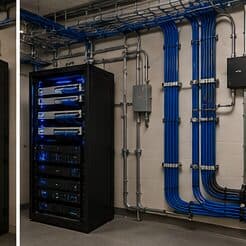
Video wall installation for new construction, in Pasadena
Video wall installation for new construction in Pasadena is a three-part question: what video wall installation involves, what new construction need from it, and what Pasadena changes about the install. Older industrial and service-corridor commercial stock, with rugged operational environments harder on equipment than office settings.
Get any of that wrong and it stops reading as one display: panels misaligned so lines step across the seams, colour mismatched between panels, content that does not account for the mullions, or a wall built so tightly that servicing one panel means dismantling the array.
Positions to prewire even if cameras come later
Camera positions are among the cheapest things to prewire and among the most annoying to retrofit, because they are usually exterior, high, and behind finished soffit. Running cable to likely positions during rough-in preserves the option at almost no cost.
The positions worth prewiring in nearly every building: primary entrance, rear or service entrance, any delivery or receiving point, parking approaches, and the equipment room itself. In residential construction, add the front door for a doorbell and the driveway approach.
- Primary and secondary entrance positions
- Delivery, receiving, and service door approaches
- Parking and vehicle approach positions
- Doorbell position in residential builds
- Cable terminated and labeled even where no camera is installed yet
What drives the cost of video wall installation here
Panel count and grade, plus the processor, drive the cost.
- Array size and panel count
- Panel grade and bezel width
- Video-wall processor and source infrastructure
- Precision mounting and any structural work
- Calibration and content setup
- Service-access provisions
Pasadena: what the location changes
The starting point for any Pasadena job is one local fact. Older industrial and service-corridor commercial stock, with rugged operational environments harder on equipment than office settings. That single condition shapes where cable can run, where equipment can sit, and how coverage is laid out — more than any spec sheet does. Two more conditions weigh on it. Metal and mixed-construction buildings requiring proper cable support and camera housings rated for the environment. Established residential neighbourhoods predating structured wiring, needing genuine retrofit. Together they make the route specific to this pocket, which is why a short walkthrough or a few clear photos settle the scope faster than a floor plan can.
- Older industrial and service-corridor commercial stock, with rugged operational environments harder on equipment than office settings
- Metal and mixed-construction buildings requiring proper cable support and camera housings rated for the environment
- Established residential neighbourhoods predating structured wiring, needing genuine retrofit
- Coastal-adjacent humidity and driven rain requiring durable exterior sealing
- Network rooms that grew organically and need remediation rather than expansion
Getting it done in Pasadena
A video wall is commissioned as one display, panel by panel.
Low-voltage rough-in happens in a specific slot: after framing and electrical, before insulation and drywall. Inside that window, running a cable anywhere is straightforward. Once drywall goes up, the same cable costs many times more and sometimes cannot be run at all.
Execution in Pasadena is planned around real conditions, not a template. Coastal-adjacent humidity and driven rain requiring durable exterior sealing. Network rooms that grew organically and need remediation rather than expansion. These decide the sequence, the access, and the method as much as the design does. EVOTECH describes Pasadena as coverage rather than a place it occupies, and omits any area detail it cannot confirm — building and site conditions only, no invented landmarks or promised arrival times.
Frequently asked questions
Is video wall installation for new construction different in Pasadena?
The sector needs stay the same, but the install changes with the place. In Pasadena, the conditions above — not the new construction label — decide routes, mounting, and equipment placement, which is why this page pairs all three.
How is a video wall different from mounting several TVs?
Precision and the system behind it. A video wall's panels must be co-planar and aligned to a fraction of a millimetre so seams read as continuous, driven by a processor that splits and scales content and compensates for the gaps, and built so one panel can be serviced without dismantling the array. Hanging several TVs is nowhere near that tolerance — treat a wall that way and it looks like separate screens.