Access-control installation for professional offices, in Pasadena
Access-control installation for professional offices in Pasadena is a three-part question: what access-control installation involves, what professional offices need from it, and what Pasadena changes about the install. Older industrial and service-corridor commercial stock, with rugged operational environments harder on equipment than office settings.
An access-control system manages who may open which door and when, and records each attempt. The immediate operational benefit over keys is revocation: a lost credential is disabled in seconds instead of prompting a rekey. The secondary benefit is the audit record, which turns 'who was here on Saturday' into a query rather than a guess.
Density is concentrated, not distributed
An office floor's network demand is not spread evenly. Individual desks are undemanding. Meeting rooms concentrate a dozen people, their laptops and phones, a display system, and a video call into one radio cell for an hour at a time. That concentration is where the design effort belongs.
The second characteristic is churn. Desk layouts change, teams grow, hot-desking arrives and departs. Offices benefit from more outlets than the current plan requires and from wireless coverage designed around areas rather than around today's seating chart.
- Demand concentrated in meeting and collaboration areas
- Desk layouts changing more often than the cabling can economically follow
- Video calls as the most visible and least forgiving workload
- Printers, phones, and access points adding to the wired device count
Where access-control installation goes wrong — and how it's avoided
Access-control mistakes range from irritating to genuinely unsafe.
- Choosing a lock type without considering egress and power-loss behaviour
- Installing a magnetic lock without proper release arrangements
- Mounting the controller on the unsecured side of the door
- Automating a door whose closer or alignment was already unreliable
- Issuing shared credentials, which destroys the audit record
- Having no defined revocation process, so old credentials stay valid
- Deploying legacy proximity credentials that are trivial to copy
Pasadena: what the location changes
In Pasadena, the plan is built outward from the conditions that are actually here. Older industrial and service-corridor commercial stock, with rugged operational environments harder on equipment than office settings. Metal and mixed-construction buildings requiring proper cable support and camera housings rated for the environment. Established residential neighbourhoods predating structured wiring, needing genuine retrofit. Each one changes where cable can run, where equipment can sit, and how coverage is shaped, which is why a walkthrough settles a Pasadena scope faster than any generic estimate.
- Older industrial and service-corridor commercial stock, with rugged operational environments harder on equipment than office settings
- Metal and mixed-construction buildings requiring proper cable support and camera housings rated for the environment
- Established residential neighbourhoods predating structured wiring, needing genuine retrofit
- Coastal-adjacent humidity and driven rain requiring durable exterior sealing
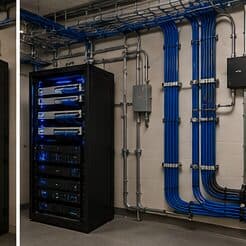
- Network rooms that grew organically and need remediation rather than expansion
Getting it done in Pasadena
Access-control commissioning is about failure modes, not just successful entry.
Wireless capacity should be planned from peak simultaneous use in each area. A floor with several meeting rooms in constant use needs more cells concentrated around them than its square footage would suggest, and those cells need a channel plan that stops them contending with each other.
Getting Pasadena work done means planning around the site as it actually is. Coastal-adjacent humidity and driven rain requiring durable exterior sealing. Network rooms that grew organically and need remediation rather than expansion. Both matter as much as the design to how and when the work happens. The scope is drawn from the real property, the coverage is stated as a service area rather than an office, and unverifiable specifics about Pasadena are kept off the page on purpose.
Frequently asked questions
Is access-control installation for professional offices different in Pasadena?
The sector needs stay the same, but the install changes with the place. In Pasadena, the conditions above — not the professional offices label — decide routes, mounting, and equipment placement, which is why this page pairs all three.
What is the difference between fail-safe and fail-secure?
It describes what happens when power is lost. Fail-safe hardware — typically a magnetic lock — releases and the door becomes passable. Fail-secure hardware — typically a standard electric strike — stays locked, though the door can still be opened from the inside by its mechanical hardware. Which is correct for a given opening depends on its role and on applicable life-safety requirements, so it is a design decision rather than a preference.