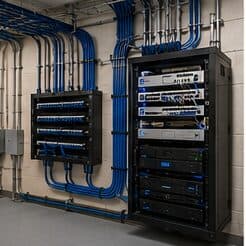
Network cabling for multifamily properties, in Richmond
Network cabling for multifamily properties in Richmond is a three-part question: what network cabling involves, what multifamily properties need from it, and what Richmond changes about the install. High proportion of new residential and commercial construction, making rough-in timing the dominant scheduling factor.
The reason cabling deserves planning attention is that it is the longest-lived part of the system. Switches get replaced on a five-year cycle and access points sooner, but the cable in the wall tends to stay for the life of the tenancy. Deciding where outlets go, how many, and what category of cable feeds them is a decision that either quietly supports the next decade or quietly constrains it.
Two audiences, one building
A multifamily property runs two distinct technology environments. Residents have their own connectivity inside their units, generally provided by whatever service they select. The property operates everything else: common-area wireless, controlled entry, intercom, package rooms, amenity spaces, cameras, and the office network.
The property-operated side is what needs design. It has to work for a resident population that turns over continuously, be administrable by on-site staff who also turn over, and survive being used by everyone in the building without a support desk.
- Resident in-unit service separate from property-operated systems
- Continuous resident turnover requiring rapid credential issue and revocation
- On-site staff administering systems without specialist training
- Common areas, amenity spaces, and package rooms all needing coverage
Where network cabling goes wrong — and how it's avoided
The recurring mistakes are not exotic. They are the shortcuts that save an hour during installation and cost days later.
- Pulling cable before agreeing on a labeling scheme
- Sizing the rack and panel for today's port count with no spare capacity
- Running low-voltage cable alongside electrical for long parallel stretches
- Supporting cable on ceiling grid, sprinkler pipe, or other trades' hangers
- Skipping certification and discovering marginal links only when a device misbehaves
Richmond: what the location changes
The starting point for any Richmond job is one local fact. High proportion of new residential and commercial construction, making rough-in timing the dominant scheduling factor. That single condition shapes where cable can run, where equipment can sit, and how coverage is laid out — more than any spec sheet does. Two more conditions weigh on it. Larger lots producing long runs to gates, outbuildings, and driveway camera positions that approach or exceed copper distance limits. Slab-on-grade construction with the rough-in window falling between electrical and drywall. Together they make the route specific to this pocket, which is why a short walkthrough or a few clear photos settle the scope faster than a floor plan can.
- High proportion of new residential and commercial construction, making rough-in timing the dominant scheduling factor
- Larger lots producing long runs to gates, outbuildings, and driveway camera positions that approach or exceed copper distance limits
- Slab-on-grade construction with the rough-in window falling between electrical and drywall
- Conduit and sleeve decisions made during rough-in determining what is possible for the following decade
- Detached structures common enough that between-building links are a routine design question rather than an exception
Getting it done in Richmond
Testing is what separates a cabling installation from a cable pull. A basic continuity or wire-map check confirms the pairs land in the right order; it says nothing about whether the link will carry its rated bandwidth. Certification testing against the relevant TIA channel or permanent-link limits measures insertion loss, return loss, near-end crosstalk, and delay skew, and produces a per-port record.
The property network carries cameras, door controllers, intercom, the leasing office, and common-area wireless. These belong on separate segments from each other — common-area guest wireless in particular should reach the internet and nothing else, since it is used by residents, visitors, and anyone within range of an amenity space.
Execution in Richmond is planned around real conditions, not a template. Conduit and sleeve decisions made during rough-in determining what is possible for the following decade. Detached structures common enough that between-building links are a routine design question rather than an exception. These decide the sequence, the access, and the method as much as the design does. EVOTECH describes Richmond as coverage rather than a place it occupies, and omits any area detail it cannot confirm — building and site conditions only, no invented landmarks or promised arrival times.
Popular services nearby
Frequently searched near this area — the pages people look for most.
Frequently asked questions
Is network cabling for multifamily properties different in Richmond?
The sector needs stay the same, but the install changes with the place. In Richmond, the conditions above — not the multifamily properties label — decide routes, mounting, and equipment placement, which is why this page pairs all three.
How long can a single network cable run be?
The fixed cable between patch panel and outlet is limited to 90 metres, with patch cords at each end bringing the total channel to 100 metres. Beyond that, the answer is not a longer cable — it is either an intermediate equipment location or a fiber link to a secondary switch.