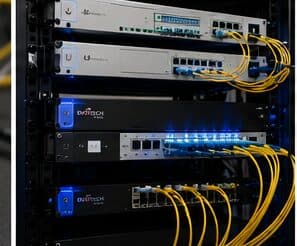
Network-rack installation for multifamily properties, in Richmond
Network-rack installation for multifamily properties in Richmond is a three-part question: what network-rack installation involves, what multifamily properties need from it, and what Richmond changes about the install. High proportion of new residential and commercial construction, making rough-in timing the dominant scheduling factor.
Depth matters as much as height and is more often overlooked. A shallow wall-mount cabinet chosen because it fits a hallway will not accept a deeper server or a UPS, and the discovery usually happens after the cabinet is mounted. Checking the deepest intended device against the cabinet's usable depth — behind the mounting rails, allowing for cable bend at the rear — avoids that.
Two audiences, one building
A multifamily property runs two distinct technology environments. Residents have their own connectivity inside their units, generally provided by whatever service they select. The property operates everything else: common-area wireless, controlled entry, intercom, package rooms, amenity spaces, cameras, and the office network.
The property-operated side is what needs design. It has to work for a resident population that turns over continuously, be administrable by on-site staff who also turn over, and survive being used by everyone in the building without a support desk.
- Resident in-unit service separate from property-operated systems
- Continuous resident turnover requiring rapid credential issue and revocation
- On-site staff administering systems without specialist training
- Common areas, amenity spaces, and package rooms all needing coverage
Where network-rack installation goes wrong — and how it's avoided
Rack mistakes are the ones that make every future visit longer.
- Sizing to today's equipment with no growth allowance
- Choosing a cabinet by width and height while ignoring depth
- Sealing a cabinet in an unventilated closet
- Mounting a heavy cabinet to drywall anchors instead of structure
- Skipping horizontal management to save two U
- Daisy-chaining power strips
- Labeling after installation, which usually means not labeling
Richmond: what the location changes
What separates a Richmond scope from the rest of the city is concrete and local. High proportion of new residential and commercial construction, making rough-in timing the dominant scheduling factor. Larger lots producing long runs to gates, outbuildings, and driveway camera positions that approach or exceed copper distance limits. Slab-on-grade construction with the rough-in window falling between electrical and drywall. That short list is what actually drives the design in this pocket, and it is why photographs or a brief site visit beat a floor plan — the plan follows the building's real constraints, not the neighborhood name on the map.
- High proportion of new residential and commercial construction, making rough-in timing the dominant scheduling factor
- Larger lots producing long runs to gates, outbuildings, and driveway camera positions that approach or exceed copper distance limits
- Slab-on-grade construction with the rough-in window falling between electrical and drywall
- Conduit and sleeve decisions made during rough-in determining what is possible for the following decade
- Detached structures common enough that between-building links are a routine design question rather than an exception
Getting it done in Richmond
A rack is commissioned by checking it under load, not by looking at it when everything is idle.
The property network carries cameras, door controllers, intercom, the leasing office, and common-area wireless. These belong on separate segments from each other — common-area guest wireless in particular should reach the internet and nothing else, since it is used by residents, visitors, and anyone within range of an amenity space.
Getting Richmond work done means planning around the site as it actually is. Conduit and sleeve decisions made during rough-in determining what is possible for the following decade. Detached structures common enough that between-building links are a routine design question rather than an exception. Both matter as much as the design to how and when the work happens. The scope is drawn from the real property, the coverage is stated as a service area rather than an office, and unverifiable specifics about Richmond are kept off the page on purpose.
Popular services nearby
Frequently searched near this area — the pages people look for most.
Frequently asked questions
Is network-rack installation for multifamily properties different in Richmond?
The sector needs stay the same, but the install changes with the place. In Richmond, the conditions above — not the multifamily properties label — decide routes, mounting, and equipment placement, which is why this page pairs all three.
What size rack is needed?
Add the U heights of every intended device, add a U of management between logical groups, add the patch panels, then add roughly a third for growth. The result is usually a size or two larger than the first instinct, and the extra space costs far less than the disruption of replacing an undersized cabinet later.