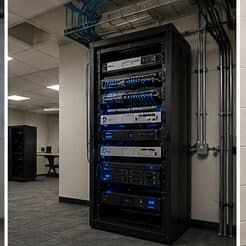
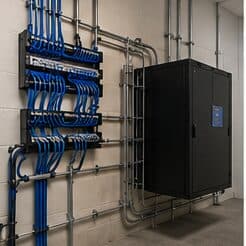
Network cabling for multifamily properties, in Sugar Land
Network cabling for multifamily properties in Sugar Land is a three-part question: what network cabling involves, what multifamily properties need from it, and what Sugar Land changes about the install. Commercial base weighted toward professional offices and medical suites rather than industrial space.
The reason cabling deserves planning attention is that it is the longest-lived part of the system. Switches get replaced on a five-year cycle and access points sooner, but the cable in the wall tends to stay for the life of the tenancy. Deciding where outlets go, how many, and what category of cable feeds them is a decision that either quietly supports the next decade or quietly constrains it.
Property systems and common-area coverage
The property network carries cameras, door controllers, intercom, the leasing office, and common-area wireless. These belong on separate segments from each other — common-area guest wireless in particular should reach the internet and nothing else, since it is used by residents, visitors, and anyone within range of an amenity space.
Common-area coverage is a distributed problem. Lobbies, corridors, fitness rooms, clubhouses, pool areas, and parking structures each have different construction and different demand, and outdoor amenity areas need equipment rated for the exposure. Corridor coverage in particular tends to be underestimated, since corridors are long, narrow, and full of doors.
Where a property spans multiple buildings, the links between them are fiber, for the same distance and electrical-isolation reasons that apply on any campus.
- Property systems segmented from common-area guest wireless
- Amenity spaces, corridors, and outdoor areas as distinct coverage zones
- Outdoor-rated equipment for pool decks and exterior amenity areas
- Fiber between buildings on multi-building properties
- Leasing office network separated from resident-facing systems
What drives the cost of network cabling here
Cabling scope is priced from conditions, not from a per-outlet number, which is why a walkthrough or a good set of photos changes an estimate more than any other input. The largest single driver is usually whether the pathway already exists.
- Total run count and average run length
- Whether existing tray, conduit, or sleeves can be reused
- Ceiling and wall construction, including hard-lid areas requiring cut and patch
- Category of cable specified and whether shielding is required
- Depth of testing and documentation requested
- Working hours: occupied space and after-hours windows extend the schedule
Sugar Land: what the location changes
What separates a Sugar Land scope from the rest of the city is concrete and local. Commercial base weighted toward professional offices and medical suites rather than industrial space. Multi-tenant buildings where base-building rules govern riser access, core penetrations, and after-hours work. Suspended-grid ceilings common in office suites, with hard-lid areas in reception and clinical spaces. That short list is what actually drives the design in this pocket, and it is why photographs or a brief site visit beat a floor plan — the plan follows the building's real constraints, not the neighborhood name on the map.
- Commercial base weighted toward professional offices and medical suites rather than industrial space
- Multi-tenant buildings where base-building rules govern riser access, core penetrations, and after-hours work
- Suspended-grid ceilings common in office suites, with hard-lid areas in reception and clinical spaces
- Retail centres with storefront glazing that complicates entrance camera placement due to daylight backlighting
- Master-planned commercial development producing comparatively consistent, newer construction
Getting it done in Sugar Land
Testing is what separates a cabling installation from a cable pull. A basic continuity or wire-map check confirms the pairs land in the right order; it says nothing about whether the link will carry its rated bandwidth. Certification testing against the relevant TIA channel or permanent-link limits measures insertion loss, return loss, near-end crosstalk, and delay skew, and produces a per-port record.
Multifamily properties are occupied continuously, which means work in corridors and common areas happens around residents, with containment, clear signage, and attention to noise during reasonable hours. Access to individual units, where required, needs the property's own notice procedures.
Getting Sugar Land work done means planning around the site as it actually is. Retail centres with storefront glazing that complicates entrance camera placement due to daylight backlighting. Master-planned commercial development producing comparatively consistent, newer construction. Both matter as much as the design to how and when the work happens. The scope is drawn from the real property, the coverage is stated as a service area rather than an office, and unverifiable specifics about Sugar Land are kept off the page on purpose.
Frequently asked questions
Is network cabling for multifamily properties different in Sugar Land?
The sector needs stay the same, but the install changes with the place. In Sugar Land, the conditions above — not the multifamily properties label — decide routes, mounting, and equipment placement, which is why this page pairs all three.
How long can a single network cable run be?
The fixed cable between patch panel and outlet is limited to 90 metres, with patch cords at each end bringing the total channel to 100 metres. Beyond that, the answer is not a longer cable — it is either an intermediate equipment location or a fiber link to a secondary switch.