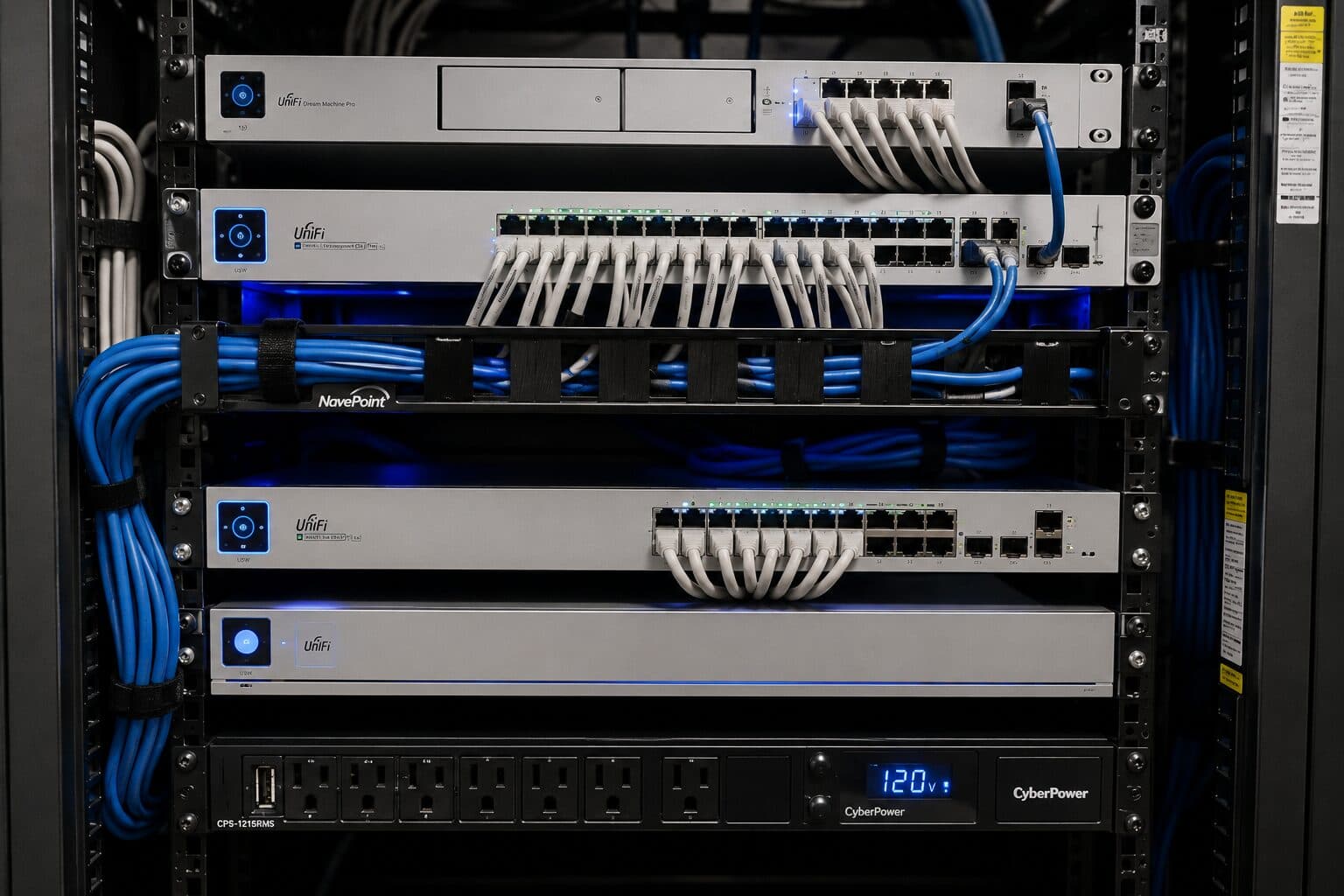
In-wall cable concealment for medical offices, in Rosenberg
In-wall cable concealment for medical offices in Rosenberg is a three-part question: what in-wall cable concealment involves, what medical offices need from it, and what Rosenberg changes about the install. Warehousing and light-industrial buildings along the highway corridor, with metal construction that reflects wireless signal and needs proper cable support.
Concealing the cables behind a wall-mounted TV or AV setup is what turns it from a device with wires hanging down into something that looks built-in. The signal cables — HDMI, network, speaker — can be routed inside the wall to a recessed box behind the display, but power is different: a standard power cord must never be run inside a wall. Power is handled with a recessed outlet behind the display or an in-wall rated power solution, which keeps the installation safe and to code.
Cameras and access in a clinical setting
Camera coverage in medical settings is deliberately limited in scope. Entrances, corridors leading to controlled areas, medication storage approaches, parking areas, and after-hours coverage of the perimeter are the usual placements. Treatment areas are not camera locations, and this is worth stating plainly during design so the boundary is explicit.
Access control usually carries more weight than cameras here, because the practical requirement is controlling and evidencing entry to specific areas rather than recording activity generally. Door records showing who entered a records room and when answer the questions that actually get asked.
Where cameras and access control are integrated, a door event can be reviewed alongside footage of the corridor approach — which is often the useful combination, and does not require a camera inside the controlled area itself.
- Entrances, corridors to controlled areas, and medication storage approaches
- No cameras in treatment or examination areas
- Access records as the primary evidence for controlled-area entry
- Integration so door events can be reviewed with corridor footage
- Exterior and parking coverage for after-hours
What changes in-wall cable concealment from job to job
Scope depends on the wall and the run.
- Wall construction: drywall, masonry, metal stud, or fireplace
- Fire blocking, insulation, and bracing in the cavity
- Distance from the display to the outlet or equipment
- Whether a recessed outlet must be added
- Number of cables to conceal
- Finish expectations and any patch-and-paint
Rosenberg: what the location changes
Warehousing and light-industrial buildings along the highway corridor, with metal construction that reflects wireless signal and needs proper cable support. In Rosenberg, that is where the plan begins, because it changes cable paths, device placement, and access-point counts before anything else does. An older rail-town commercial core with masonry buildings and limited existing pathway. Newer suburban subdivisions on slab foundations following the regional attic-routing pattern. None of these are generic checklist items — each moves the design in a direction a citywide assumption would miss, and the honest recommendation always depends on what this particular property allows.
- Warehousing and light-industrial buildings along the highway corridor, with metal construction that reflects wireless signal and needs proper cable support
- An older rail-town commercial core with masonry buildings and limited existing pathway
- Newer suburban subdivisions on slab foundations following the regional attic-routing pattern
- Dust exposure in industrial and distribution environments, affecting rack and equipment placement
- Gulf Coast humidity and driven-rain events requiring rated exterior housings and sealed penetrations
Getting it done in Rosenberg
Concealment is judged by a clean result and a safe, code-compliant power path.
A medical office has a clear division between public, staff, and controlled areas, and the technology follows that division. Waiting areas need guest connectivity that reaches nothing internal. Treatment rooms need reliable connectivity for clinical systems. Records areas and medication storage need controlled access with a usable audit trail.
On site, the schedule and working method turn on conditions like these. Dust exposure in industrial and distribution environments, affecting rack and equipment placement. Gulf Coast humidity and driven-rain events requiring rated exterior housings and sealed penetrations. Both shape how and when a crew can actually operate, which is why EVOTECH scopes each Rosenberg job from the property itself rather than assuming one approach fits every address. Coverage is stated as a service area, never an office claim, and anything about Rosenberg that cannot be verified is left out instead of invented.
Frequently asked questions
Is in-wall cable concealment for medical offices different in Rosenberg?
The sector needs stay the same, but the install changes with the place. In Rosenberg, the conditions above — not the medical offices label — decide routes, mounting, and equipment placement, which is why this page pairs all three.
Can the power cord be hidden in the wall too?
Not the standard cord — running one inside a wall is against code and a genuine hazard. Power is concealed correctly with a recessed outlet behind the display or a rated in-wall power-relocation kit, which puts the outlet where the TV needs it without burying a cord. The signal cables can go in the wall; power is handled the right way.