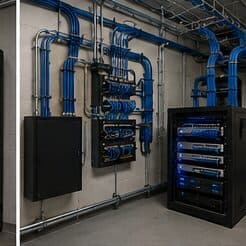
In-wall cable concealment for medical offices, in Spring
In-wall cable concealment for medical offices in Spring is a three-part question: what in-wall cable concealment involves, what medical offices need from it, and what Spring changes about the install. Retail and food-service commercial base where payment-system separation is a standing requirement.
Concealing the cables behind a wall-mounted TV or AV setup is what turns it from a device with wires hanging down into something that looks built-in. The signal cables — HDMI, network, speaker — can be routed inside the wall to a recessed box behind the display, but power is different: a standard power cord must never be run inside a wall. Power is handled with a recessed outlet behind the display or an in-wall rated power solution, which keeps the installation safe and to code.
Working around a clinic day
Work in treatment areas is scheduled around patient sessions, which typically means early mornings, evenings, or non-clinical days. Corridors and public areas are more flexible but still need containment and clean working practice.
Infection control and cleanliness expectations exceed those of a standard commercial site. Dust control during drilling, protection of surfaces, and clearing the work area completely at the end of each session are baseline requirements rather than courtesies.
- Treatment-area work scheduled around clinical sessions
- Dust containment and surface protection throughout
- Complete clear-down at the end of every session
- Cutover planning that keeps clinical systems available
- Coordination with practice management on access to controlled areas
What changes in-wall cable concealment from job to job
Scope depends on the wall and the run.
- Wall construction: drywall, masonry, metal stud, or fireplace
- Fire blocking, insulation, and bracing in the cavity
- Distance from the display to the outlet or equipment
- Whether a recessed outlet must be added
- Number of cables to conceal
- Finish expectations and any patch-and-paint
Spring: what the location changes
In Spring, the plan is built outward from the conditions that are actually here. Retail and food-service commercial base where payment-system separation is a standing requirement. Ceiling construction varying considerably between adjacent units, from open deck to hard lid to suspended grid. Restaurant kitchen environments requiring equipment placement away from heat, steam, and grease-laden air. Each one changes where cable can run, where equipment can sit, and how coverage is shaped, which is why a walkthrough settles a Spring scope faster than any generic estimate.
- Retail and food-service commercial base where payment-system separation is a standing requirement
- Ceiling construction varying considerably between adjacent units, from open deck to hard lid to suspended grid
- Restaurant kitchen environments requiring equipment placement away from heat, steam, and grease-laden air
- Storefront glazing on retail units complicating daylight entrance camera placement
- Residential areas following the regional slab-foundation and attic-routing pattern
Getting it done in Spring
Concealment is judged by a clean result and a safe, code-compliant power path.
Three priorities dominate. Separate the networks so patient-facing guest access cannot reach clinical systems. Control access to the areas that require it, with records that show who entered and when. Plan any cutover so clinical operations are not interrupted mid-session.
Getting Spring work done means planning around the site as it actually is. Storefront glazing on retail units complicating daylight entrance camera placement. Residential areas following the regional slab-foundation and attic-routing pattern. Both matter as much as the design to how and when the work happens. The scope is drawn from the real property, the coverage is stated as a service area rather than an office, and unverifiable specifics about Spring are kept off the page on purpose.
Frequently asked questions
Is in-wall cable concealment for medical offices different in Spring?
The sector needs stay the same, but the install changes with the place. In Spring, the conditions above — not the medical offices label — decide routes, mounting, and equipment placement, which is why this page pairs all three.
Can the power cord be hidden in the wall too?
Not the standard cord — running one inside a wall is against code and a genuine hazard. Power is concealed correctly with a recessed outlet behind the display or a rated in-wall power-relocation kit, which puts the outlet where the TV needs it without burying a cord. The signal cables can go in the wall; power is handled the right way.