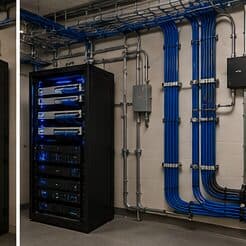
Cat6 cabling for medical offices, in Spring
Cat6 cabling for medical offices in Spring is a three-part question: what cat6 cabling involves, what medical offices need from it, and what Spring changes about the install. Retail and food-service commercial base where payment-system separation is a standing requirement.
Cat6 carries gigabit Ethernet across the full 100-metre channel without drama, and that covers the overwhelming majority of what plugs into an office or home wall plate: computers, phones, printers, access points, cameras, and door controllers. Where it gets interesting is 10 gigabit. Cat6 can carry 10GBASE-T, but only to roughly 55 metres, and that figure assumes a favourable alien-crosstalk environment — cables not bundled tightly with many neighbours carrying the same signal.
Working around a clinic day
Work in treatment areas is scheduled around patient sessions, which typically means early mornings, evenings, or non-clinical days. Corridors and public areas are more flexible but still need containment and clean working practice.
Infection control and cleanliness expectations exceed those of a standard commercial site. Dust control during drilling, protection of surfaces, and clearing the work area completely at the end of each session are baseline requirements rather than courtesies.
- Treatment-area work scheduled around clinical sessions
- Dust containment and surface protection throughout
- Complete clear-down at the end of every session
- Cutover planning that keeps clinical systems available
- Coordination with practice management on access to controlled areas
What changes cat6 cabling from job to job
The Cat6-versus-Cat6A decision is usually made run by run rather than for the whole building, and the inputs are specific.
- Actual pathway length per run, measured rather than estimated
- Whether the location will ever need more than gigabit
- Bundle density along the shared portion of the pathway
- Whether shielding is warranted by the electrical environment
- Pathway capacity, since Cat6A occupies noticeably more space
- Termination labour, which rises with shielded constructions
Spring: what the location changes
In Spring, the plan is built outward from the conditions that are actually here. Retail and food-service commercial base where payment-system separation is a standing requirement. Ceiling construction varying considerably between adjacent units, from open deck to hard lid to suspended grid. Restaurant kitchen environments requiring equipment placement away from heat, steam, and grease-laden air. Each one changes where cable can run, where equipment can sit, and how coverage is shaped, which is why a walkthrough settles a Spring scope faster than any generic estimate.
- Retail and food-service commercial base where payment-system separation is a standing requirement
- Ceiling construction varying considerably between adjacent units, from open deck to hard lid to suspended grid
- Restaurant kitchen environments requiring equipment placement away from heat, steam, and grease-laden air
- Storefront glazing on retail units complicating daylight entrance camera placement
- Residential areas following the regional slab-foundation and attic-routing pattern
Getting it done in Spring
Certification for a Cat6 link measures the parameters that define the category: insertion loss, near-end and far-end crosstalk, return loss, and propagation delay skew across the frequency range up to 250 MHz. A pass means the link meets the standard's limits with margin recorded.
Three priorities dominate. Separate the networks so patient-facing guest access cannot reach clinical systems. Control access to the areas that require it, with records that show who entered and when. Plan any cutover so clinical operations are not interrupted mid-session.
Getting Spring work done means planning around the site as it actually is. Storefront glazing on retail units complicating daylight entrance camera placement. Residential areas following the regional slab-foundation and attic-routing pattern. Both matter as much as the design to how and when the work happens. The scope is drawn from the real property, the coverage is stated as a service area rather than an office, and unverifiable specifics about Spring are kept off the page on purpose.
Frequently asked questions
Is cat6 cabling for medical offices different in Spring?
The sector needs stay the same, but the install changes with the place. In Spring, the conditions above — not the medical offices label — decide routes, mounting, and equipment placement, which is why this page pairs all three.
Is Cat6 enough, or should everything be Cat6A?
For most device locations Cat6 is enough, because most devices need gigabit and will for a long time. Cat6A earns its place on runs that must carry 10G at distance, runs sitting in dense bundles, and uplinks between equipment positions. Specifying Cat6A for the whole building is rarely wrong technically, but it costs pathway space and termination time that a mixed design keeps.