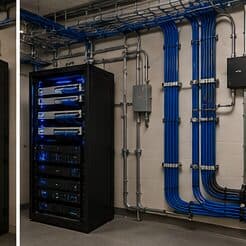
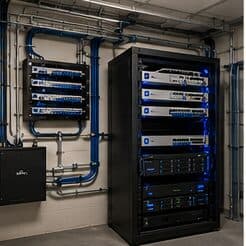
Cat6A cabling for medical offices, in Rosenberg
Cat6A cabling for medical offices in Rosenberg is a three-part question: what cat6a cabling involves, what medical offices need from it, and what Rosenberg changes about the install. Warehousing and light-industrial buildings along the highway corridor, with metal construction that reflects wireless signal and needs proper cable support.
The practical decision is not whether Cat6A is better. It plainly is. The decision is which runs need it, because a Cat6A cable is noticeably thicker and stiffer, fills pathway faster, takes longer to dress into a rack, and takes longer again to terminate if it is shielded. On a large project those minutes multiply.
Cameras and access in a clinical setting
Camera coverage in medical settings is deliberately limited in scope. Entrances, corridors leading to controlled areas, medication storage approaches, parking areas, and after-hours coverage of the perimeter are the usual placements. Treatment areas are not camera locations, and this is worth stating plainly during design so the boundary is explicit.
Access control usually carries more weight than cameras here, because the practical requirement is controlling and evidencing entry to specific areas rather than recording activity generally. Door records showing who entered a records room and when answer the questions that actually get asked.
Where cameras and access control are integrated, a door event can be reviewed alongside footage of the corridor approach — which is often the useful combination, and does not require a camera inside the controlled area itself.
- Entrances, corridors to controlled areas, and medication storage approaches
- No cameras in treatment or examination areas
- Access records as the primary evidence for controlled-area entry
- Integration so door events can be reviewed with corridor footage
- Exterior and parking coverage for after-hours
What changes cat6a cabling from job to job
What changes a Cat6A scope is mostly physical.
- Count of runs genuinely requiring 10G at distance
- Shielded versus unshielded construction
- Existing pathway capacity and whether it must be enlarged
- PoE class carried and resulting bundle-size constraints
- Rack space available for dressing a stiffer cable cleanly
- Termination labour, which is materially higher for shielded builds
Rosenberg: what the location changes
What separates a Rosenberg scope from the rest of the city is concrete and local. Warehousing and light-industrial buildings along the highway corridor, with metal construction that reflects wireless signal and needs proper cable support. An older rail-town commercial core with masonry buildings and limited existing pathway. Newer suburban subdivisions on slab foundations following the regional attic-routing pattern. That short list is what actually drives the design in this pocket, and it is why photographs or a brief site visit beat a floor plan — the plan follows the building's real constraints, not the neighborhood name on the map.
- Warehousing and light-industrial buildings along the highway corridor, with metal construction that reflects wireless signal and needs proper cable support
- An older rail-town commercial core with masonry buildings and limited existing pathway
- Newer suburban subdivisions on slab foundations following the regional attic-routing pattern
- Dust exposure in industrial and distribution environments, affecting rack and equipment placement
- Gulf Coast humidity and driven-rain events requiring rated exterior housings and sealed penetrations
Getting it done in Rosenberg
Certification to Cat6A runs the same parameter set as Cat6 but across the full 500 MHz range, where margins are naturally tighter. Passing at 250 MHz says nothing about behaviour at 500 MHz, so the test configuration has to match the intended rating.
A medical office has a clear division between public, staff, and controlled areas, and the technology follows that division. Waiting areas need guest connectivity that reaches nothing internal. Treatment rooms need reliable connectivity for clinical systems. Records areas and medication storage need controlled access with a usable audit trail.
Execution in Rosenberg is planned around real conditions, not a template. Dust exposure in industrial and distribution environments, affecting rack and equipment placement. Gulf Coast humidity and driven-rain events requiring rated exterior housings and sealed penetrations. These decide the sequence, the access, and the method as much as the design does. EVOTECH describes Rosenberg as coverage rather than a place it occupies, and omits any area detail it cannot confirm — building and site conditions only, no invented landmarks or promised arrival times.
Frequently asked questions
Is cat6a cabling for medical offices different in Rosenberg?
The sector needs stay the same, but the install changes with the place. In Rosenberg, the conditions above — not the medical offices label — decide routes, mounting, and equipment placement, which is why this page pairs all three.
Is Cat6A worth it if nothing today runs 10 gigabit?
Sometimes. The argument for it is that reopening a ceiling is far more expensive than the cable premium, so runs that are hard to reach and likely to matter later are good candidates. The argument against blanket use is pathway fill and labour. A common middle path is Cat6A on uplinks, dense areas, and inaccessible runs, with Cat6 elsewhere.