Business phone & VoIP for medical offices, in Rosenberg
Business phone & VoIP for medical offices in Rosenberg is a three-part question: what business phone & voip involves, what medical offices need from it, and what Rosenberg changes about the install. Warehousing and light-industrial buildings along the highway corridor, with metal construction that reflects wireless signal and needs proper cable support.
Because the phones are network devices, their call quality depends on the network. Voice is unforgiving of jitter and packet loss in a way that a file download is not, so a phone system going onto a busy flat network without any prioritisation is the most common cause of choppy or dropped calls — and it is a design problem, not a handset fault.
Cameras and access in a clinical setting
Camera coverage in medical settings is deliberately limited in scope. Entrances, corridors leading to controlled areas, medication storage approaches, parking areas, and after-hours coverage of the perimeter are the usual placements. Treatment areas are not camera locations, and this is worth stating plainly during design so the boundary is explicit.
Access control usually carries more weight than cameras here, because the practical requirement is controlling and evidencing entry to specific areas rather than recording activity generally. Door records showing who entered a records room and when answer the questions that actually get asked.
Where cameras and access control are integrated, a door event can be reviewed alongside footage of the corridor approach — which is often the useful combination, and does not require a camera inside the controlled area itself.
- Entrances, corridors to controlled areas, and medication storage approaches
- No cameras in treatment or examination areas
- Access records as the primary evidence for controlled-area entry
- Integration so door events can be reviewed with corridor footage
- Exterior and parking coverage for after-hours
What changes business phone & voip from job to job
Phone-system scope moves with the number of extensions and the call features, not the building size.
- Handset count and any conference, paging, or door-phone endpoints
- On-premise call server versus a hosted platform
- Peak concurrent calls and the resulting upload requirement
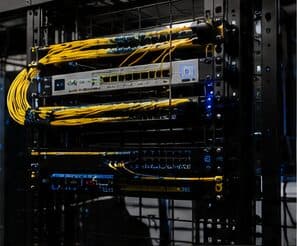
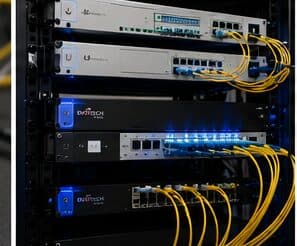
- Whether the existing cabling and switching can carry the handsets
- Number porting complexity and how many numbers move
- Auto-attendant, voicemail, call-group, and after-hours routing complexity
- Multi-site dial plan requirements
Rosenberg: what the location changes
What separates a Rosenberg scope from the rest of the city is concrete and local. Warehousing and light-industrial buildings along the highway corridor, with metal construction that reflects wireless signal and needs proper cable support. An older rail-town commercial core with masonry buildings and limited existing pathway. Newer suburban subdivisions on slab foundations following the regional attic-routing pattern. That short list is what actually drives the design in this pocket, and it is why photographs or a brief site visit beat a floor plan — the plan follows the building's real constraints, not the neighborhood name on the map.
- Warehousing and light-industrial buildings along the highway corridor, with metal construction that reflects wireless signal and needs proper cable support
- An older rail-town commercial core with masonry buildings and limited existing pathway
- Newer suburban subdivisions on slab foundations following the regional attic-routing pattern
- Dust exposure in industrial and distribution environments, affecting rack and equipment placement
- Gulf Coast humidity and driven-rain events requiring rated exterior housings and sealed penetrations
Getting it done in Rosenberg
Phones are commissioned by making real calls under real conditions, not by confirming the handsets register.
A medical office has a clear division between public, staff, and controlled areas, and the technology follows that division. Waiting areas need guest connectivity that reaches nothing internal. Treatment rooms need reliable connectivity for clinical systems. Records areas and medication storage need controlled access with a usable audit trail.
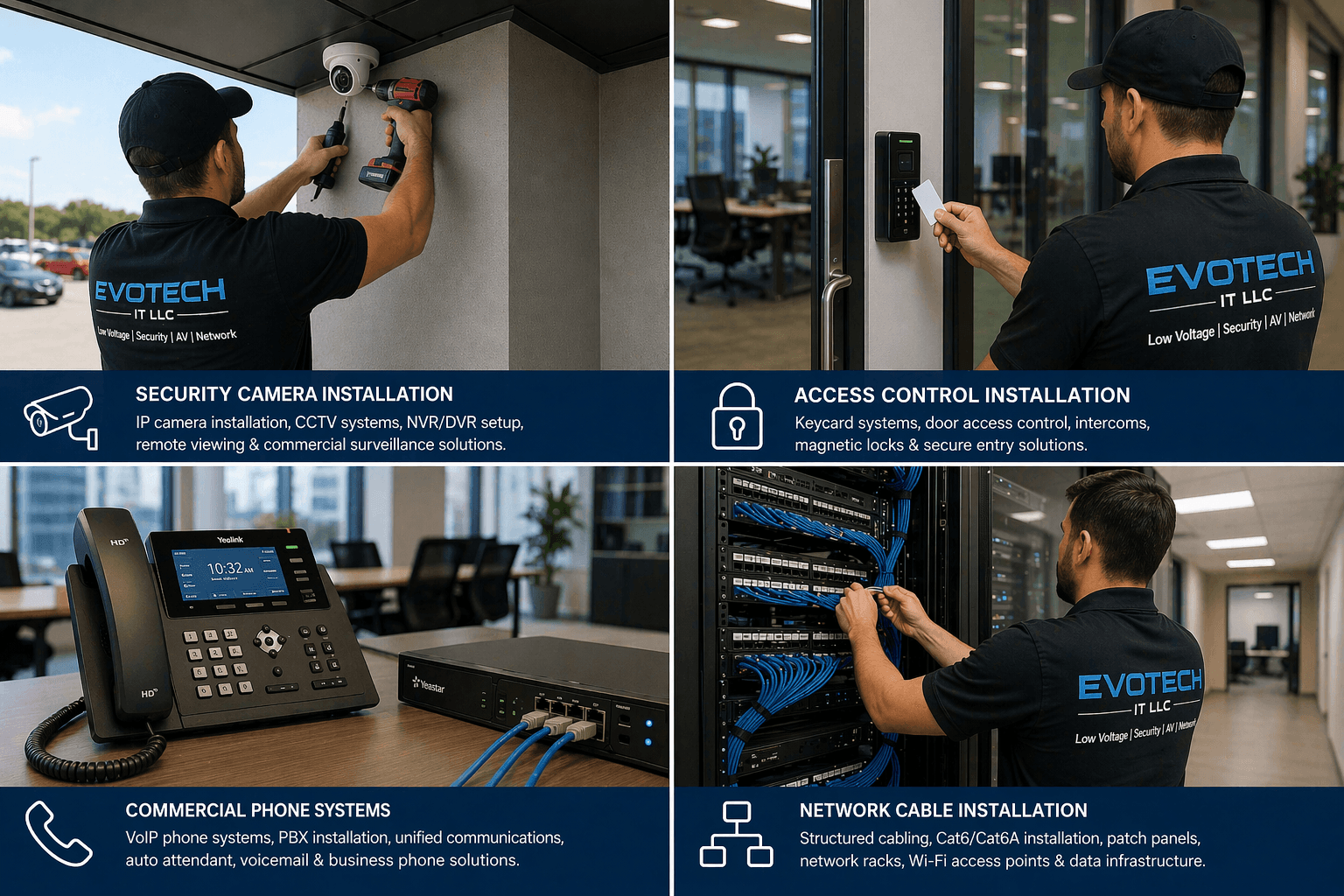
Execution in Rosenberg is planned around real conditions, not a template. Dust exposure in industrial and distribution environments, affecting rack and equipment placement. Gulf Coast humidity and driven-rain events requiring rated exterior housings and sealed penetrations. These decide the sequence, the access, and the method as much as the design does. EVOTECH describes Rosenberg as coverage rather than a place it occupies, and omits any area detail it cannot confirm — building and site conditions only, no invented landmarks or promised arrival times.
Frequently asked questions
Is business phone & voip for medical offices different in Rosenberg?
The sector needs stay the same, but the install changes with the place. In Rosenberg, the conditions above — not the medical offices label — decide routes, mounting, and equipment placement, which is why this page pairs all three.
Why do our VoIP calls sound choppy when the internet seems fine?
Almost always jitter or contention rather than raw bandwidth. Voice packets are time-sensitive, and on a network that treats them the same as a backup or a large upload they get delayed or dropped whenever the network is busy. A dedicated voice segment with quality-of-service prioritisation fixes the majority of these cases without changing the internet plan.