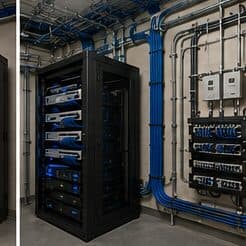
Cat6A cabling for medical offices, in Richmond
Cat6A cabling for medical offices in Richmond is a three-part question: what cat6a cabling involves, what medical offices need from it, and what Richmond changes about the install. High proportion of new residential and commercial construction, making rough-in timing the dominant scheduling factor.
Cat6A is specified to 500 MHz and supports 10GBASE-T across a full 100-metre channel. It achieves that mainly by controlling alien crosstalk — the interference between adjacent cables that constrains Cat6 at 10G — through larger construction, tighter pair geometry, and in shielded variants a foil layer.
Controlled areas and uninterruptible systems
A medical office has a clear division between public, staff, and controlled areas, and the technology follows that division. Waiting areas need guest connectivity that reaches nothing internal. Treatment rooms need reliable connectivity for clinical systems. Records areas and medication storage need controlled access with a usable audit trail.
The other defining characteristic is that some systems cannot simply be taken down for an afternoon. Practice management, imaging, and anything connected to patient scheduling has a real cost when interrupted, so cutover planning matters more here than in most commercial environments.
- Distinct public, staff, and controlled zones with different requirements
- Clinical systems that cannot tolerate unplanned interruption
- Records and medication areas requiring access control with audit records
- Patient scheduling constraining when work can happen in treatment areas
Where cat6a cabling goes wrong — and how it's avoided
Cat6A mistakes tend to come from treating it as a drop-in upgrade rather than a different physical product.
- Ordering Cat6A for an existing pathway without recalculating fill
- Bundling high-PoE Cat6A as tightly as low-power Cat6
- Bonding shields at one end only, or breaking continuity with an unshielded coupler
- Certifying to Cat6 limits and calling the link Cat6A
- Forcing stiff cable into a bend radius sized for thinner cable
Richmond: what the location changes
In Richmond, the plan is built outward from the conditions that are actually here. High proportion of new residential and commercial construction, making rough-in timing the dominant scheduling factor. Larger lots producing long runs to gates, outbuildings, and driveway camera positions that approach or exceed copper distance limits. Slab-on-grade construction with the rough-in window falling between electrical and drywall. Each one changes where cable can run, where equipment can sit, and how coverage is shaped, which is why a walkthrough settles a Richmond scope faster than any generic estimate.
- High proportion of new residential and commercial construction, making rough-in timing the dominant scheduling factor
- Larger lots producing long runs to gates, outbuildings, and driveway camera positions that approach or exceed copper distance limits
- Slab-on-grade construction with the rough-in window falling between electrical and drywall
- Conduit and sleeve decisions made during rough-in determining what is possible for the following decade
- Detached structures common enough that between-building links are a routine design question rather than an exception
Getting it done in Richmond
Certification to Cat6A runs the same parameter set as Cat6 but across the full 500 MHz range, where margins are naturally tighter. Passing at 250 MHz says nothing about behaviour at 500 MHz, so the test configuration has to match the intended rating.
Clinical systems belong on their own segment, separate from staff general-purpose devices, separate again from patient guest access, and separate from building systems such as cameras and door controllers. This limits what any single compromised device can reach and makes the network far easier to reason about when something misbehaves.
On site, the schedule and working method turn on conditions like these. Conduit and sleeve decisions made during rough-in determining what is possible for the following decade. Detached structures common enough that between-building links are a routine design question rather than an exception. Both shape how and when a crew can actually operate, which is why EVOTECH scopes each Richmond job from the property itself rather than assuming one approach fits every address. Coverage is stated as a service area, never an office claim, and anything about Richmond that cannot be verified is left out instead of invented.
Popular services nearby
Frequently searched near this area — the pages people look for most.
Frequently asked questions
Is cat6a cabling for medical offices different in Richmond?
The sector needs stay the same, but the install changes with the place. In Richmond, the conditions above — not the medical offices label — decide routes, mounting, and equipment placement, which is why this page pairs all three.
Is Cat6A worth it if nothing today runs 10 gigabit?
Sometimes. The argument for it is that reopening a ceiling is far more expensive than the cable premium, so runs that are hard to reach and likely to matter later are good candidates. The argument against blanket use is pathway fill and labour. A common middle path is Cat6A on uplinks, dense areas, and inaccessible runs, with Cat6 elsewhere.