Why this page exists
Technology for medical offices in Montrose sits where two things meet: how medical offices actually operate, and what Montrose specifically brings to the building. Montrose 77006 mixes early-20th-century bungalows, mid-century apartments, and new infill townhomes, so no two adjacent addresses are guaranteed the same wall construction or ceiling access.
Three priorities dominate. Separate the networks so patient-facing guest access cannot reach clinical systems. Control access to the areas that require it, with records that show who entered and when. Plan any cutover so clinical operations are not interrupted mid-session.
Separation, access, and continuity
Three priorities dominate. Separate the networks so patient-facing guest access cannot reach clinical systems. Control access to the areas that require it, with records that show who entered and when. Plan any cutover so clinical operations are not interrupted mid-session.
Everything else — coverage quality, cable tidiness, camera placement — matters, but these three are the ones with consequences beyond inconvenience.
- Guest, staff, clinical, and building-system networks kept separate
- Access control on records, medication, and treatment areas as appropriate
- Cutovers scheduled around clinical sessions, not around installer convenience
- Wired connections for imaging and other equipment that depends on throughput
- Equipment position secured against casual access
Montrose: what the location adds
In Montrose, the plan is built outward from the conditions that are actually here. Montrose 77006 mixes early-20th-century bungalows, mid-century apartments, and new infill townhomes, so no two adjacent addresses are guaranteed the same wall construction or ceiling access. Original bungalows have shallow attics, plaster-and-lath walls, and pier-and-beam crawlspaces that open up pathways the newer townhomes do not have. New three-story townhomes are slab-on-grade with tight chases, so vertical runs are planned around the stair core. Each one changes where cable can run, where equipment can sit, and how coverage is shaped, which is why a walkthrough settles a Montrose scope faster than any generic estimate.
- Montrose 77006 mixes early-20th-century bungalows, mid-century apartments, and new infill townhomes, so no two adjacent addresses are guaranteed the same wall construction or ceiling access
- Original bungalows have shallow attics, plaster-and-lath walls, and pier-and-beam crawlspaces that open up pathways the newer townhomes do not have
- New three-story townhomes are slab-on-grade with tight chases, so vertical runs are planned around the stair core
- Walkable, high-density blocks mean exterior camera placement has to account for close-set neighbors and shared property lines
- Small-business storefronts along the corridors need commercial network and camera work interleaved with the residential streets behind them
Segmentation and clinical connectivity
Clinical systems belong on their own segment, separate from staff general-purpose devices, separate again from patient guest access, and separate from building systems such as cameras and door controllers. This limits what any single compromised device can reach and makes the network far easier to reason about when something misbehaves.
For clinical equipment that moves large files — imaging in particular — wired connections are worth insisting on where the equipment supports them. Wireless is fine for tablets and general staff use, but a modality pushing studies across a congested wireless cell produces exactly the kind of intermittent slowness that is difficult to diagnose and disruptive to a clinic day.
Guest access in a waiting area should be isolated from everything internal and rate-limited. It is a courtesy, and it should be architecturally incapable of touching anything clinical.
- Clinical, staff, guest, and building-system traffic on separate segments
- Wired connections for imaging and other high-throughput clinical equipment
- Waiting-area guest access isolated and capped
- Access points placed for coverage in treatment rooms without relying on corridor spill
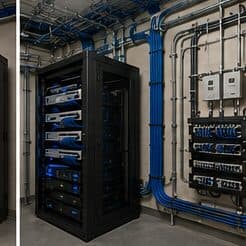
- Equipment room secured, since it holds the systems everything depends on
Installing in Montrose
Camera coverage in medical settings is deliberately limited in scope. Entrances, corridors leading to controlled areas, medication storage approaches, parking areas, and after-hours coverage of the perimeter are the usual placements. Treatment areas are not camera locations, and this is worth stating plainly during design so the boundary is explicit.
On site, the schedule and working method turn on conditions like these. Walkable, high-density blocks mean exterior camera placement has to account for close-set neighbors and shared property lines. Small-business storefronts along the corridors need commercial network and camera work interleaved with the residential streets behind them. Both shape how and when a crew can actually operate, which is why EVOTECH scopes each Montrose job from the property itself rather than assuming one approach fits every address. Coverage is stated as a service area, never an office claim, and anything about Montrose that cannot be verified is left out instead of invented.
Popular services nearby
Frequently searched near this area — the pages people look for most.
Frequently asked questions
What do medical offices in Montrose usually need first?
It varies by site, but the pattern for medical offices holds in Montrose: get the network and cabling backbone right, then layer cameras and access on top. What Montrose changes is the physical install — the conditions listed above drive routes and equipment placement more than the sector alone does.
Should patient guest Wi-Fi be offered?
It is common in waiting areas, and the requirement is that it is architecturally isolated: unable to reach clinical systems, staff devices, or building systems, and rate-limited so it cannot affect anything operational. Configured that way it is a low-risk courtesy; configured as a shared flat network it is not.