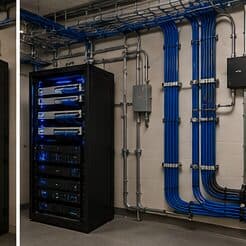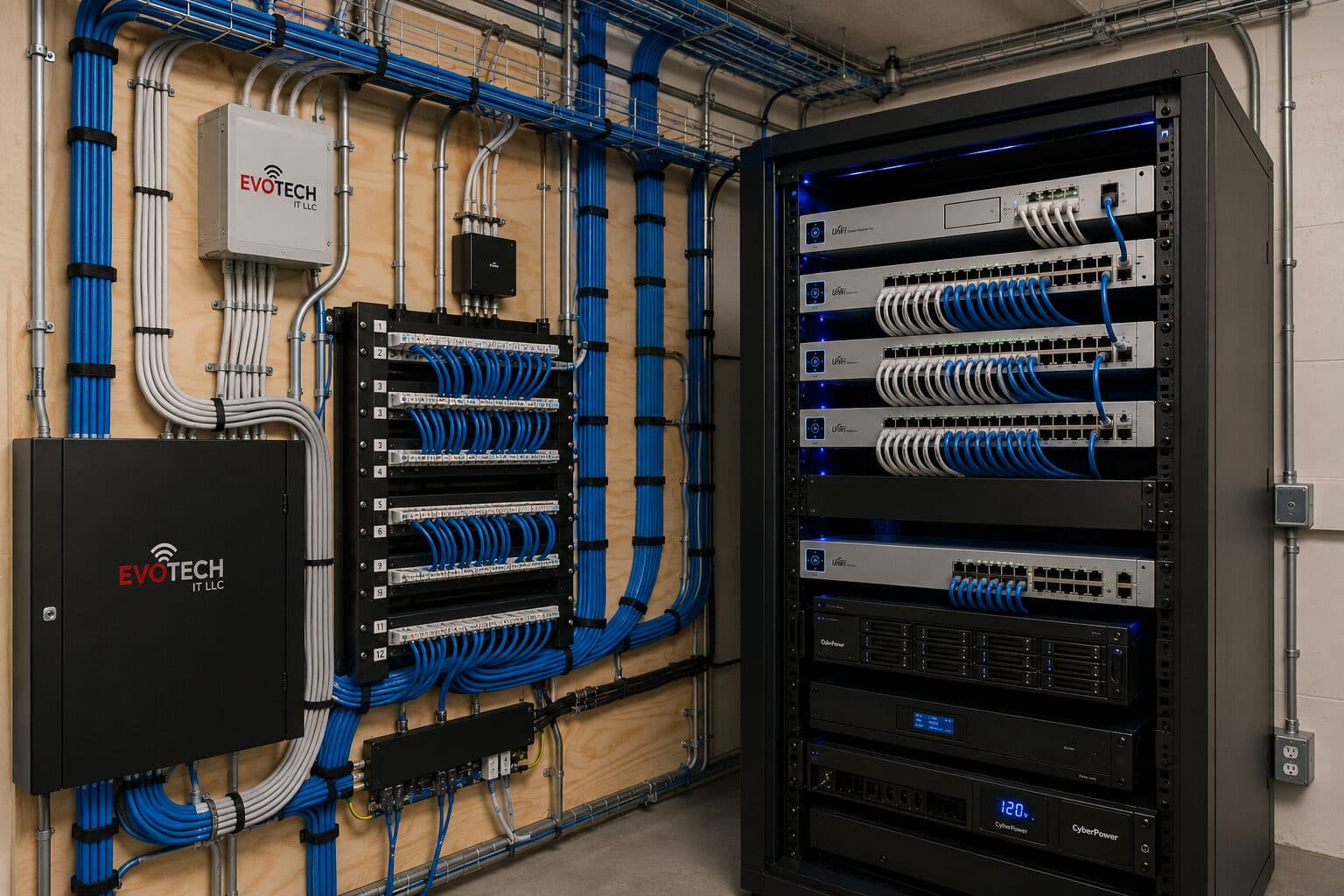
In-wall cable concealment for home offices, in Katy
In-wall cable concealment for home offices in Katy is a three-part question: what in-wall cable concealment involves, what home offices need from it, and what Katy changes about the install. Housing stock skewed toward newer, larger single-family construction with wide floor plans that exceed single-router coverage.
Concealing the cables behind a wall-mounted TV or AV setup is what turns it from a device with wires hanging down into something that looks built-in. The signal cables — HDMI, network, speaker — can be routed inside the wall to a recessed box behind the display, but power is different: a standard power cord must never be run inside a wall. Power is handled with a recessed outlet behind the display or an in-wall rated power solution, which keeps the installation safe and to code.
Wire the desk, then fix the coverage
The single highest-value change for a home office is a wired connection to the desk. It removes wireless variability entirely for the machine that matters, and it is usually one cable run.
After that: an access point positioned to serve the office area properly for the devices that stay wireless, and enough separation that work equipment is not sharing a flat network with everything else in the house.
- One wired run to the primary work position
- An access point positioned for the office end of the house
- Work equipment separated from household and guest devices
- Equipment position with power and ventilation, not a sealed cabinet
- Wired connections for stationary devices elsewhere that compete for airtime
Where in-wall cable concealment goes wrong — and how it's avoided
Concealment goes wrong on power and on the wall's contents.
- Running a standard power cord inside the wall
- Forcing a fish tape past fire blocking and damaging the finish or wall
- Not planning patch-and-paint before cutting access
- Leaving no service loop for future work
- Assuming a clean path exists without checking the construction
- Compromising the wall's fire integrity to hide a cable
Katy: what the location changes
Housing stock skewed toward newer, larger single-family construction with wide floor plans that exceed single-router coverage. In Katy, that is where the plan begins, because it changes cable paths, device placement, and access-point counts before anything else does. Structured media panels commonly present but frequently located in a garage or perimeter utility space rather than centrally. Builder-installed cable often terminated to a panel but not extended to ceiling positions suitable for access points. None of these are generic checklist items — each moves the design in a direction a citywide assumption would miss, and the honest recommendation always depends on what this particular property allows.
- Housing stock skewed toward newer, larger single-family construction with wide floor plans that exceed single-router coverage
- Structured media panels commonly present but frequently located in a garage or perimeter utility space rather than centrally
- Builder-installed cable often terminated to a panel but not extended to ceiling positions suitable for access points
- Slab foundations with accessible attics, making attic-to-interior-wall routing the standard retrofit path
- Suburban commercial development in retail pads and medical suites with suspended-grid ceilings and comparatively straightforward pathway
Getting it done in Katy
Concealment is judged by a clean result and a safe, code-compliant power path.
Home office projects frequently expand slightly, because the same attic access and the same equipment position serve other things. A doorbell run, a camera at the driveway approach, a wired connection to a television, and an access point for the upstairs are all much cheaper done in the same visit than separately.
On site, the schedule and working method turn on conditions like these. Slab foundations with accessible attics, making attic-to-interior-wall routing the standard retrofit path. Suburban commercial development in retail pads and medical suites with suspended-grid ceilings and comparatively straightforward pathway. Both shape how and when a crew can actually operate, which is why EVOTECH scopes each Katy job from the property itself rather than assuming one approach fits every address. Coverage is stated as a service area, never an office claim, and anything about Katy that cannot be verified is left out instead of invented.
Frequently asked questions
Is in-wall cable concealment for home offices different in Katy?
The sector needs stay the same, but the install changes with the place. In Katy, the conditions above — not the home offices label — decide routes, mounting, and equipment placement, which is why this page pairs all three.
Can the power cord be hidden in the wall too?
Not the standard cord — running one inside a wall is against code and a genuine hazard. Power is concealed correctly with a recessed outlet behind the display or a rated in-wall power-relocation kit, which puts the outlet where the TV needs it without burying a cord. The signal cables can go in the wall; power is handled the right way.