Access-control installation for home offices, in Katy
Access-control installation for home offices in Katy is a three-part question: what access-control installation involves, what home offices need from it, and what Katy changes about the install. Housing stock skewed toward newer, larger single-family construction with wide floor plans that exceed single-router coverage.
An access-control system manages who may open which door and when, and records each attempt. The immediate operational benefit over keys is revocation: a lost credential is disabled in seconds instead of prompting a rekey. The secondary benefit is the audit record, which turns 'who was here on Saturday' into a query rather than a guess.
Wire the desk, then fix the coverage
The single highest-value change for a home office is a wired connection to the desk. It removes wireless variability entirely for the machine that matters, and it is usually one cable run.
After that: an access point positioned to serve the office area properly for the devices that stay wireless, and enough separation that work equipment is not sharing a flat network with everything else in the house.
- One wired run to the primary work position
- An access point positioned for the office end of the house
- Work equipment separated from household and guest devices
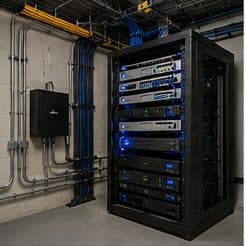
- Equipment position with power and ventilation, not a sealed cabinet
- Wired connections for stationary devices elsewhere that compete for airtime
Where access-control installation goes wrong — and how it's avoided
Access-control mistakes range from irritating to genuinely unsafe.
- Choosing a lock type without considering egress and power-loss behaviour
- Installing a magnetic lock without proper release arrangements
- Mounting the controller on the unsecured side of the door
- Automating a door whose closer or alignment was already unreliable
- Issuing shared credentials, which destroys the audit record
- Having no defined revocation process, so old credentials stay valid
- Deploying legacy proximity credentials that are trivial to copy
Katy: what the location changes
In Katy, the plan is built outward from the conditions that are actually here. Housing stock skewed toward newer, larger single-family construction with wide floor plans that exceed single-router coverage. Structured media panels commonly present but frequently located in a garage or perimeter utility space rather than centrally. Builder-installed cable often terminated to a panel but not extended to ceiling positions suitable for access points. Each one changes where cable can run, where equipment can sit, and how coverage is shaped, which is why a walkthrough settles a Katy scope faster than any generic estimate.
- Housing stock skewed toward newer, larger single-family construction with wide floor plans that exceed single-router coverage
- Structured media panels commonly present but frequently located in a garage or perimeter utility space rather than centrally
- Builder-installed cable often terminated to a panel but not extended to ceiling positions suitable for access points
- Slab foundations with accessible attics, making attic-to-interior-wall routing the standard retrofit path
- Suburban commercial development in retail pads and medical suites with suspended-grid ceilings and comparatively straightforward pathway
Getting it done in Katy
Access-control commissioning is about failure modes, not just successful entry.
Home office projects frequently expand slightly, because the same attic access and the same equipment position serve other things. A doorbell run, a camera at the driveway approach, a wired connection to a television, and an access point for the upstairs are all much cheaper done in the same visit than separately.
Getting Katy work done means planning around the site as it actually is. Slab foundations with accessible attics, making attic-to-interior-wall routing the standard retrofit path. Suburban commercial development in retail pads and medical suites with suspended-grid ceilings and comparatively straightforward pathway. Both matter as much as the design to how and when the work happens. The scope is drawn from the real property, the coverage is stated as a service area rather than an office, and unverifiable specifics about Katy are kept off the page on purpose.
Frequently asked questions
Is access-control installation for home offices different in Katy?
The sector needs stay the same, but the install changes with the place. In Katy, the conditions above — not the home offices label — decide routes, mounting, and equipment placement, which is why this page pairs all three.
What is the difference between fail-safe and fail-secure?
It describes what happens when power is lost. Fail-safe hardware — typically a magnetic lock — releases and the door becomes passable. Fail-secure hardware — typically a standard electric strike — stays locked, though the door can still be opened from the inside by its mechanical hardware. Which is correct for a given opening depends on its role and on applicable life-safety requirements, so it is a design decision rather than a preference.