Cat6 cabling for home offices, in Bellaire
Cat6 cabling for home offices in Bellaire is a three-part question: what cat6 cabling involves, what home offices need from it, and what Bellaire changes about the install. Established older homes alongside larger new construction on compact residential lots.
So the honest framing is this: specify Cat6 when the device locations need gigabit and the building is unlikely to push 10G to the desk. Specify Cat6A when a run has to support 10G at full distance, when the cable will sit in a dense bundle, or when the location feeds equipment that already asks for more than gigabit.
Related residential work
Home office projects frequently expand slightly, because the same attic access and the same equipment position serve other things. A doorbell run, a camera at the driveway approach, a wired connection to a television, and an access point for the upstairs are all much cheaper done in the same visit than separately.
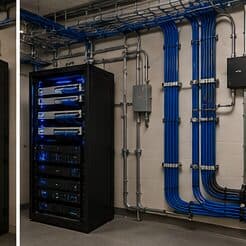
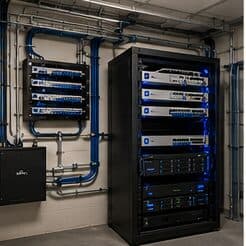
The equipment position is the common dependency. Somewhere with power, ventilation, and access — a closet shelf or a small wall cabinet — serves the office network, any cameras, and the doorbell, and getting it right once avoids revisiting it three times.
- Doorbell and driveway camera runs sharing the same attic access
- Television and media positions wired at the same time
- Upstairs access point added while the pathway is open
- A single equipment position serving all of it
- Spare runs terminated for future use
Where cat6 cabling goes wrong — and how it's avoided
The common errors are decisions made once and regretted for years.
- Specifying Cat6 for a run that will need 10G at 80 metres
- Specifying Cat6A everywhere and losing pathway space that a mixed design would have kept
- Terminating a Cat6 run on leftover Cat5e hardware
- Bundling forty identical runs tightly and then expecting short-run 10G to hold
- Treating the certification report as paperwork rather than reading the margins
Bellaire: what the location changes
The starting point for any Bellaire job is one local fact. Established older homes alongside larger new construction on compact residential lots. That single condition shapes where cable can run, where equipment can sit, and how coverage is laid out — more than any spec sheet does. Two more conditions weigh on it. High finish expectations, requiring discreet routing and clean concealment. Slab-on-grade foundations making attic-to-interior-wall the standard retrofit route. Together they make the route specific to this pocket, which is why a short walkthrough or a few clear photos settle the scope faster than a floor plan can.
- Established older homes alongside larger new construction on compact residential lots
- High finish expectations, requiring discreet routing and clean concealment
- Slab-on-grade foundations making attic-to-interior-wall the standard retrofit route
- Ongoing teardown-and-rebuild activity, making prewire valuable on new construction
- Mature trees on many lots affecting outdoor wireless and camera framing
Getting it done in Bellaire
Certification for a Cat6 link measures the parameters that define the category: insertion loss, near-end and far-end crosstalk, return loss, and propagation delay skew across the frequency range up to 250 MHz. A pass means the link meets the standard's limits with margin recorded.
A home office shares its connection with everything else in the house, and household demand is highest during exactly the hours that matter least to the household and most to the person working. Streaming, gaming, backups, and connected devices all contend for the same circuit and, if the office is on wireless, for the same airtime.
Getting Bellaire work done means planning around the site as it actually is. Ongoing teardown-and-rebuild activity, making prewire valuable on new construction. Mature trees on many lots affecting outdoor wireless and camera framing. Both matter as much as the design to how and when the work happens. The scope is drawn from the real property, the coverage is stated as a service area rather than an office, and unverifiable specifics about Bellaire are kept off the page on purpose.
Frequently asked questions
Is cat6 cabling for home offices different in Bellaire?
The sector needs stay the same, but the install changes with the place. In Bellaire, the conditions above — not the home offices label — decide routes, mounting, and equipment placement, which is why this page pairs all three.
Is Cat6 enough, or should everything be Cat6A?
For most device locations Cat6 is enough, because most devices need gigabit and will for a long time. Cat6A earns its place on runs that must carry 10G at distance, runs sitting in dense bundles, and uplinks between equipment positions. Specifying Cat6A for the whole building is rarely wrong technically, but it costs pathway space and termination time that a mixed design keeps.