
Why this page exists
Business phone & VoIP in Stafford is scoped around the same physical realities EVOTECH weighs everywhere — but read through Stafford's specific conditions: commercial base weighted toward warehouse, showroom, and light-industrial buildings rather than office space. This page pairs what the service actually involves with what the Stafford market changes about it.
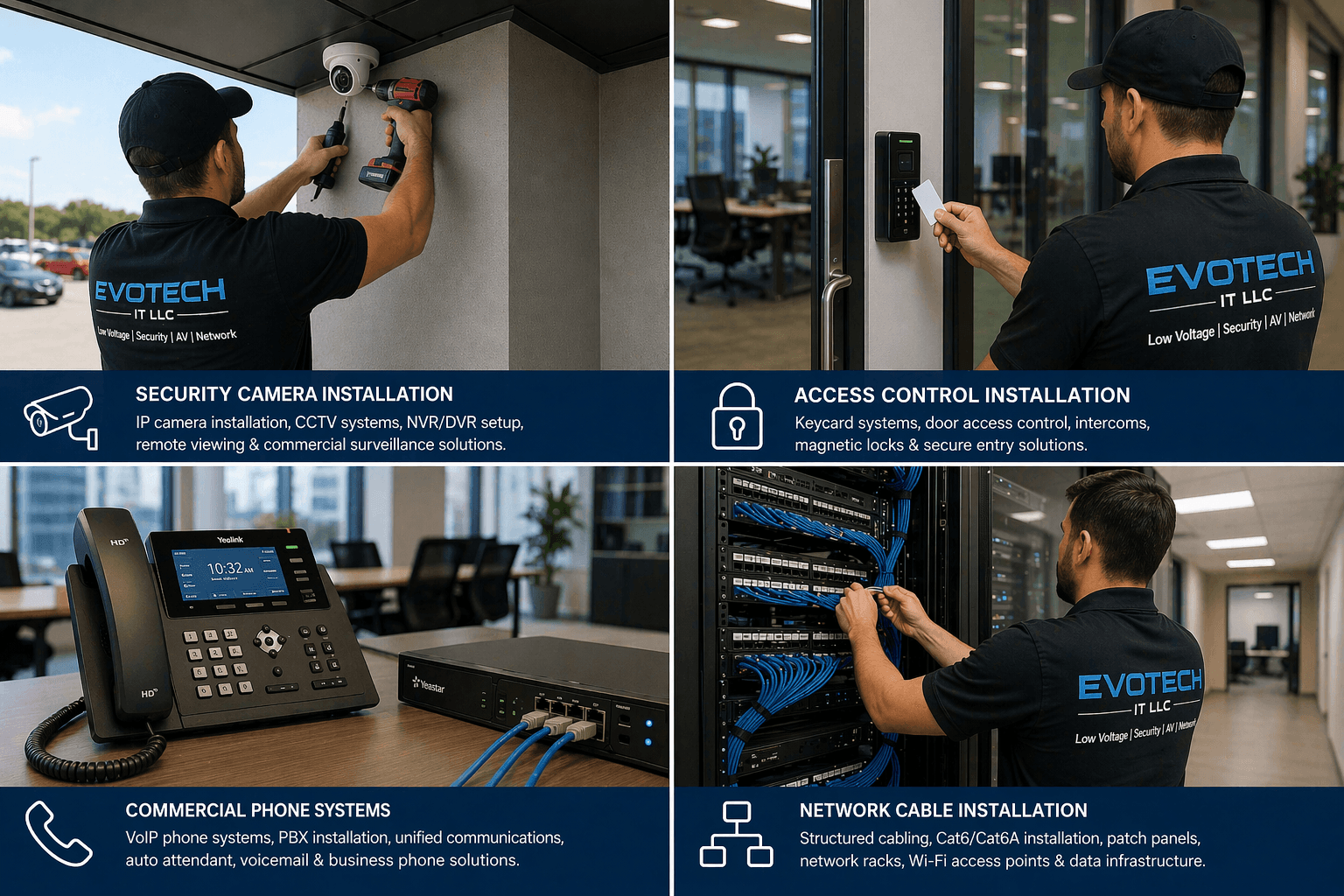
Modern business phones run over the data network — VoIP handsets plug into the same switches as everything else and draw their power from PoE. That is the appeal: one cabling system, central management, and features like auto-attendant, voicemail-to-email, call groups, and remote extensions that older key systems could not offer. The decision that shapes the rest is on-premise versus cloud: an on-site call server you own and maintain, or a hosted service where the provider runs the platform and the site just needs handsets, power, and a good circuit.
What business phone & voip usually involves
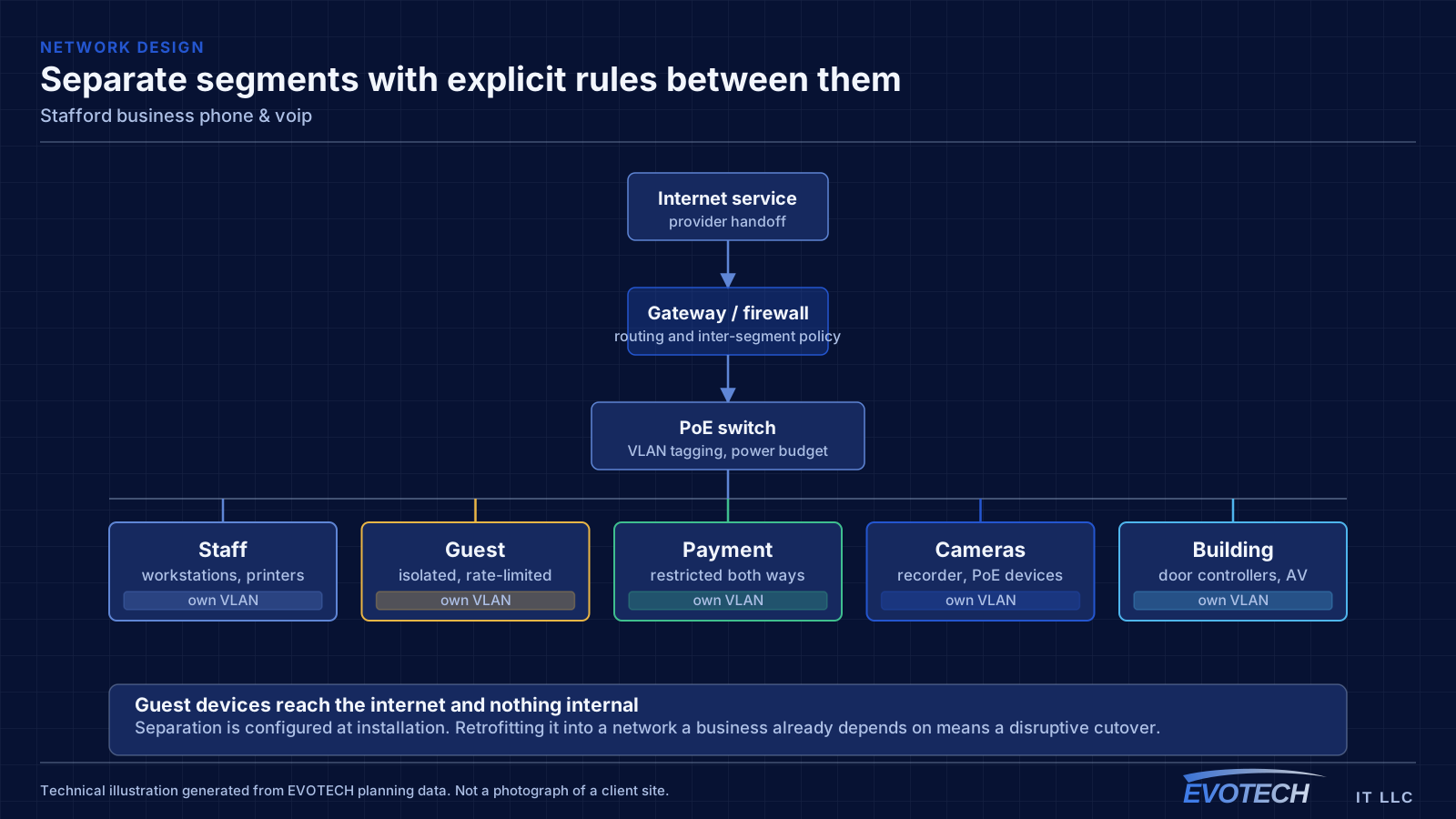
The defining VoIP problem is call quality on a network that was never prepared for voice. Jitter — variation in packet timing — makes speech robotic; packet loss clips words; and both get worse when a backup or a large upload competes for the same uplink. Voice needs to be prioritised over other traffic, and its own segment, or it inherits every congestion event on the network.
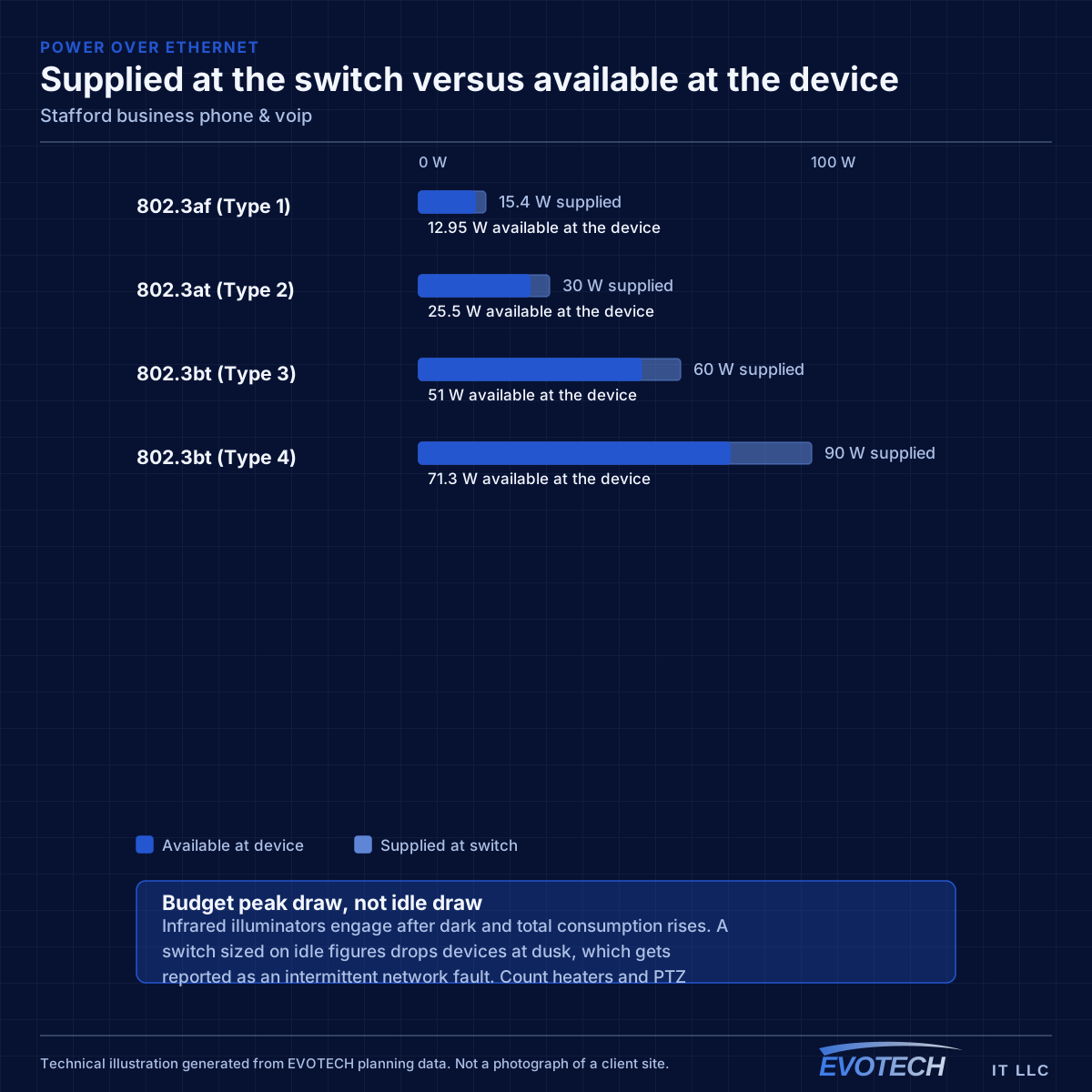
The second problem is power. PoE handsets, a PoE switch, and the call server all have to stay up for phones to work, and a site that puts its phones on an unprotected switch loses its phones with every brief outage — including the ability to call for help.
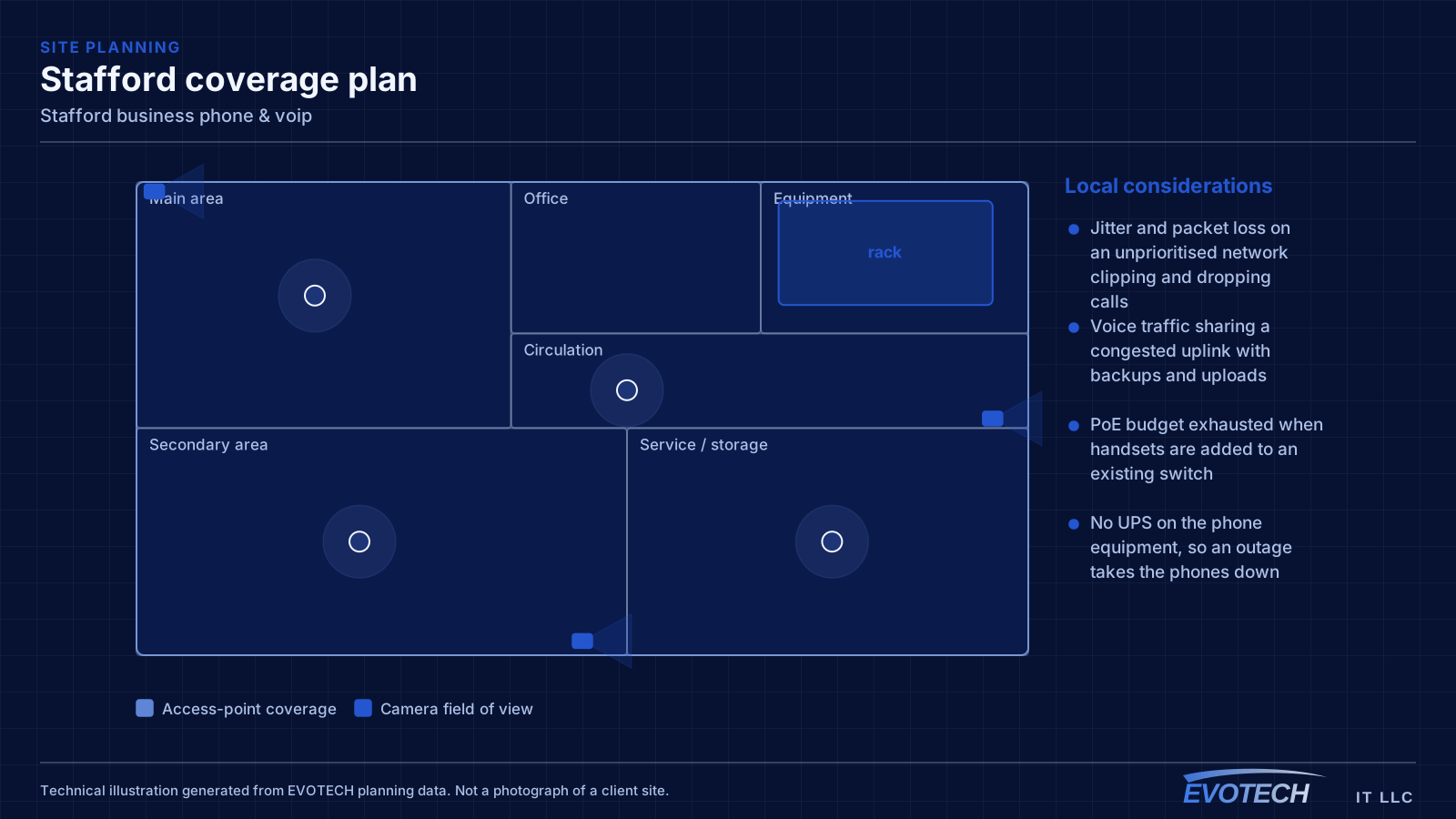
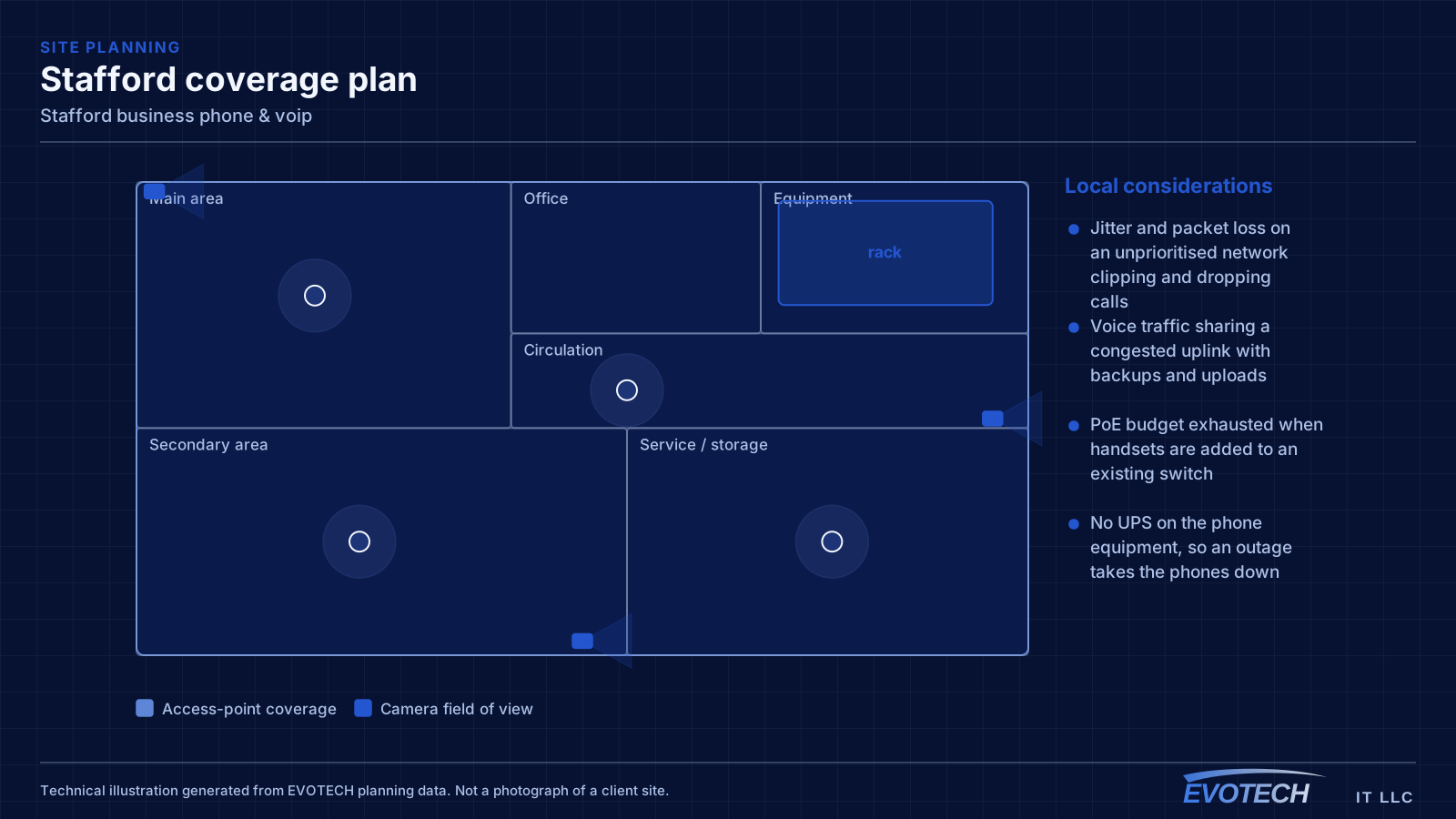
- Jitter and packet loss on an unprioritised network clipping and dropping calls
- Voice traffic sharing a congested uplink with backups and uploads
- PoE budget exhausted when handsets are added to an existing switch
- No UPS on the phone equipment, so an outage takes the phones down
- Insufficient internet upload bandwidth for the number of simultaneous calls
- Number porting scheduled without a cutover plan, risking dead lines
Stafford property conditions that change the plan
Steel structure and metal cladding reflect wireless signal, which produces coverage patterns that do not match the intuition built from working in drywall offices. Add racking and stock, and the environment changes again — which is why designs based on an empty-building survey should be treated as provisional here.
Distance is the other constant. A building whose far corner sits beyond 100 metres of cable path from the equipment room needs an intermediate distribution point fed by fiber. That is standard practice, and it is more reliable than any attempt to stretch a copper run or bridge the gap wirelessly.
Two decisions dominate: where the intermediate distribution points go, and how access points are positioned relative to the racking. The first is arithmetic — measure the cable paths and place distribution points so every device sits within the limit. The second is a design judgement that benefits from validating with the racking loaded rather than empty.
- Metal structure reflecting signal and complicating coverage prediction
- Racking and stock changing the environment after the survey
- Footprints exceeding copper distance from a single position
- Small conditioned office areas attached to large operational space
- Dock and yard areas needing their own approach
- Fiber to intermediate distribution points where distance requires
- Access-point positioning designed for aisles, validated with stock in place
- Mounting height chosen deliberately rather than defaulting to the roof deck
- Equipment sited in conditioned space or a filtered enclosure
- Dock and yard camera positions resolved for distance and power
Getting business phone & voip done in Stafford
Voice quality is protected by keeping voice traffic separate and prioritised. A dedicated voice network segment, with quality-of-service marking so switches and the gateway send voice packets ahead of bulk data, is what keeps calls clean when the network is busy. Without it, a call and a large file transfer compete as equals, and the call loses.
High-level work needs lift access, and that needs floor space clear of racking, stock, and forklift traffic — usually the largest scheduling constraint on a warehouse project. Coordinating it with operations often means working during quieter shifts or scheduled shutdowns.
- Lift access requiring clear floor coordinated with operations
- Work often scheduled during quieter shifts or shutdowns
- Pathways routed clear of forklift and racking impact zones
- Proper support and containment for exposed runs
- Dust protection for equipment in operational areas
Frequently asked questions
Does EVOTECH have an office in Stafford?
No. This is a service-area page: EVOTECH serves Stafford without claiming a physical office there. The wording stays as coverage, not a location claim.
Why do our VoIP calls sound choppy when the internet seems fine?
Almost always jitter or contention rather than raw bandwidth. Voice packets are time-sensitive, and on a network that treats them the same as a backup or a large upload they get delayed or dropped whenever the network is busy. A dedicated voice segment with quality-of-service prioritisation fixes the majority of these cases without changing the internet plan.
Why is wireless harder in a metal building?
Steel reflects, which produces coverage patterns quite unlike those in drywall construction — strong in some places, unexpectedly weak in others, with reflections that interfere with each other. Add stocked racking, which absorbs signal, and a design based on an empty building no longer applies. Validation with stock in place is the step that matters.