
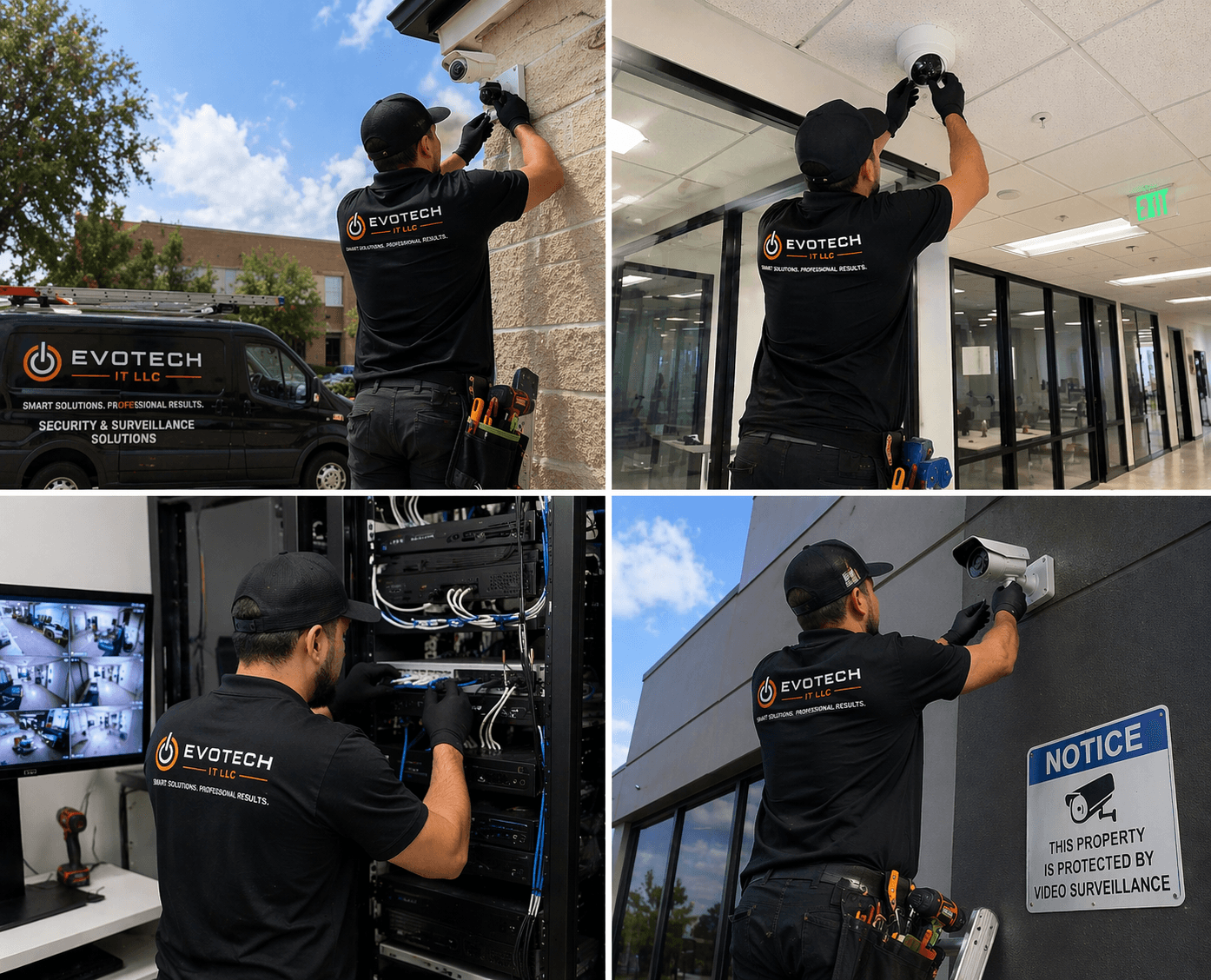
Why this page exists
Floodlight camera installation in Spring is scoped around the same physical realities EVOTECH weighs everywhere — but read through Spring's specific conditions: retail and food-service commercial base where payment-system separation is a standing requirement. This page pairs what the service actually involves with what the Spring market changes about it.
A floodlight camera combines a motion-activated light with a camera, so an area lights up and records when something moves — good for deterrence and for usable colour footage at night. The catch is that the camera is looking into its own light source, so placement has to give useful footage without the floodlight washing out the near field or throwing hard shadows, and the motion detection has to trigger on people rather than every passing car or swaying tree.
What floodlight camera installation usually involves
The signature problem is the camera fighting its own light: mounted or aimed poorly, the floodlight blows out the near field, casts hard shadows, or reflects off a nearby wall back into the lens, so the footage is worse than a plain camera would give. Placement that keeps the light on the scene and off the lens's immediate foreground is what makes the combined unit work.
The second is nuisance triggering. A floodlight camera aimed to catch a wide area lights up and records every passing car, pedestrian, and swaying branch, which fills storage and trains everyone to ignore the alerts. Motion zones tuned to the actual approach path are what keep the triggers meaningful.
- Floodlight washing out the near field or reflecting into the lens
- Hard shadows from a poorly angled light hiding the subject
- Nuisance triggering on traffic, pedestrians, and foliage
- Mounted too low for tamper resistance and useful angle
- Depending on battery and Wi-Fi for a device meant to always watch
- Aimed for wide area rather than the approach that matters
Spring property conditions that change the plan
Retail and restaurant units in this area span several construction types. A converted space may have open structure overhead and easy routing; a mall unit may be hard lid throughout; a newer pad site usually has suspended grid. The scope difference between these is significant even when the floor area and outlet count are identical.
What stays constant across all of them is the network requirement: separate segments for payment, operations, and guest, with guest isolated and rate-limited. That is a configuration matter rather than a construction one, and it applies regardless of what the ceiling looks like.
For commercial work: what the ceiling actually is across the whole unit, where the equipment can live so it stays cool and dry, how the networks will be separated, and what the available working window is.
- Ceiling construction varying widely between adjacent units
- Payment, operations, and guest separation required consistently
- Kitchen environments constraining equipment placement in food service
- Storefront glazing affecting entrance camera framing
- Landlord rules applying in leased and centre units
- Ceiling construction confirmed across the whole unit, not just the front
- Equipment position away from kitchen heat and moisture
- Network segmentation agreed before installation
- Entrance camera positioned to avoid daylight backlighting
- Working window and landlord permissions established
Getting floodlight camera installation done in Spring
Mounting height and angle balance deterrence, coverage, and tamper resistance. High enough to be out of easy reach and to light the approach, angled so the light falls on the scene rather than into the camera's near foreground, and positioned so a person approaching is lit from a useful angle rather than silhouetted or shadowed. Keeping the light off nearby reflective surfaces — a light wall, a soffit — stops it bouncing back into the lens.
Food-service work happens outside service hours, with each session ending with the site operational for the next opening. Retail work can often proceed during trading with containment and barriered ladder areas, though anything over the sales floor or noisy is better placed before opening.
- Food-service work outside service hours
- Retail work during trading with containment where feasible
- Merchandise and surface protection throughout
- Sessions ending with the site fully operational
- Residential attic work scheduled early during summer
Frequently asked questions
Does EVOTECH have an office in Spring?
No. This is a service-area page: EVOTECH serves Spring without claiming a physical office there. The wording stays as coverage, not a location claim.
Why is my floodlight camera's footage washed out at night?
The camera is fighting its own light. If the floodlight blows out the near field or reflects off a nearby wall or soffit back into the lens, the footage is worse than a plain camera would give. Aiming the light onto the scene and off the lens's immediate foreground — and away from reflective surfaces — is what fixes it.
Why does payment-system separation come up on every retail and restaurant project?
Because it addresses both a security and an operational risk. A payment terminal sharing a flat network with guest devices is reachable from those devices, and guest usage can also saturate the connection payment processing depends on. Separating them at installation is straightforward; doing it later in a running business is not.